
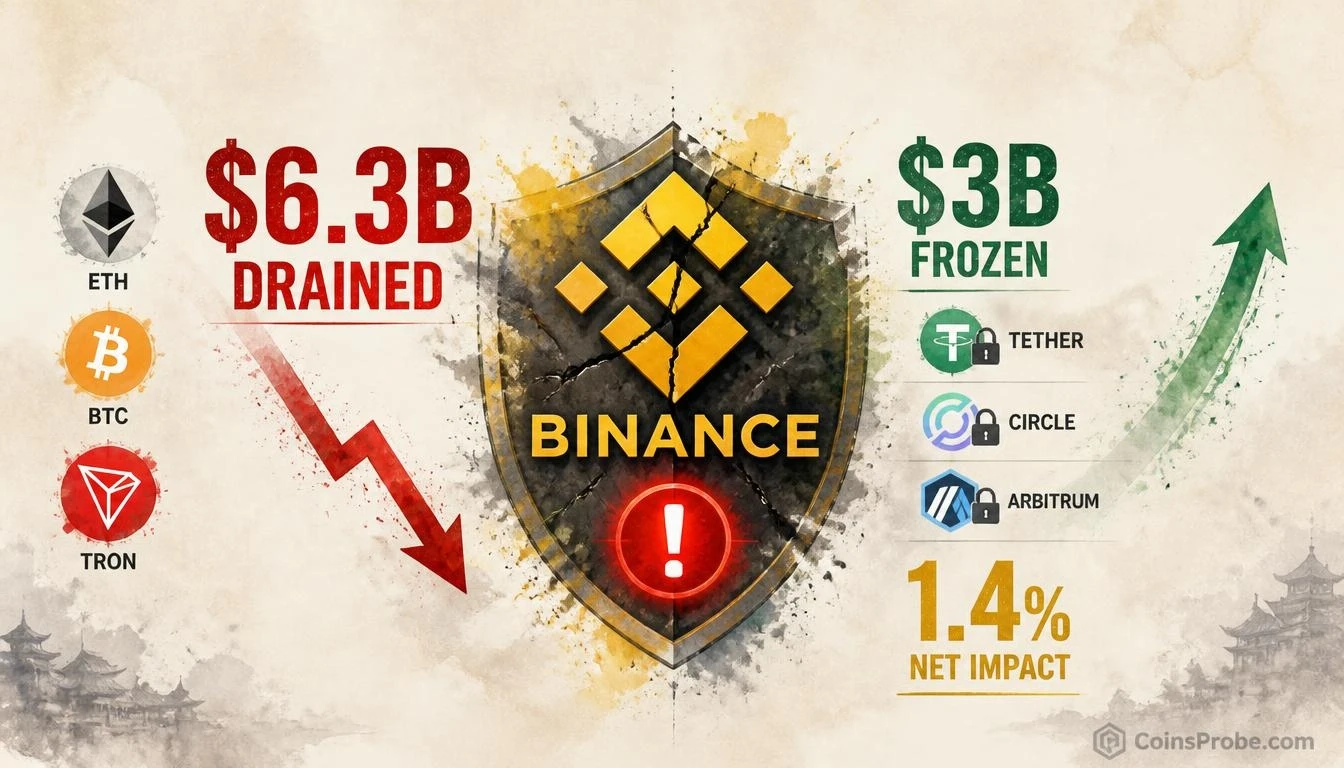

- $6.3B drained from Binance wallets on Oct 29 — ETH $3.53B, BTC $1.45B, Tron $628M, L2s $38M
- On-chain freezes by Tether ($1.567B), Circle ($800M+), and Arbitrum (~$3B total) cut gross exposure by 47.6%
- Net impact reduced to 1.4% of Binance's $151.5B Proof of Reserves after SAFU (15,000 BTC) + company funds deployed
- Co-CEO Yi He confirms withdrawals expected to resume within 48 hours; no user balance impairment reported
The largest crypto hack on record hit Binance on October 29, 2026 — with $6.3 billion drained from Binance-labeled wallets in a single coordinated attack. Despite the headline number, a rapid sequence of on-chain freezes and reserve deployments reduced the effective loss to a fraction of Binance’s $151.5 billion in verified holdings. The exchange’s infrastructure absorbed one of the most severe security events in the industry’s history without a solvency crisis.
CryptoQuant (@cryptoquant_com) published a detailed on-chain breakdown of the incident on October 30, 2026, tracing the precise flow of funds from the initial transaction through freezes, SAFU deployment, and remaining exchange liability. The analysis draws on CryptoQuant’s live wallet-tracking data and Binance’s own Proof of Reserves from October 1.
The Attack — What On-Chain Data Shows
The initial transaction was timestamped October 29 at 20:24 UTC. The wallet labeled “Binance 14” initiated the drain — sending 167,464 ETH, approximately $1.6 billion in USDT, and 63 additional tokens in a single coordinated move. The total drained broke down across chains as follows:
| Chain | Amount Drained |
|---|---|
| Ethereum (ETH) | $3.53B |
| Bitcoin (BTC) | $1.45B |
| Tron | $628M |
| Layer-2 networks | $38M |
| Total | $6.3B |
Source: CryptoQuant on-chain data, October 30, 2026
Binance confirmed the attack vector as a compromised DevOps laptop. Critically, no private keys were leaked — meaning the attacker exploited access-level credentials rather than the exchange’s core cryptographic infrastructure. Withdrawals were suspended immediately after detection.
The Freeze Response — $3B Locked Within Hours
The speed of the issuer-level freeze response is the structural story here. Three stablecoin and token issuers acted within the response window:
- Tether froze $1.567 billion in USDT.
- Circle froze over $800 million in USDC.
- Arbitrum froze 74.6 million ARB tokens plus 8,425 ETH.
Combined, these freezes accounted for approximately $3 billion of the $6.3 billion drained — cutting the net unrecoverable exposure by 47.6% before any exchange reserves were deployed. This is the critical mechanism that separated the Binance incident from historical hacks where frozen-asset recovery was near zero.
This level of coordinated issuer response reflects a post-2025 shift in stablecoin freeze infrastructure — one that has significant implications for how on-chain risk is priced, as covered in our analysis of exchange reserve structures.
SAFU + Reserves — The Remaining Coverage
After freezes, Binance deployed two additional layers to cover residual losses.
The Secure Asset Fund for Users (SAFU) held 15,000 BTC at the time of the attack — approximately $1.18 billion at current valuation. This absorbed the next tranche of losses. The remaining ~$2.1 billion is covered directly by Binance company funds.
CryptoQuant’s analysis maps how the $6.3B gross figure collapses across coverage layers:
| Coverage Layer | Amount | Net Exposure After |
|---|---|---|
| On-chain freezes | ~$3.0B | $3.3B remaining |
| SAFU (15,000 BTC) | ~$1.18B | ~$2.12B remaining |
| Binance company funds | ~$2.1B | $0 user loss |
Source: CryptoQuant on-chain breakdown, October 30, 2026
Binance’s Proof of Reserves, published October 1, showed $151.5 billion across its eight largest assets — all 1:1 or better backed. CryptoQuant’s analysis calculated the hack’s impact as a percentage of those reserves across three stages: 4.2% gross → 2.2% post-freeze → 1.4% post-SAFU. At 1.4%, the net exposure sits within a range that Binance’s company funds can absorb without touching user balances.
User Impact and Timeline
Per Binance Co-CEO Yi He, withdrawals are expected to resume within 48 hours of the suspension. User funds were not directly at risk following the freeze and SAFU response chain. The exchange has not reported any user balance impairment as of the CryptoQuant publication timestamp.
For on-chain context on how Bitcoin reserves at major exchanges behave during stress events, see our breakdown of Bitcoin UTXO age band signals — which tracks holder behavior during exchange-level disruptions.
What This Event Reveals About Exchange Risk Architecture
Three structural observations emerge from CryptoQuant’s data:
First, stablecoin freeze infrastructure now functions as a first-responder layer. The $3B frozen within hours of the attack is not a discretionary response — it reflects contractual freeze authority that Tether and Circle hold over their tokens regardless of wallet ownership. This makes the gross drained figure a ceiling, not a floor, for actual loss.
Second, the attack vector — a compromised DevOps laptop with no private-key leak — is operationally distinct from smart contract exploits or key-signing breaches. It represents an access-control failure, not a cryptographic failure. The distinction matters for how exchanges model their security perimeter going forward.
Third, the SAFU fund’s 15,000 BTC balance proved material but not sufficient as a standalone buffer against a $6.3B event. Binance’s company fund deployment confirms that exchange solvency in a catastrophic hack scenario depends on balance sheet depth, not reserve funds alone.
Bullish Scenario
If withdrawals resume within the 48-hour window confirmed by Co-CEO Yi He, and on-chain data shows frozen assets being returned to Binance wallets, market confidence is likely to recover quickly. Historical exchange hack recoveries where user funds were made whole — notably Bitfinex’s 2016 socialized loss mechanism — saw prices stabilize within days once the coverage mechanism was confirmed verifiable on-chain.
Bearish Scenario
If Binance’s company fund coverage of the remaining ~$2.1 billion proves insufficient, or if additional drained wallets not captured in the initial CryptoQuant analysis surface, the 1.4%-of-reserves figure would need revision upward. A withdrawal delay extending beyond 48 hours would likely trigger secondary exchange outflows as users seek to remove funds from Binance preemptively — compounding liquidity pressure.
The structural message from CryptoQuant’s on-chain breakdown is direct: a $6.3B headline number is not a $6.3B loss. The freeze-SAFU-reserve waterfall compressed actual net exposure to 1.4% of Binance’s verified $151.5B in holdings. The 48-hour withdrawal resumption window and on-chain confirmation of frozen asset returns are the two data points that will determine whether this remains a contained incident or becomes a protracted liquidity event. Watch Binance’s withdrawal status and CryptoQuant’s live wallet-tracking dashboard for real-time resolution.
Source: x.comFrequently Asked Questions
Were Binance user funds actually lost in the $6.3B hack?
How did Tether and Circle freeze stolen funds so quickly?
What is Binance’s SAFU fund and was it enough to cover the hack?
What was the attack vector — were private keys compromised?
Source: CryptoQuant · Published by CoinsProbe Markets Desk
The opinions and market insights shared on CoinsProbe represent the views of individual authors based on prevailing market conditions at the time of publication. Cryptocurrency investments carry significant risk and volatility. Readers are encouraged to conduct their own research and seek professional financial advice before making investment decisions. CoinsProbe and its contributors do not accept responsibility for financial losses or decisions made based on published content.
CoinsProbe may publish sponsored articles, affiliate links, or promotional collaborations. All sponsored material is clearly labeled to maintain transparency with our audience. Our editorial decisions remain fully independent, and advertising partnerships do not influence reviews, rankings, or published opinions.
Since 2023, CoinsProbe has delivered reliable insights on cryptocurrency, blockchain, and digital assets. Our content is created by experienced researchers and analysts who follow strict editorial standards focused on accuracy, transparency, and credibility. Every article is carefully reviewed and verified using trusted sources and current market data. We provide unbiased analysis and timely updates covering everything from emerging crypto projects to major industry developments.