
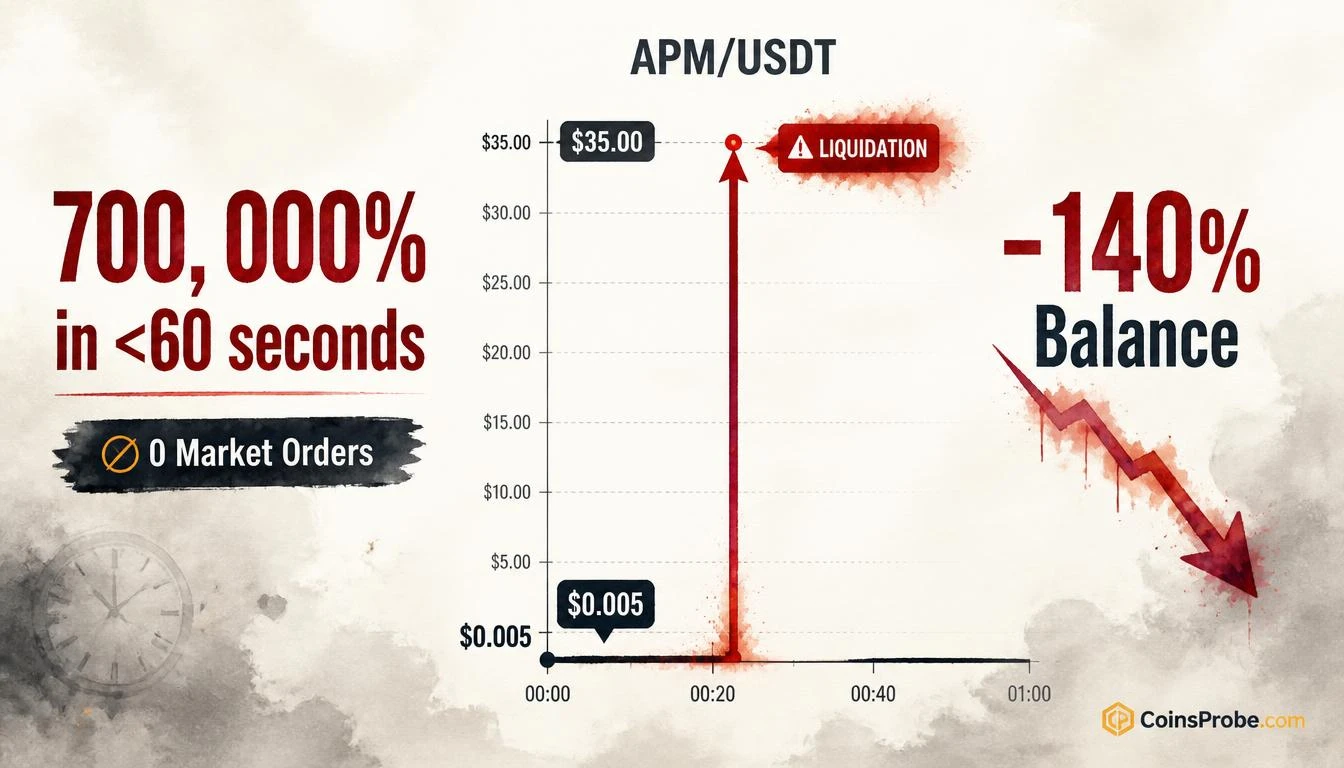
- APM/USDT moved from $0.005 to $35 in under 60 seconds on Aster DEX — a 700,000% surge with zero market orders executed
- The move was fully isolated to Aster DEX — APM/USDT did not move even 1% on any other platform during the same window
- At least one trader was left at -140% balance after instantaneous liquidation triggered by the price spike
- This mirrors a prior Aster DEX incident where APM/USDT previously spiked to $45, liquidating traders despite 5x margin
A trader on Aster DEX reported one of the most extreme price anomalies in recent crypto history: APM/USDT rocketed from $0.005 to $35 in under one minute — a 700,000% move — without a single market order being executed. The incident, reported via the AsterDEX Telegram channel on October 12, 2026, left at least one trader at -140% on their balance after what they described as a price “teleport.”
Critically, the move was entirely isolated to Aster DEX. APM/USDT did not register even a 1% price change on any other trading platform during the same window — a hallmark of an oracle manipulation or internal matching engine failure, not a genuine market move.
What Happened — A Price “Teleport” With No Market Orders
The mechanics reported here are unlike a standard pump-and-dump. In a conventional manipulation event, market buy orders drive the price up sequentially through the order book, leaving an auditable trail of executed trades. According to the trader’s account published on the AsterDEX Telegram channel, no market orders were placed — the price simply shifted instantaneously from $0.005 to $35.
| Detail | Value |
|---|---|
| Starting price | $0.005 |
| Peak price | $35.00 |
| Move magnitude | 700,000% |
| Duration | Under 60 seconds |
| Market orders executed | Zero (per trader’s account) |
| Price move on other platforms | Less than 1% |
| Trader’s resulting balance | -140% |
Source: AsterDEX Telegram channel, October 12, 2026
A -140% balance outcome on a perpetual futures position means the loss exceeded the trader’s deposited margin — only possible when liquidation occurs at a price that overshoots the margin buffer, typically triggered by an instantaneous price spike that bypasses normal liquidation mechanics. This is consistent with a price feed manipulation scenario rather than an organic market move.
This is not the first time APM/USDT on Aster DEX has produced this outcome. As documented in a prior CoinsProbe report, APM/USDT previously pumped from $0.01 to $45 on Aster DEX, liquidating traders despite 5x margin coverage — a near-identical pattern involving the same asset on the same platform.
Why Zero Market Orders Is the Critical Detail
Standard exchange price discovery requires buy-side market orders to consume sell-side liquidity and push price higher. If APM/USDT moved 700,000% with no market orders, the price change originated not from the order book but from the price feed itself — either an internal oracle, an admin-level price override, or a matching engine manipulation.
The isolation of the move to Aster DEX alone confirms this. A genuine demand shock would propagate across venues through arbitrage within seconds. The absence of any price movement on other platforms means no cross-venue arbitrage occurred — which is only consistent with a price change that existed solely in Aster DEX’s internal system.
The consequences for leveraged traders are immediate and total. When a liquidation engine references a price feed that jumps 700,000% instantaneously, open positions are marked against that artificial price before any human response is possible. The -140% outcome reported is the direct result of liquidation at a price that no external market ever validated.
This pattern extends beyond APM. Traders who have experienced catastrophic isolated liquidations on other platforms — including the trader who accumulated 33 liquidations and $37.64M in losses on Hyperliquid — illustrate the systemic risk that concentrated leverage carries when platform-level anomalies occur.
Is This Recoverable — And What Happens Next
The trader’s account notes that the Aster team’s response to the incident compounded the harm — though the full response text was cut off in the published message. This is the phase that typically determines whether an event is classified as a platform failure (where restitution is possible) or an intentional manipulation (where it is not).
For affected traders, the critical questions are: whether Aster DEX acknowledges the price anomaly as illegitimate, whether trade history and liquidation logs are publicly verifiable on-chain, and whether the price feed source is disclosed. None of those answers are available from the current source text alone.
The metric to monitor is whether any on-chain transaction data corroborates the zero-market-order claim. If APM/USDT’s on-chain order flow shows no buys during the spike window, the trader’s account is verifiable. If order flow data is unavailable — because Aster DEX operates an off-chain matching engine — that absence itself is material information about the platform’s transparency structure.
Traders running leveraged positions on low-liquidity perpetuals outside top-tier venues carry a specific and underappreciated risk: liquidation engines that reference internal price feeds rather than aggregated external oracles. The APM/USDT incident is the clearest recent illustration of what that risk looks like when it materializes. For further context on extreme liquidation mechanics, the SOL trader with a 78% win rate who was liquidated at $99.68 on a $19.78M position demonstrates that even experienced traders are not immune to platform-level price events.
The core structural question Aster DEX must answer: if no market orders moved APM/USDT’s price, what did — and who controlled it.
Frequently Asked Questions
How did APM/USDT move 700,000% without market orders on Aster DEX?
Why did traders lose more than 100% of their balance on the APM spike?
Has APM/USDT done this before on Aster DEX?
What should traders check before using a perpetual DEX like Aster?
Source: AsterDEX · Published by CoinsProbe Markets Desk
The opinions and market insights shared on CoinsProbe represent the views of individual authors based on prevailing market conditions at the time of publication. Cryptocurrency investments carry significant risk and volatility. Readers are encouraged to conduct their own research and seek professional financial advice before making investment decisions. CoinsProbe and its contributors do not accept responsibility for financial losses or decisions made based on published content.
CoinsProbe may publish sponsored articles, affiliate links, or promotional collaborations. All sponsored material is clearly labeled to maintain transparency with our audience. Our editorial decisions remain fully independent, and advertising partnerships do not influence reviews, rankings, or published opinions.
Since 2023, CoinsProbe has delivered reliable insights on cryptocurrency, blockchain, and digital assets. Our content is created by experienced researchers and analysts who follow strict editorial standards focused on accuracy, transparency, and credibility. Every article is carefully reviewed and verified using trusted sources and current market data. We provide unbiased analysis and timely updates covering everything from emerging crypto projects to major industry developments.