
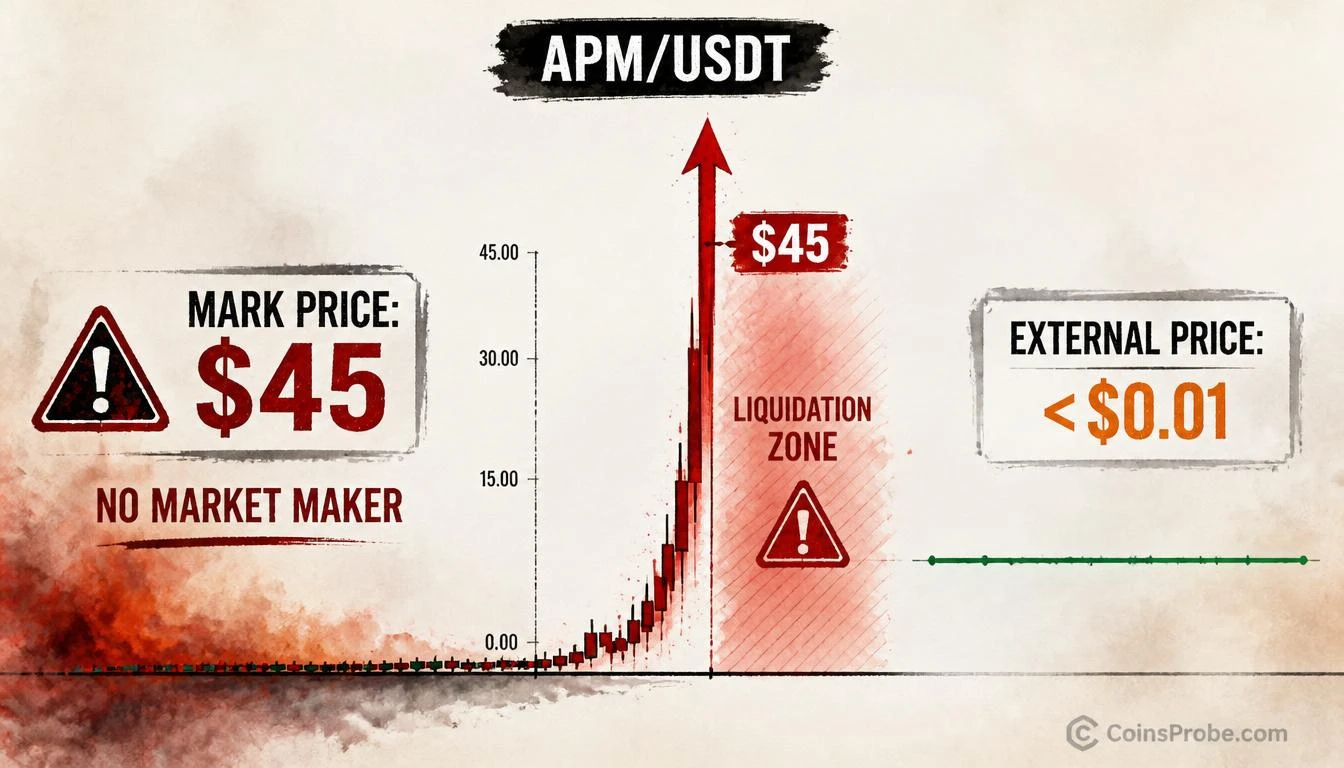

- APM/USDT spiked from under $0.01 to $45 on Aster DEX — a 4,400x move not reflected on any external market
- Accounts liquidated in seconds even when margin held was 5x the position size — mark price oracle drove forced closures
- Order placement was blocked during the spike, trapping both shorts (liquidated) and longs (unable to enter)
- The token showed zero movement on all other exchanges and DEXs simultaneously, confirming internal pricing failure
A token listed as APM/USDT on Aster DEX surged from under one cent to $45 in seconds — a move that liquidated trading accounts even when the margin held was five times the size of the position itself. The price spike did not register on any other exchange or decentralized exchange at the time, raising immediate questions about market structure failures on the platform.
Multiple users reported the same experience simultaneously, confirming this was not an isolated edge case. The incident has drawn attention to a structural gap in how smaller perpetuals exchanges handle thin-liquidity markets and oracle pricing — and what happens to traders caught in between.
What Happened — The APM/USDT Spike on Aster DEX
According to accounts shared in the AsterDEX Telegram channel, APM/USDT printed a vertical price move from below $0.01 to $45 within seconds. At a $45 print, that represents a move of more than 4,400x from the sub-cent entry point — yet this price existed only on Aster’s internal pricing system, not on external markets.
The mechanism that caused liquidations is specific: Aster DEX, like most perpetuals platforms, uses a “fair price” or mark price — separate from the last traded price — to calculate margin and trigger liquidations. When the internal fair price registered $45, the platform’s liquidation engine treated short positions as deeply underwater and began force-closing them, regardless of whether any actual trade had occurred at that price in the real market.
| Data Point | Detail |
|---|---|
| Token Pair | APM/USDT (Aster DEX) |
| Price Before Spike | Under $0.01 |
| Price at Spike Peak | $45.00 |
| Implied Move | >4,400x |
| Price on External Markets/DEXs | No movement recorded |
| Margin vs. Position Size | 5x (margin was larger than position) |
| Liquidation Speed | Seconds |
Source: AsterDEX Telegram channel, October 12, 2026
Why Margin Size Did Not Protect Traders
Under normal market conditions, holding margin five times the position size provides substantial buffer against liquidation. But when the mark price moves 4,400x in seconds — driven by a thin or absent order book rather than genuine price discovery — no realistic margin ratio can absorb that delta. The liquidation engine does not distinguish between a real market move and a phantom price print caused by zero liquidity. It responds only to the mark price calculation, and at $45, every short position was mathematically insolvent on paper.
The Double Trap — No Exit for Longs Either
The structural failure extended beyond short liquidations. Users who attempted to open long positions to profit from the spike — or to hedge existing exposure — found that the exchange blocked new order placement. The platform’s mechanism cited an even higher “fair price” than $45 as the reason orders could not be filled, creating a scenario where traders could neither exit short positions nor enter long positions to capture the move.
This is the defining characteristic of a market-maker absence event: without a functioning counterparty on the other side of the order book, the spread between bid and ask collapses into zero liquidity. The exchange’s pricing engine continues to update based on whatever data feed it references, but actual execution becomes impossible. Traders are locked into positions that the system simultaneously marks as liquidatable and unexitable.
Is This an Aster-Specific Problem — or a Thin-Market Structural Risk?
The APM/USDT incident is not unique to Aster DEX. It reflects a known risk in perpetuals markets that list low-liquidity tokens without adequate market-maker infrastructure. When a token has minimal order book depth, a single large buy order — or a manipulative wash trade — can move the internal price by orders of magnitude. If the exchange’s mark price oracle tracks that internal price too closely, rather than using a time-weighted average price (TWAP) or aggregated external feed, the result is exactly what Aster users experienced: phantom liquidations at prices that do not exist on any other venue.
The question of whether this constitutes exchange negligence, oracle manipulation, or deliberate market abuse is separate from the structural mechanics — but the mechanics are clear. Any perpetuals exchange listing a token with no verifiable external price feed and no committed market maker is exposing its users to this exact failure mode. Traders in thin markets should treat mark price methodology — not just leverage ratio — as the primary risk variable.
For readers tracking broader liquidation dynamics across crypto markets, see our earlier coverage of Bitcoin’s +6.7% single-day surge and its three-factor catalyst, which illustrates how legitimate price discovery differs from thin-market price distortion.
The APM/USDT event on Aster DEX was not a market move — it was a liquidity failure. APM printed $45 internally while trading at fractions of a cent everywhere else. The traders who were liquidated were not wrong about the market; they were wrong about the exchange. The metric every trader on smaller perpetuals platforms should verify before opening a position: does the platform’s mark price use an aggregated external feed with a TWAP buffer, or does it track its own thin internal order book? On October 12, 2026, that distinction cost Aster users their entire margin — five times over.
Frequently Asked Questions
How did APM/USDT reach $45 on Aster DEX if it didn’t move on other exchanges?
Why were traders liquidated even with margin five times larger than their position?
Could traders profit by going long during the APM spike on Aster?
What should traders check before using a perpetuals exchange listing low-liquidity tokens?
Source: Asterdex +1 More · Published by CoinsProbe Markets Desk
The opinions and market insights shared on CoinsProbe represent the views of individual authors based on prevailing market conditions at the time of publication. Cryptocurrency investments carry significant risk and volatility. Readers are encouraged to conduct their own research and seek professional financial advice before making investment decisions. CoinsProbe and its contributors do not accept responsibility for financial losses or decisions made based on published content.
CoinsProbe may publish sponsored articles, affiliate links, or promotional collaborations. All sponsored material is clearly labeled to maintain transparency with our audience. Our editorial decisions remain fully independent, and advertising partnerships do not influence reviews, rankings, or published opinions.
Since 2023, CoinsProbe has delivered reliable insights on cryptocurrency, blockchain, and digital assets. Our content is created by experienced researchers and analysts who follow strict editorial standards focused on accuracy, transparency, and credibility. Every article is carefully reviewed and verified using trusted sources and current market data. We provide unbiased analysis and timely updates covering everything from emerging crypto projects to major industry developments.