

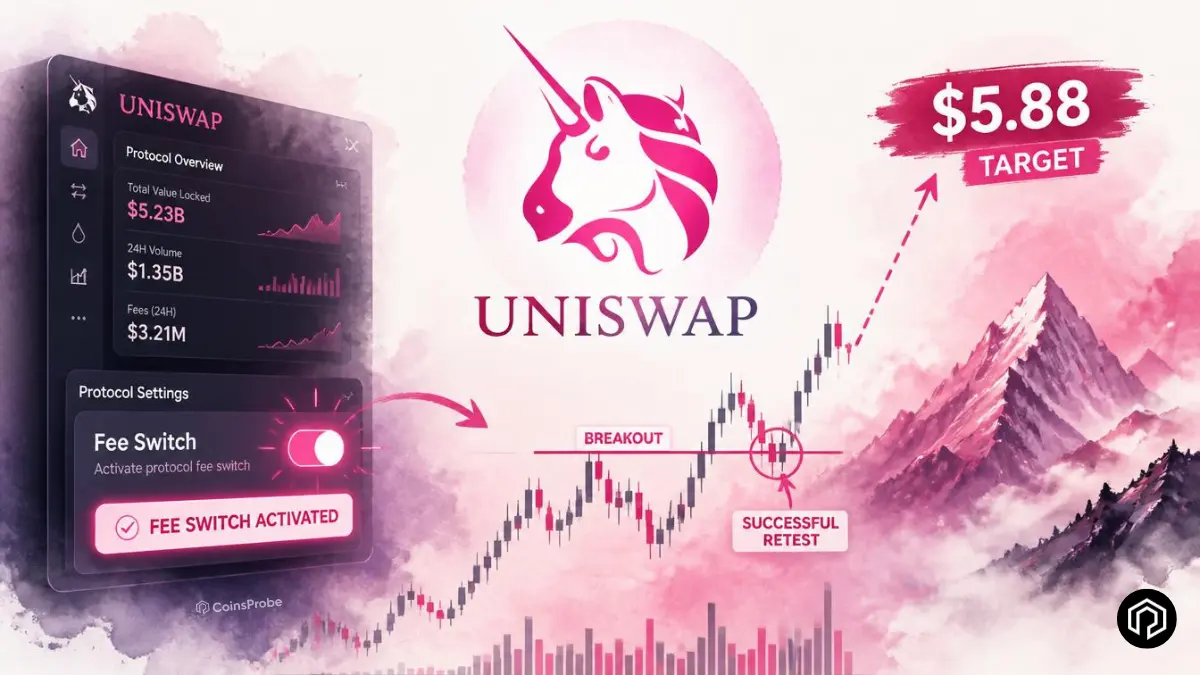

- UNI trades at $4.23, up 32.3% over the past month following the activation of the v4 fee switch and buy-and-burn mechanism.
- 106,000 UNI was burned on July 29, marking the third-largest single-day burn in the token's history.
- On-chain activity remains strong, with new addresses, active users, and whale transactions all rising.
- A confirmed breakout targets $5.88, offering around 40% upside if momentum continues.
Uniswap’s v4 fee switch activation is one of the most significant fundamental events in DeFi protocol history — a governance decision years in the making that has now translated into immediate, measurable on-chain consequences: real token burns, sustained new user growth, elevated whale activity, and a confirmed technical breakout that is holding its retest. Here is the complete picture.
UNI is trading at $4.23 — up +3.06% in 24 hours, +15.72% over 7 days, and +32.33% over 30 days — with a market cap of approximately $2.64 billion. The token ran from approximately $3.83 to $4.54 between July 29–31 — a +19% move — on the back of fee switch activation and burn mechanism launch, before easing to the current $4.23 as the market digests the catalyst.

The v4 Fee Switch Goes Live
After years of governance debate and community discussion, Uniswap’s v4 fee switch has officially activated — meaning a portion of the protocol’s trading fees now flow toward UNI token holders rather than exclusively to liquidity providers.
The fee switch has been one of the most consequential unresolved questions in DeFi governance for multiple years — with billions of dollars in cumulative Uniswap fees generated without any direct value flowing to UNI holders. The activation changes that relationship permanently: the protocol is now a revenue-sharing asset rather than a governance-only token.
Simultaneously, the buy-and-burn mechanism went live — with fee revenue being used to purchase UNI from the open market and burn it, creating direct deflationary pressure tied to protocol usage volume. The larger Uniswap’s trading volume, the more UNI is purchased and burned — mechanically linking protocol success to token supply reduction.
As we covered in our Uniswap $92.5M monthly fees and broadening wedge article — Uniswap already generates approximately $92.55M in monthly protocol fees and $51.94B in monthly DEX volume. With the buy-and-burn now active, this fee flow is being partially redirected into open-market UNI purchases — creating sustained, mechanical demand that did not exist before July 29.
Third Highest UNI Burn Day on Record: 106,000 UNI
The burn data from July 29, 2026 confirms the fee switch is generating immediate, material token deflation:
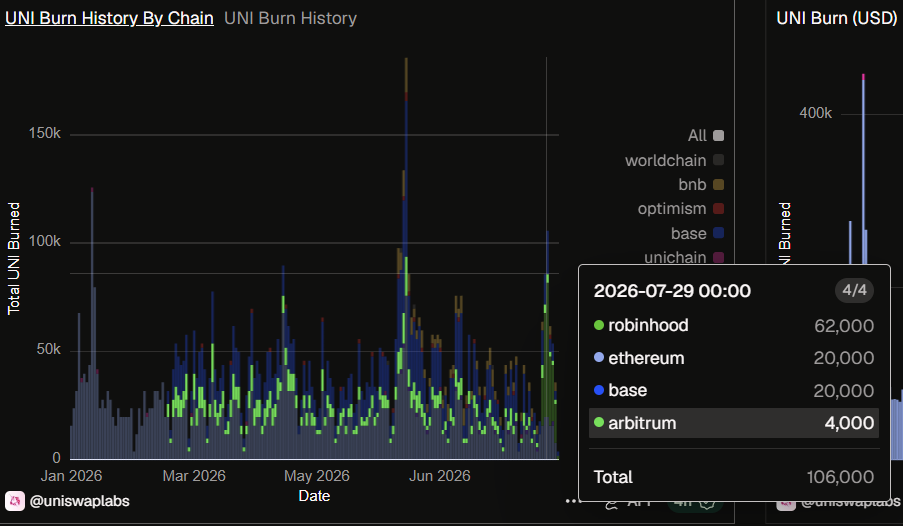
106,000 UNI burned in a single day — the third highest single-day burn event in Uniswap’s history — on the first day the mechanism was active. The breakdown is revealing: Robinhood Chain contributing 62,000 of the 106,000 burned (approximately 58% of the total) reflects the explosive trading volume that chain has generated since its July 1 launch, which we documented in our Robinhood Chain beats BSC in DEX volume article.
The burn history chart shows the July 29 spike as one of the most prominent in the 2026 dataset — with recent weeks showing consistently elevated burn activity as Robinhood Chain’s trading volume contributes to the mechanism at scale. This is not a one-off spike — it is the beginning of a sustained deflationary mechanism that will compound as long as Uniswap maintains its DEX volume leadership.
UNI On-Chain Activity Holds for Two Consecutive Days
The most analytically significant data point from the fee switch activation is not the first day’s price reaction — it is that the on-chain response held for a second consecutive day.
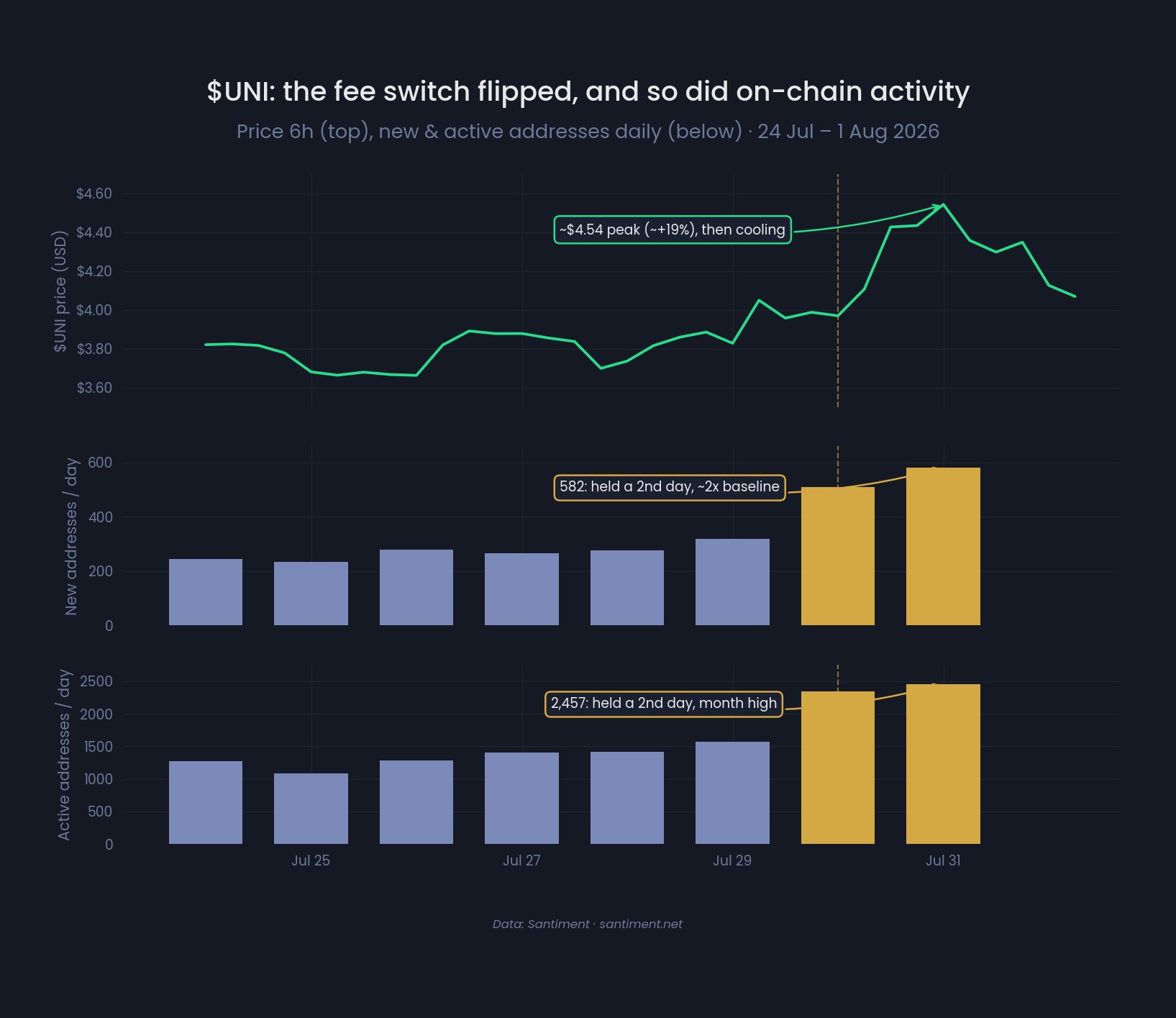
Santiment data from July 24 to August 1, 2026:
Why two days matters more than one:
A one-day catalyst pop — price surges on announcement, activity spikes briefly, then normalises — is a familiar pattern that fades within 24–48 hours as the initial excitement dissipates. The data shows something different:
New addresses at 510 on July 30 then 582 on July 31 — holding above double the July baseline for a second consecutive day. This is not a spike that faded — it is a step-change that held.
Active addresses at 2,341 then 2,457 — the highest readings of the entire month of July — also holding for two days. Month highs on two consecutive days is not noise.
Whale transactions ($100K+) at 142 on July 30 — the busiest day of the month bar one — as large holders moved in simultaneously with the fee switch activation.
The critical observation: The on-chain step-up held while price started cooling. Price peaked at $4.54 and began easing back toward $4.07 — but new addresses, active addresses, and whale activity remained elevated. When on-chain fundamentals hold while price cools, it is a signal that the catalyst produced genuine adoption rather than a temporary speculative bid. The fee switch flipped the fees — and the chain flipped on too.
Technical Analysis — Breakout, Retest, and $5.88 Target
As we analysed in our Uniswap broadening wedge article — UNI was forming a right-angled descending broadening wedge with the lower support at $2.317 and the upper descending resistance trendline as the breakout trigger.
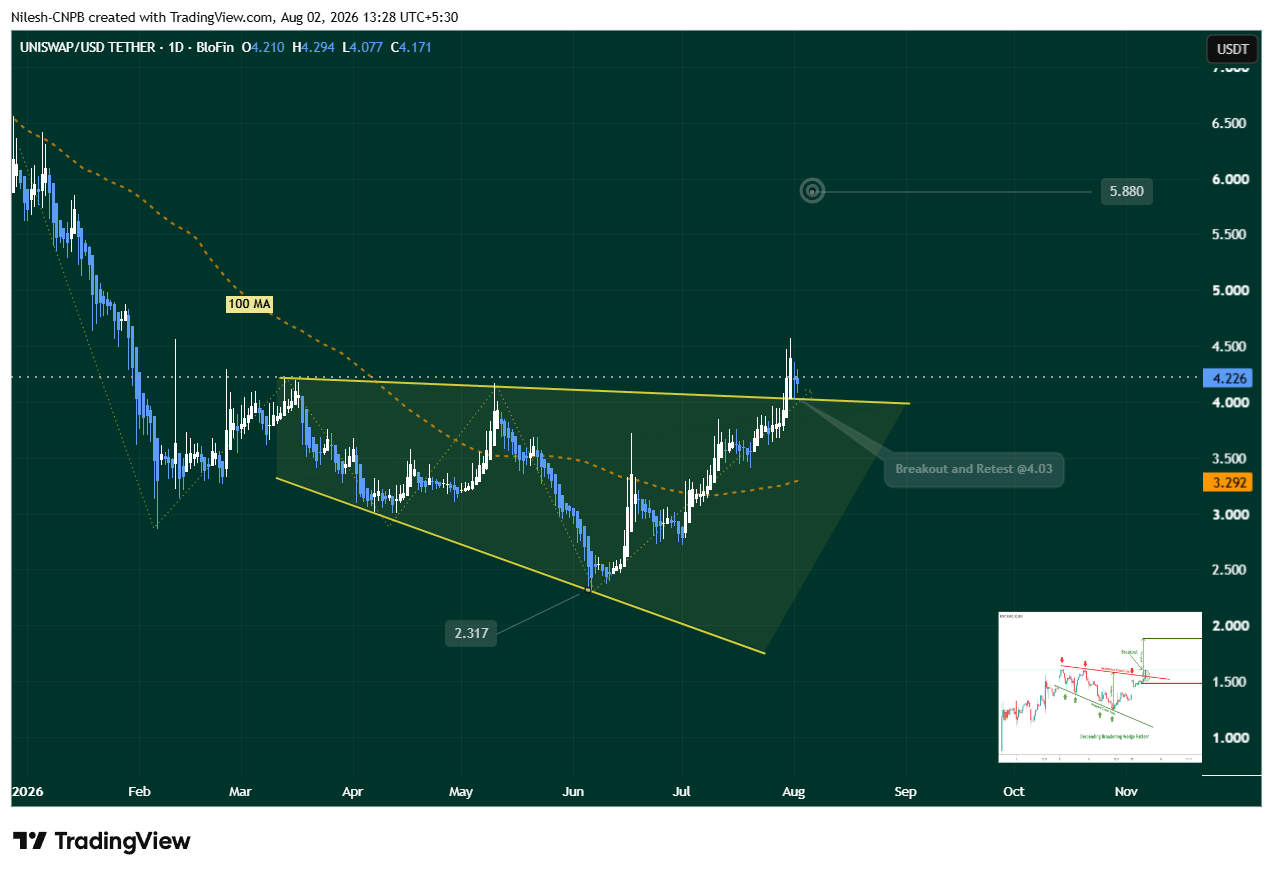
What the daily chart now shows:
The breakout from the upper resistance trendline near $4.03 has occurred — with price pushing up to a local high of approximately $4.57 before pulling back to retest the broken resistance level. The retest near $4.03 — the “Breakout and Retest @4.03” label visible on the chart — has held, with UNI now trading above it at $4.23.
A reclaim of the $4.57 local high — clearing the level UNI reached on the initial fee switch breakout — would confirm the retest has held and the breakout is developing into a sustained move toward the $5.88 measured target, representing approximately +40% additional upside from the current $4.23.
The support to hold: The breakout trendline near $4.03 must continue to act as support for the bullish structure to remain intact. A sustained daily close below $4.03 would suggest the retest has failed and the breakout requires reassessment.
Why This Setup Is More Complete Than Most
The UNI setup at this moment combines three layers that rarely align simultaneously:
Fundamental catalyst: The v4 fee switch activation is a permanent structural change — not a one-time announcement or partnership. Fee revenue now flows to UNI holders and the buy-and-burn mechanism. This changes UNI’s investment case from governance token to revenue-sharing asset permanently.
On-chain confirmation: Two consecutive days of elevated new addresses, active addresses, and whale activity — with metrics holding while price cooled — confirms the fee switch produced genuine adoption acceleration rather than a speculative bid that fades.
Technical confirmation: A confirmed breakout from a multi-month descending broadening wedge, a successful retest of the breakout level, and a clear measured move target at $5.88 — with the retest level ($4.03) providing the specific invalidation floor.
Bottom Line
Uniswap’s fee switch activation on July 29 produced the third highest single-day UNI burn on record (106,000 UNI), a +19% price run from $3.83 to $4.54, and — most significantly — a two-day sustained step-up in new addresses, active addresses, and whale activity that held even as price began cooling. The daily chart confirms the breakout from the right-angled descending broadening wedge has retested the $4.03 trendline and held.
From here: a reclaim of $4.57 activates the $5.88 measured target (+40%). The $4.03 breakout trendline is the support that keeps the structure intact. The fee switch has permanently changed what UNI is — the chart and on-chain data are beginning to reflect that.
Frequently Asked Questions (FAQ)
What is the Uniswap v4 fee switch?
A governance mechanism that redirects a portion of Uniswap’s trading fees toward UNI token holders — activated on July 29, 2026 — permanently changing UNI from a governance-only token to a revenue-sharing asset with a simultaneous buy-and-burn mechanism.
The opinions and market insights shared on CoinsProbe represent the views of individual authors based on prevailing market conditions at the time of publication. Cryptocurrency investments carry significant risk and volatility. Readers are encouraged to conduct their own research and seek professional financial advice before making investment decisions. CoinsProbe and its contributors do not accept responsibility for financial losses or decisions made based on published content.
CoinsProbe may publish sponsored articles, affiliate links, or promotional collaborations. All sponsored material is clearly labeled to maintain transparency with our audience. Our editorial decisions remain fully independent, and advertising partnerships do not influence reviews, rankings, or published opinions.
Since 2023, CoinsProbe has delivered reliable insights on cryptocurrency, blockchain, and digital assets. Our content is created by experienced researchers and analysts who follow strict editorial standards focused on accuracy, transparency, and credibility. Every article is carefully reviewed and verified using trusted sources and current market data. We provide unbiased analysis and timely updates covering everything from emerging crypto projects to major industry developments.