
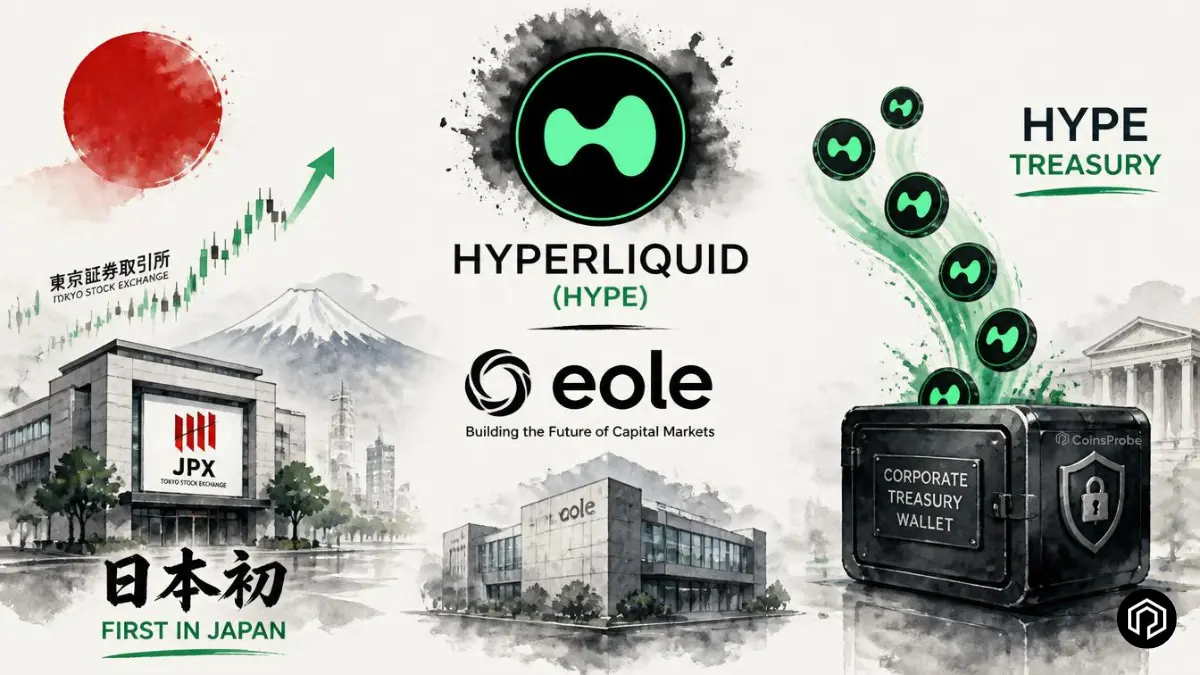

- Japan’s Eole Inc. became the first publicly listed Japanese company to buy HYPE, purchasing 1,078.25 tokens for about $68,000.
- Eole plans to increase its HYPE holdings to around $670,000 by August-end as part of its crypto treasury strategy.
- The company views Hyperliquid and HyperEVM as key infrastructure for emerging AI-driven commerce.
- The move highlights growing institutional interest in HYPE as a corporate treasury asset.
When a publicly listed company files an official TDnet disclosure to announce the purchase of a DeFi protocol’s native token as a corporate treasury asset — that is a meaningful data point about where institutional adoption of decentralised finance infrastructure is heading. Eole’s acquisition of HYPE is modest in dollar terms but historically significant in what it represents: the first Japanese listed company to formally hold HYPE, with a stated strategy to expand that holding and integrate it into its core business direction.
The Official Acquisition — By the Numbers
The acquisition was formally disclosed through Japan’s TDnet official corporate disclosure system on July 28/29, 2026:
| Detail | Data |
|---|---|
| Company | Eole Inc. (イオレ) |
| Exchange listing | Tokyo Growth Market (TSE: 2334) |
| Purchase date | July 28, 2026 |
| Quantity purchased | 1,078.25469311 HYPE |
| Total amount paid | ¥10,084,663.8716 |
| Average purchase price | ¥9,352.766 per HYPE |
| Target total by end-August | ¥100 million |
| Historic status | First Japanese listed company to hold HYPE |
Eole also confirmed that HYPE holdings will be measured at fair value each quarter — similar to its existing Bitcoin accounting treatment — with gains or losses reflected directly in the income statement. This approach mirrors the fair value accounting framework that MicroStrategy and other corporate Bitcoin treasury holders use in their financial reporting, applied here to HYPE.
Why Eole Is Buying HYPE — The Strategic Rationale
This acquisition did not emerge from a speculative trading decision. It was disclosed under Eole’s previously announced change in use of funds (disclosed July 16, 2026), which expanded the company’s digital asset allocation from Bitcoin only to a broader set of digital assets. The HYPE purchase is the first execution under that expanded mandate.
The “Neo Crypto Bank” strategy:
Eole has positioned its digital asset activities under a broader corporate vision it calls the “Neo Crypto Bank” strategy — building on-chain financial infrastructure and capabilities rather than simply holding crypto assets as passive treasury positions. The HYPE acquisition is described as a strategic foundation for this vision rather than a pure capital gains play.
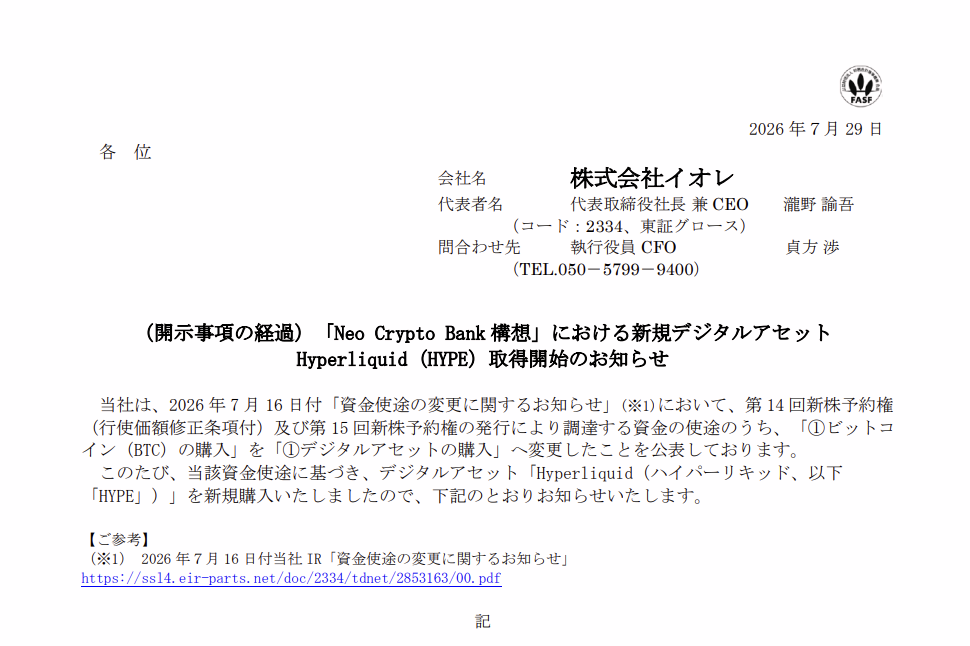
Executive Director Kensuke Amo (@amokensuke) provided the detailed strategic context beyond the formal disclosure — explaining three specific threads that converge in the HYPE acquisition decision.
The Three Strategic Threads — Kensuke Amo’s Explanation
Thread 1 — Agentic Commerce and the AI Agent Economy
The most forward-looking element of Eole’s HYPE thesis is its focus on Agentic Commerce — a term describing the emerging era where AI agents autonomously handle payments, contracts, and financial transactions on behalf of users and businesses.
The key constraint that AI agents face in traditional finance: they generally do not have traditional bank accounts and cannot access conventional payment rails. They require high-speed, low-cost, fully programmable on-chain financial infrastructure that can execute transactions autonomously without human intermediation at each step.
Hyperliquid’s architecture directly addresses this requirement: a finance-specialised Layer-1 capable of processing thousands of transactions per second with sub-100ms latency, combined with the Ethereum-compatible HyperEVM that enables programmable smart contract execution. This combination makes Hyperliquid one of the strongest candidates Eole has identified for becoming core infrastructure for AI-driven financial activity as the Agentic Commerce era develops.
As we covered in our How to Use AI Agents on Robinhood article — the intersection of AI agents and financial execution is one of the most active development areas in 2026. Eole is positioning HYPE as its infrastructure bet on that specific thesis.
Thread 2 — The US Regulatory DAT Dynamic
Amo also highlighted a structural market dynamic that is driving corporate interest in HYPE treasury vehicles globally:
Strict US regulations — including AML requirements, CFTC jurisdiction over derivatives, and SEC framework uncertainty — make it difficult for many US retail and institutional investors to access Hyperliquid directly through Web3 frontends. The regulatory friction around direct protocol access has created demand for an alternative access vehicle: regulated, publicly listed HYPE Digital Asset Treasury (DAT) companies.
Examples already operating in the US include Hyperliquid Strategies and PURR — publicly listed vehicles that allow investors to gain exposure to Hyperliquid’s ecosystem and protocol revenue while remaining within traditional financial market frameworks that US compliance structures permit.
Eole is positioning itself as the Japanese equivalent of this category — a publicly listed vehicle providing regulated, compliant HYPE exposure to Japanese investors and institutions who face similar or different regulatory frictions in accessing Hyperliquid directly.
Thread 3 — Future Integration Plans
Beyond the initial acquisition, Amo outlined Eole’s forward-looking plans for the HYPE position:
Staking exploration — Eole plans to explore staking and other operational methods that would allow the HYPE position to generate yield rather than sitting as a passive holding. This connects directly to the AQAv2 USDC yield mechanism we covered — which activates in August 2026 and provides protocol-level yield to HYPE stakers.
Volatility hedging — Using traditional financial market instruments where appropriate to manage the price exposure from the HYPE position within Japanese regulatory compliance requirements.
Product and service integration — Integrating HYPE and Hyperliquid infrastructure into Eole’s own products and services as the Neo Crypto Bank strategy develops — moving from passive holding toward active operational use of the asset.
Why This Matters Beyond the Dollar Amount
The initial ¥10 million (~$61,000) purchase is modest by global crypto treasury standards. But the significance of this announcement is not the dollar amount — it is what the formal TDnet disclosure represents:
A Japanese publicly listed company has formally, legally, and with full corporate disclosure accountability, adopted HYPE as a treasury asset — with a stated strategy, a defined expansion target, and a management-level strategic rationale that goes beyond speculation.
This is categorically different from retail or even institutional trading of HYPE. A listed company filing an official government disclosure about holding HYPE means the asset is now on the balance sheet of a public company, subject to quarterly fair value accounting, disclosed to shareholders and regulators, and integrated into a stated corporate strategy. That institutional legitimacy has a value that is independent of the dollar amount involved.
The path from first listed company to broad listed company adoption — in Japan or any market — typically follows a similar pattern: one company moves first, the disclosure becomes a reference point for others evaluating the same decision, and subsequent adopters can point to the precedent rather than navigating the uncertainty alone.
As we covered in our Will HYPE Reach $100 article — one of the key factors in HYPE’s long-term thesis is institutional adoption expanding beyond pure trading interest into treasury and strategic holding. Eole’s announcement is a data point in that direction.
Key Context — Hyperliquid’s Protocol Fundamentals
The institutional interest Eole is expressing is grounded in Hyperliquid’s operational reality as one of the most genuinely used DeFi protocols in existence:
As we covered throughout 2026 — Hyperliquid has achieved consistent top-three perpetual DEX volume rankings, generated substantial protocol fee revenue that funds its USDC yield and buyback mechanisms, launched Portfolio Margin and other institutional-grade features, and built the AQAv2 yield mechanism that activates for stakers in August 2026. The HIP-4 permissionless prediction markets — currently in testnet — represent the next major product expansion.
Eole’s acquisition is a bet on this fundamental picture continuing to develop — and on Hyperliquid’s infrastructure becoming a foundational layer for AI-driven financial applications as the Agentic Commerce era matures.
Bottom Line
Eole Inc.’s acquisition of HYPE — the first by a Japanese publicly listed company — is a historically notable milestone for Hyperliquid’s institutional adoption story in Asia. The ¥100 million target by end-August, the fair value accounting treatment, the “Neo Crypto Bank” strategic framing, and the specific Agentic Commerce thesis articulated by Executive Director Kensuke Amo all indicate this is a deliberate, strategic position rather than a speculative purchase.
Whether other Japanese listed companies follow Eole’s precedent — and whether the DAT vehicle model that has developed in the US begins to replicate in Japan and other markets — will be one of the more interesting institutional adoption stories to watch as 2026 progresses.
Frequently Asked Questions (FAQ)
Which Japanese listed company is the first to buy HYPE?
Eole Inc. (TSE: 2334) — listed on the Tokyo Growth Market — became the first publicly listed company in Japan to officially acquire HYPE, purchasing 1,078.25 HYPE for ¥10,084,663 (~$61,000) with a target to reach ¥100 million in total HYPE holdings by end of August 2026.
What is Eole’s “Neo Crypto Bank” strategy?
A corporate strategy positioning Eole as an on-chain financial infrastructure builder — using digital assets including Bitcoin and now HYPE as strategic treasury assets integrated into the company’s products and services, rather than passive speculative holdings.
Why is Eole buying HYPE specifically?
Three reasons: Hyperliquid’s sub-100ms Layer-1 and HyperEVM are viewed as core infrastructure for the AI agent economy (Agentic Commerce); strict US regulations are driving demand for regulated HYPE DAT vehicles; and Eole plans to stake HYPE for yield and integrate it into its products.
What is Agentic Commerce and why does it matter for HYPE?
Agentic Commerce refers to AI agents autonomously handling payments and financial transactions — they cannot use traditional bank accounts and require high-speed, programmable on-chain finance. Hyperliquid’s architecture is positioned as ideal infrastructure for this use case.
How will Eole account for its HYPE holdings?
At fair value each quarter — similar to its Bitcoin accounting treatment — with gains or losses reflected directly in the income statement. This mirrors the corporate crypto treasury accounting approach used by companies like MicroStrategy.
What is a HYPE Digital Asset Treasury (DAT) company?
A publicly listed vehicle providing regulated, compliant exposure to Hyperliquid’s ecosystem and protocol revenue — allowing investors who face regulatory barriers to direct Web3 access to gain HYPE exposure within traditional financial market frameworks.
The opinions and market insights shared on CoinsProbe represent the views of individual authors based on prevailing market conditions at the time of publication. Cryptocurrency investments carry significant risk and volatility. Readers are encouraged to conduct their own research and seek professional financial advice before making investment decisions. CoinsProbe and its contributors do not accept responsibility for financial losses or decisions made based on published content.
CoinsProbe may publish sponsored articles, affiliate links, or promotional collaborations. All sponsored material is clearly labeled to maintain transparency with our audience. Our editorial decisions remain fully independent, and advertising partnerships do not influence reviews, rankings, or published opinions.
Since 2023, CoinsProbe has delivered reliable insights on cryptocurrency, blockchain, and digital assets. Our content is created by experienced researchers and analysts who follow strict editorial standards focused on accuracy, transparency, and credibility. Every article is carefully reviewed and verified using trusted sources and current market data. We provide unbiased analysis and timely updates covering everything from emerging crypto projects to major industry developments.