
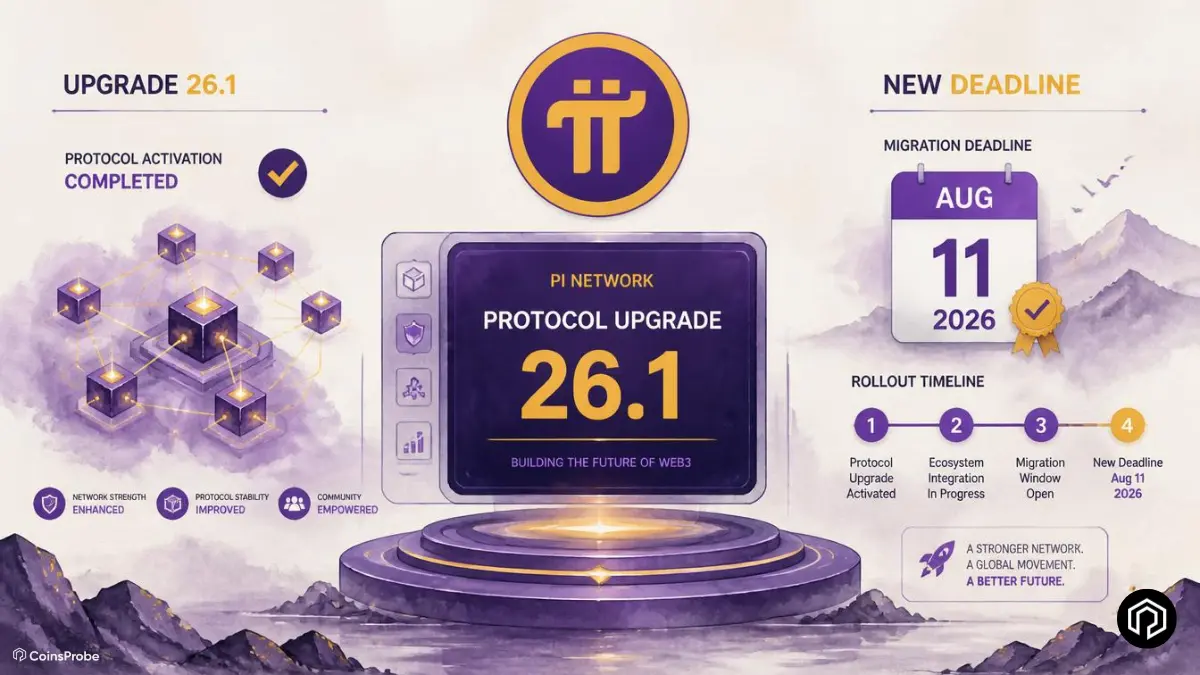

- Pi Network Protocol 26.1 rollout is underway, with a mandatory August 11, 2026 deadline for Mainnet node operators.
- The upgrade includes internal data migrations, with less than five minutes of expected downtime for most operators.
- Protocol 27.0 is not ready yet; node operators should wait for further instructions.
- v26.1 continues Pi’s infrastructure upgrades following Protocol 25’s BN254 and Poseidon cryptography improvements.
Pi Network’s sequential protocol upgrade programme continues to advance — and with the August 11 deadline now confirmed for Protocol v26.1, node operators who have not yet begun the upgrade process need to act now rather than waiting for the deadline to approach.
Where v26.1 Fits in the Upgrade Sequence
Pi’s blockchain upgrade strategy has been methodical and sequential throughout 2026 — advancing step-by-step through a defined upgrade path rather than making large version jumps. As we covered in our Protocol v25 upgrade and Dark Mode article — the v25 upgrade on July 22 introduced BN254 cryptography and Poseidon hashing, expanding the network’s capacity for zero-knowledge application development.
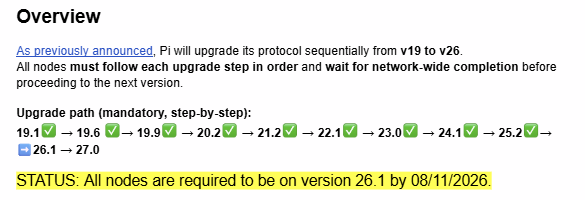
The full mandatory upgrade sequence:
Current status as of late July 2026:
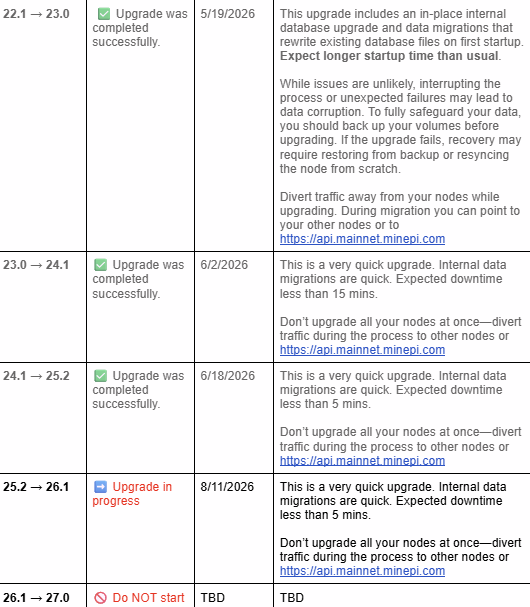
The sequential nature of this upgrade path is non-negotiable — nodes must complete each step in order and wait for network-wide completion before advancing. Jumping ahead to a higher version is not permitted and risks network disconnection.
What Protocol v26.1 Involves
Protocol 26.1 is characterised by the Pi Core Team as a relatively straightforward upgrade — primarily involving internal data migrations rather than the kind of major cryptographic or consensus changes that prior versions introduced.
Expected downtime for most operators: less than five minutes — making this one of the less disruptive upgrades in the current sequence and reducing the operational burden on node operators compared to more complex prior versions.
What this upgrade builds on:
Protocol 26.1 continues the infrastructure strengthening that Protocol v25 established — where BN254 elliptic curve cryptography and Poseidon hashing were introduced to enable privacy-preserving zero-knowledge applications and more efficient smart contracts. As we covered in our Protocol v25 article — these additions gave Pi developers the cryptographic primitives needed for genuine ZK application development for the first time.
Pi’s blockchain is built on the open-source Stellar Core codebase — with the Core Team continuously adapting and extending it for Pi’s specific requirements. Each version in the upgrade sequence strengthens network infrastructure, improves security, stability, and scalability, and lays a progressively more capable foundation for the developer ecosystem and future Mainnet applications.
Step-by-Step Upgrade Instructions
The upgrade process varies depending on how you run your node. Here is what each operator type needs to know:
Pi Desktop (Windows / macOS):
Upgrades are typically handled automatically when the node application is started — you should see the upgrade applied without manual intervention. Verify the node shows as running on Protocol 26.1 after restart before considering the process complete.
Pi Linux Node CLI:
Auto-update is the recommended approach. If auto-update is enabled, the system will handle the migration. If auto-update has been disabled, run the appropriate manual update command for your setup and monitor the node status until it shows as “Synced” — do not assume completion until the sync status is confirmed.
Self-Managed Docker:
Manual intervention is required. Operators must:
- Pull the latest 26.1 Docker image:
pinetwork/pi-node-docker:organization_mainnet-v1.0-p26.1.0(or equivalent) - Update the Docker container configuration to reference the new image
- Restart the container
- Verify the node is syncing correctly after restart
Verification step (all setups):
Check the ingest_latest_ledger value on your node against the mainnet API at https://api.mainnet.minepi.com to confirm your node is on the correct ledger and properly synced to the network following the upgrade.
Full technical details, release notes, and verification steps are available in the official Pi Node Protocol Upgrade Guide.
Critical Operational Warning — Do Not Upgrade All Nodes Simultaneously
Pi Network’s official guidance includes a specific and important warning for operators running multiple nodes:
Do not upgrade all your nodes at the same time.
During the upgrade process — even with the sub-five-minute expected downtime — having all nodes simultaneously offline creates a gap in the services those nodes provide. Instead:
Divert traffic to other nodes or to the official endpoint https://api.mainnet.minepi.com during the upgrade window. Upgrade nodes sequentially — complete and verify one node before beginning the next. This maintains network participation continuity throughout the upgrade process.
The August 11 Deadline — Why Acting Now Matters
The August 11, 2026 deadline is a hard deadline — not a recommendation. Nodes that have not completed the upgrade to Protocol 26.1 by this date will be at risk of disconnection from the Mainnet network until the upgrade is completed.
For most operators, the upgrade itself takes less than five minutes. The risk is not the upgrade process — it is delay creating a situation where you are inadvertently disconnected from Mainnet during a period when the network has already moved forward.
As we covered in our Protocol v25.2 June 18 deadline article — the consequences of missing upgrade deadlines in the sequential Pi protocol process are straightforward: disconnection from the active network until the upgrade is completed. There is no grace period built into the network-level enforcement.
The recommended approach: complete the upgrade well ahead of August 11 — not on August 11 itself. This allows time to troubleshoot any unexpected issues without the pressure of an imminent deadline.
What’s Next — Protocol 27.0 on the Horizon
Protocol 27.0 has already appeared on Pi Network’s upgrade roadmap — confirming that the sequential upgrade sequence continues beyond the current v26.1 step. However, the Core Team’s guidance is explicit:
Do not start the 27.0 upgrade until further notice.
The timing and specific requirements for 27.0 will be communicated separately. Operators who have completed 26.1 should monitor official Pi Network channels for the 27.0 announcement rather than attempting to advance ahead of the official guidance.
Other developments the community is watching alongside the protocol upgrades:
The Mainnet Launchpad and DEX feature development — building on the SLICE test token distribution and liquidity pool mechanics tested on Testnet. Accelerated KYC processing and Mainnet migration support — the ongoing friction point for many Pioneers that protocol upgrades do not directly address. Broader smart contract adoption — where Protocol v25’s ZK cryptography additions have laid the technical foundation. Additional ecosystem tools building on the Pi2Day 2026 releases of SoloHost, Pi Sign-in, and PiVerify.
Bottom Line
Protocol v26.1 is a mandatory upgrade with a clear August 11 deadline — and at less than five minutes of expected downtime for most operators, the upgrade itself is one of the least burdensome in the current sequence. The barrier to completion is low. The consequence of missing the deadline — Mainnet disconnection — is significant.
Node operators should complete the upgrade now rather than waiting for the deadline, follow the sequential process appropriate for their setup (Desktop, Linux CLI, or Docker), verify sync status after completion, and monitor official channels for the Protocol 27.0 announcement.
Pi Network’s systematic protocol upgrade programme continues to strengthen the infrastructure that future Mainnet applications — including the Launchpad DEX, ZK applications, and broader smart contract ecosystem — will depend on. Each upgrade builds the foundation. v26.1 is the current step in that process.
Frequently Asked Questions (FAQ)
What is the Pi Network Protocol v26.1 upgrade?
The next mandatory step in Pi’s sequential protocol upgrade sequence — following the completion of v25.2 (June 18) and v25 features (July) — requiring all Mainnet node operators to upgrade by August 11, 2026 to remain connected to the network.
How long does the Protocol v26.1 upgrade take?
For most operators, the upgrade involves internal data migrations with expected downtime of less than five minutes — making it one of the least disruptive upgrades in the current sequence.
What is the full upgrade sequence for Pi Network?
19.1 → 19.6 → 19.9 → 20.2 → 21.2 → 22.1 → 23.0 → 24.1 → 25.2 → 26.1 → 27.0 — nodes must complete each step in order and cannot skip ahead.
Can I upgrade all my nodes at the same time?
No — the official guidance explicitly warns against upgrading all nodes simultaneously. Upgrade sequentially, diverting traffic to other nodes or the official endpoint https://api.mainnet.minepi.com during each upgrade window.
When does Protocol 27.0 start?
Protocol 27.0 has appeared on the roadmap but operators are explicitly instructed not to start the 27.0 upgrade until further notice from the Core Team. Monitor official Pi Network channels for the announcement.
The opinions and market insights shared on CoinsProbe represent the views of individual authors based on prevailing market conditions at the time of publication. Cryptocurrency investments carry significant risk and volatility. Readers are encouraged to conduct their own research and seek professional financial advice before making investment decisions. CoinsProbe and its contributors do not accept responsibility for financial losses or decisions made based on published content.
CoinsProbe may publish sponsored articles, affiliate links, or promotional collaborations. All sponsored material is clearly labeled to maintain transparency with our audience. Our editorial decisions remain fully independent, and advertising partnerships do not influence reviews, rankings, or published opinions.
Since 2023, CoinsProbe has delivered reliable insights on cryptocurrency, blockchain, and digital assets. Our content is created by experienced researchers and analysts who follow strict editorial standards focused on accuracy, transparency, and credibility. Every article is carefully reviewed and verified using trusted sources and current market data. We provide unbiased analysis and timely updates covering everything from emerging crypto projects to major industry developments.