



- Michael Saylor addressed the 32 BTC sale controversy at BTC Prague — stating bluntly: "I told you not to sell Bitcoin. I never said the company wouldn't sell."
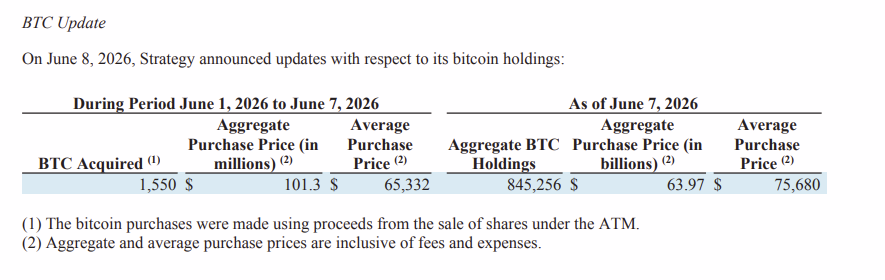
- Strategy sold 32 BTC (~$2.5M) between May 26–31 to fund preferred stock distributions — then bought back 1,550 BTC (~$101M) days later — a 48x larger repurchase that brought total holdings to 845,256 BTC.
- The net result of the entire sequence: Strategy is 1,518 BTC heavier than before the controversy began — at an average repurchase price of $65,332 — significantly below the original sale price of $77,135.
- Saylor's clarification draws a clear line: the "never sell" mantra was always personal advice for individual investors — not a binding corporate commitment for a public company with fiduciary obligations to preferred shareholders.
The quote that went viral at BTC Prague on June 12, 2026 was not a defence. It was a correction:
“I told you not to sell Bitcoin. I never said the company wouldn’t sell. Anyone who has listened to our earnings calls, read our filings, or has a functioning brain knows this. We have always been very clear: if needed, we will sell Bitcoin.”
Delivered with characteristic Saylor confidence — the comment landed like a cold bucket of water on the narrative that had been building since Strategy’s 32 BTC sale made headlines in early June. For weeks, commentators had been framing the sale as a “collapse” of the “never sell” philosophy. Saylor’s response at BTC Prague made clear he viewed the entire controversy as a misreading of a distinction he considers obvious.
The Sale That Sparked Outrage — In Perspective
Between May 26 and May 31, 2026 — Strategy sold 32 BTC for approximately $2.5 million at an average price of $77,135 per coin. The proceeds were used specifically to fund distributions on the company’s preferred stock.
To put the scale in perspective:
| Metric | Data |
|---|---|
| BTC sold | 32 BTC |
| Proceeds | ~$2.5 million |
| Average sale price | $77,135 |
| Total BTC held at time | 843,706 BTC |
| % of total holdings sold | 0.0038% |
As we covered in our Strategy 32 BTC sale article — the transaction was immaterial in absolute terms. What made it significant was not the size but the symbolism: it ended a 41-month consecutive accumulation streak and triggered the “Saylor is selling” narrative that dominated crypto Twitter for days.
What happened next made the original controversy look even more misplaced.
The 48x Buyback That Followed
Days after the 32 BTC sale — Strategy announced the purchase of 1,550 BTC for approximately $101 million at an average price of $65,332 per coin.
| Metric | Data |
|---|---|
| BTC purchased | 1,550 BTC |
| Total cost | ~$101 million |
| Average purchase price | $65,332 |
| New total holdings | 845,256 BTC |
| Net BTC change | +1,518 BTC |
| Buyback ratio vs sale | ~48x |
The arithmetic of the full sequence is straightforward: Strategy sold 32 BTC at $77,135 and bought back 1,550 BTC at $65,332 — ending the sequence with 1,518 more Bitcoin than it started with, acquired at a price significantly below where it sold.
For those following Strategy’s accumulation strategy rather than the narrative — this is exactly the kind of tactical treasury management Saylor has always described: selling a negligible amount to meet a specific obligation and immediately redeploying capital into larger Bitcoin purchases at lower prices.
As we covered in our Saylor AI capital absorption article — Saylor has consistently framed Strategy’s Bitcoin position as dynamic treasury management rather than a static “never touch” vault. The BTC Prague comments are the clearest articulation of that distinction yet.
Saylor’s Argument — Personal Advice vs Corporate Obligation
The core of Saylor’s BTC Prague clarification draws a distinction that his critics largely ignored:
“I told you not to sell Bitcoin” — This is personal investment advice directed at individual Bitcoin holders. Saylor has consistently argued that for individuals, selling Bitcoin is a mistake because it means accepting inferior assets or fiat in exchange for the world’s premier store of value.
“I never said the company wouldn’t sell” — Strategy is a publicly listed company with SEC filings, earnings calls, preferred shareholders, and fiduciary obligations. Its Bitcoin treasury is a corporate asset — not a personal holding — and the company has disclosed in every relevant filing that it retains the right to sell Bitcoin for corporate purposes when necessary.
The distinction is real and had been documented publicly long before the 32 BTC controversy. As Saylor noted — anyone who had read Strategy’s SEC filings or attended its earnings calls would have known this. The company has disclosed the framework consistently. The media and social media narrative chose to ignore it.
Saylor’s dismissal of the criticism at BTC Prague was pointed: “Anyone who has listened to our earnings calls, read our filings, or has a functioning brain knows this.” Not a gentle correction — but a characteristically blunt one.
Why the Backlash Happened Anyway
Understanding why the controversy generated the reaction it did requires acknowledging how effectively Saylor had shaped the public perception of Strategy’s Bitcoin strategy over five years.
The “never sell” message had been so consistently and forcefully communicated — through viral social media posts, conference appearances, and media interviews — that many followers absorbed it as an absolute commitment rather than personal advice. When the 32 BTC sale was disclosed, it felt like a betrayal of a promise — even though the promise had technically never been made in the corporate context.
Some critics framed it as applying different rules for institutions versus retail investors — arguing that Saylor had built a narrative that encouraged individual holders to never sell while retaining corporate flexibility to do exactly that. The criticism is understandable emotionally even if it misreads the technical reality.
Others — particularly in Bitcoin-native communities — called the sale pragmatic and transparent, noting that Strategy has always been a public company first and a Bitcoin proxy second.
What the Numbers Say About Strategy’s Conviction
Regardless of the narrative debate — the numbers present a clear picture of Strategy’s actual Bitcoin positioning:
| Milestone | Data |
|---|---|
| Total BTC held | 845,256 BTC |
| % of total Bitcoin supply | ~4% |
| Average cost basis | ~$63.86 billion total |
| BTC sold in 41 months | 32 BTC |
| BTC bought back immediately | 1,550 BTC |
| Current unrealised position | Significant at $62K+ BTC |
41 months. One sale of 32 BTC to meet a preferred stock obligation. Followed immediately by the purchase of 1,550 BTC at a lower price. That is the actual record — and it is not the record of a company losing conviction in its core thesis.
As we covered in our Strategy $12.27B unrealised loss article — Saylor has maintained his conviction through the deepest paper loss in Strategy’s history. His comments at BTC Prague are consistent with that pattern — not a reversal of it.
The Broader Context — Corporate Bitcoin Strategy Is Evolving
The Strategy episode is also a window into how corporate Bitcoin treasury management is maturing as an institutional practice.
In 2020 when Strategy began accumulating — the “we will never sell” framing was a powerful signal to the market about conviction. In 2026 — with Strategy holding 845,256 BTC, preferred stock obligations, convertible notes, and a complex capital structure — the reality is necessarily more nuanced.
As the corporate Bitcoin treasury space expands — with more companies adopting Bitcoin as a primary reserve asset — the distinction between long-term strategic conviction and short-term tactical flexibility will become increasingly important. Strategy’s episode is a preview of the governance and communication challenges that every corporate Bitcoin holder will eventually face.
Bottom Line
Michael Saylor’s BTC Prague statement is not a reversal — it is a clarification of something he argues was always true. Strategy sold 32 BTC to fund a preferred stock obligation. It then bought 1,550 BTC at a lower price. The net result is 1,518 more Bitcoin at a better average cost.
The “never sell” advice has always been directed at individual investors making personal investment decisions. Strategy as a public company has always retained — and disclosed — the right to manage its Bitcoin treasury tactically when corporate obligations require it.
The controversy said more about how effectively Saylor had shaped the narrative over five years than it did about any actual change in Strategy’s Bitcoin philosophy. The numbers — 845,256 BTC and counting — tell the real story.
Frequently Asked Questions (FAQ)
Why did Strategy sell 32 Bitcoin?
Strategy sold 32 BTC (worth ~$2.5 million) between May 26–31, 2026, to fund distributions on its preferred stock. This was the company’s first Bitcoin sale since December 2022.
What did Michael Saylor say about the Bitcoin sale?
At BTC Prague, Saylor clarified: “I told you not to sell Bitcoin. I never said the company wouldn’t sell.” He emphasized that the “never sell” advice was for individuals, not for Strategy as a public company with fiduciary duties.
How much Bitcoin does Strategy own now?
As of June 8, 2026, Strategy holds 845,256 BTC after purchasing 1,550 BTC for ~$101 million shortly after the small sale.
Did Strategy break the “Never Sell Bitcoin” rule?
According to Saylor, no. He maintains the “never sell” mantra is personal advice for retail investors. The company has always stated in filings that it may sell Bitcoin if needed for corporate purposes.
Will Strategy sell more Bitcoin in the future?
Saylor confirmed the company may sell small amounts when necessary (e.g., for preferred stock obligations), but its overall strategy remains strongly Bitcoin-focused and accumulation-oriented.
How many Bitcoin has Strategy bought?
Strategy continues its aggressive Bitcoin buying strategy. The latest 1,550 BTC purchase in June 2026 added to its already record-breaking holdings of over 845,000 BTC.
The opinions and market insights shared on CoinsProbe represent the views of individual authors based on prevailing market conditions at the time of publication. Cryptocurrency investments carry significant risk and volatility. Readers are encouraged to conduct their own research and seek professional financial advice before making investment decisions. CoinsProbe and its contributors do not accept responsibility for financial losses or decisions made based on published content.
CoinsProbe may publish sponsored articles, affiliate links, or promotional collaborations. All sponsored material is clearly labeled to maintain transparency with our audience. Our editorial decisions remain fully independent, and advertising partnerships do not influence reviews, rankings, or published opinions.
Since 2023, CoinsProbe has delivered reliable insights on cryptocurrency, blockchain, and digital assets. Our content is created by experienced researchers and analysts who follow strict editorial standards focused on accuracy, transparency, and credibility. Every article is carefully reviewed and verified using trusted sources and current market data. We provide unbiased analysis and timely updates covering everything from emerging crypto projects to major industry developments.