


- Bitcoin is trading at $61,100 — down -30.18% year-to-date and more than 50% below its $126,198 all-time high — with a market cap of approximately $1.224 trillion.
- Strategy holds 843,706 BTC at an average cost of $75,699 — currently sitting on approximately $12.27 billion in unrealized losses — one of the largest corporate paper losses in Bitcoin's history.
- Michael Saylor responded publicly today — attributing the pressure to AI infrastructure absorbing capital at historic scale — and arguing this is temporary and actually strengthens Bitcoin's long-term case.
- Strategy remains the largest corporate Bitcoin holder — controlling approximately 4% of total BTC supply — with no meaningful selling beyond the symbolic 32 BTC disposal in early June.
Bitcoin is under sustained pressure — trading at $61,100 after a -1.21% 24-hour decline. The asset is now -30.18% year-to-date and has lost more than 50% from its December 2025 all-time high of $126,198 — with a market cap of approximately $1.224 trillion.
As we covered in our Bitcoin 200 SMA bearish fractal and our Bitcoin MVRV support analysis, the repeated failure to reclaim the 200-day SMA at $82,000 has been the defining technical fact of 2026 — and the resulting downtrend has created the conditions for Strategy’s current paper loss.

Strategy’s $12.27B Unrealized Loss
Strategy — the company led by Executive Chairman Michael Saylor — is now carrying one of the largest unrealized corporate losses in Bitcoin’s history.

The $12.27 billion figure adds to earlier quarterly mark-to-market hits reported throughout 2026. Strategy accumulated its position using debt, equity raises, and convertible notes — a leveraged approach that amplifies both upside and downside relative to Bitcoin’s price movement.
The critical distinction: these are unrealized losses. Strategy has not sold — and every public statement from Saylor indicates that is not the plan. As we covered in our Strategy 32 BTC sale article, the only disposal on record is a negligible 32 BTC in early June — essentially immaterial against 843,706 total holdings.
What Saylor Said — The Full Thesis
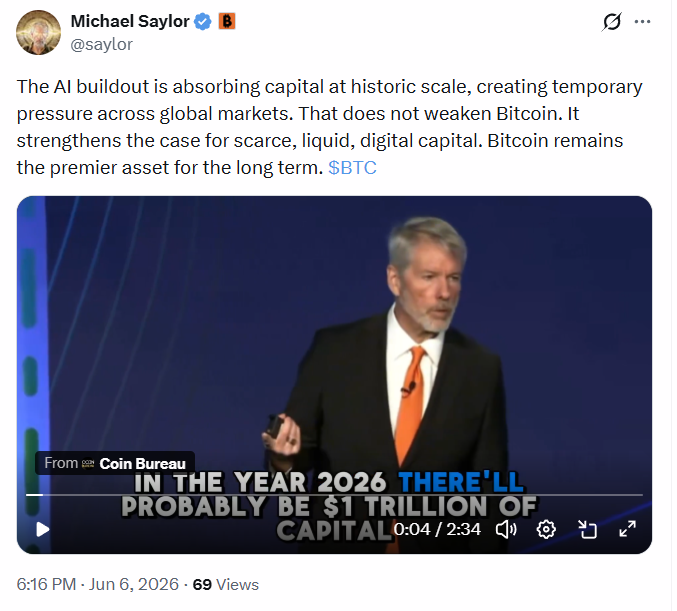
Rather than staying quiet as the paper losses mounted — Saylor posted publicly on X today with a direct and unambiguous response:
“The AI buildout is absorbing capital at historic scale, creating temporary pressure across global markets. That does not weaken Bitcoin. It strengthens the case for scarce, liquid, digital capital. Bitcoin remains the premier asset for the long term. $BTC”
The post — accompanied by a video message — breaks into three distinct arguments worth examining:
“The AI buildout is absorbing capital at historic scale”
The global AI infrastructure buildout in 2026 represents one of the largest capital allocation events in technology history. Data centres, GPU clusters, power infrastructure, semiconductor capacity — the investment required to sustain frontier AI is measured in hundreds of billions annually. Institutional capital that might otherwise flow into Bitcoin is being redirected into AI infrastructure — creating real macro pressure across risk assets globally. The third-highest Bitcoin ETF weekly outflows on record provides direct empirical support for this capital rotation thesis.
“That does not weaken Bitcoin. It strengthens the case”
The counterintuitive turn. As AI absorbs capital and demonstrates extraordinary productivity gains — the question of how to store and preserve that value becomes more urgent. Bitcoin’s fixed supply and sovereign-grade liquidity make it the natural answer. The more powerful AI becomes — the more valuable becomes an asset that cannot be inflated or replicated. AI does not diminish Bitcoin’s scarcity premium — it potentially amplifies it.
“Bitcoin remains the premier asset for the long term”
The same conclusion Saylor has reached at every prior Bitcoin low — in 2020 below $12,000, in 2022 at the bear market bottom, and now in 2026 with the largest paper loss in Strategy’s history. The consistency of the message across every point of maximum doubt is either the defining feature of conviction investing — or its greatest risk.
The Risk Saylor Does Not Address
Saylor’s post is conviction framing — not risk disclosure. What he does not say matters:
The debt structure — Strategy’s debt obligations do not pause because AI is absorbing capital. If Bitcoin remains at $61,100 for an extended period — the gap between the $75,699 cost basis and current price creates real balance sheet pressure regardless of the long-term thesis.
The timing question — “Temporary” could mean months or years. Strategy’s debt maturities are on a fixed schedule. The thesis needs to be right within a specific timeframe — not just eventually.
Bottom Line
Saylor’s response to $12.27 billion in unrealized losses is the same conviction in different market conditions — and his AI capital absorption framework provides the most coherent macro explanation for Bitcoin’s current pressure from any institutional participant in 2026.
The thesis: AI is creating temporary pressure that will eventually amplify demand for scarce digital assets. Bitcoin is the premier beneficiary of that demand — not the victim of the current transition.
Whether “temporary” resolves within Strategy’s debt structure timeline is the question that defines this chapter of the most audacious corporate Bitcoin bet in history.
Frequently Asked Questions (FAQ)
How much is Strategy losing on its Bitcoin position?
Strategy holds 843,706 BTC at ~$75,699 average cost. With BTC at $61,100 — the unrealized loss is approximately $12.27 billion.
What did Michael Saylor say in response to back $BTC?
He argued that AI infrastructure is absorbing capital at historic scale — creating temporary macro pressure — and that this actually strengthens Bitcoin’s case as scarce digital capital rather than weakening it.
Has Strategy sold any Bitcoin?
Only a negligible 32 BTC in early June — immaterial against 843,706 total holdings. No meaningful selling has occurred.
The opinions and market insights shared on CoinsProbe represent the views of individual authors based on prevailing market conditions at the time of publication. Cryptocurrency investments carry significant risk and volatility. Readers are encouraged to conduct their own research and seek professional financial advice before making investment decisions. CoinsProbe and its contributors do not accept responsibility for financial losses or decisions made based on published content.
CoinsProbe may publish sponsored articles, affiliate links, or promotional collaborations. All sponsored material is clearly labeled to maintain transparency with our audience. Our editorial decisions remain fully independent, and advertising partnerships do not influence reviews, rankings, or published opinions.
Since 2023, CoinsProbe has delivered reliable insights on cryptocurrency, blockchain, and digital assets. Our content is created by experienced researchers and analysts who follow strict editorial standards focused on accuracy, transparency, and credibility. Every article is carefully reviewed and verified using trusted sources and current market data. We provide unbiased analysis and timely updates covering everything from emerging crypto projects to major industry developments.