

- SEC and CFTC classify XRP, HBAR, and 14 other cryptos as digital commodities.
- New framework confirms many crypto assets are not securities.
- Move could boost institutional adoption and regulatory clarity.
In a major development for the crypto industry, the U.S. Securities and Exchange Commission (SEC) and the Commodity Futures Trading Commission (CFTC) have jointly issued new guidance that officially classifies XRP and Hedera’s HBAR — along with several top cryptocurrencies — as digital commodities.
The move marks a significant step toward long-awaited regulatory clarity in the United States and could have far-reaching implications for the broader market.
TODAY 🚨: The Commission issued an interpretation that clarifies the application of federal securities laws to crypto assets.
— U.S. Securities and Exchange Commission (@SECGov) March 17, 2026
This is a major step to provide greater clarity regarding the Commission’s treatment of crypto assets.
Read the release here: https://t.co/DDykVLHZQI pic.twitter.com/zbLFS2JH6g
A Clear Framework for Crypto Assets
The guidance, released on March 17, 2026, outlines a structured approach to classifying crypto assets into five categories:
- Digital commodities
- Digital collectibles
- Digital tools
- Stablecoins
- Digital securities
Among these, digital commodities are explicitly not considered securities, which is a key distinction for both investors and institutions.
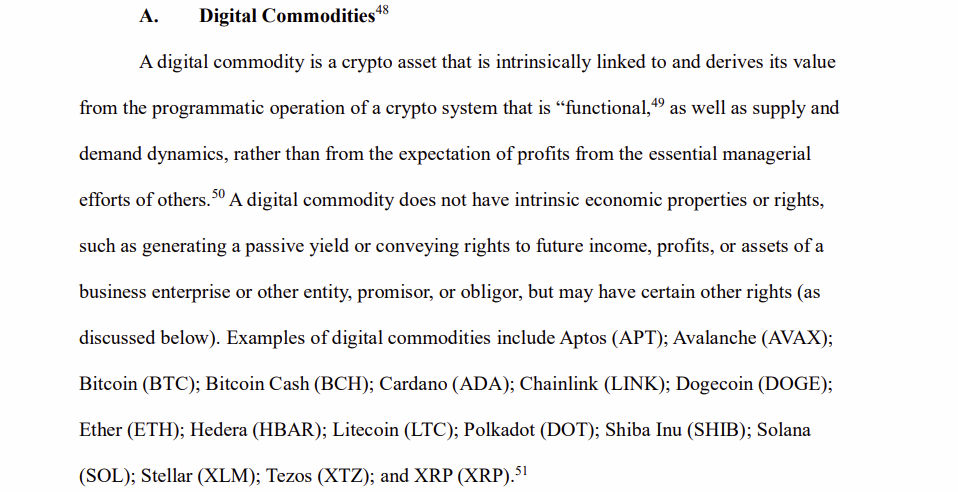
According to the regulators, a digital commodity is defined as a crypto asset whose value comes from the functionality of its underlying network and market dynamics — rather than relying on the efforts of a central entity to generate profits.
16 Major Cryptos Fall Under Digital Commodities
The guidance identifies 16 leading cryptocurrencies as digital commodities, including:
- Bitcoin (BTC)
- Ethereum (ETH)
- XRP (XRP)
- Hedera (HBAR)
- Solana (SOL)
- Cardano (ADA)
- Avalanche (AVAX)
- Polkadot (DOT)
- Chainlink (LINK)
- Dogecoin (DOGE)
- Shiba Inu (SHIB)
- Litecoin (LTC)
- Stellar (XLM)
- Tezos (XTZ)
- Aptos (APT)
- Bitcoin Cash (BCH)
This classification removes a major layer of uncertainty, especially for XRP, which had been at the center of a long-running legal battle involving Ripple Labs.
It also reinforces the positioning of Hedera’s HBAR as part of a functional, enterprise-focused blockchain ecosystem.
What Activities Are Now Considered Safe?
The guidance also brings clarity to common crypto activities.
According to the release, actions such as:
- Mining on Proof-of-Work networks
- Staking on Proof-of-Stake chains
- Token wrapping
- Certain types of airdrops
generally do not qualify as securities transactions, as long as they meet the outlined conditions.
This is a big shift from the previous uncertainty, where similar activities often existed in a legal gray area.
Industry Reaction and Market Impact
The announcement has been widely seen as a turning point.
SEC Chair Paul Atkins described the framework as providing “clear lines in clear terms,” while the joint statement emphasized that most crypto assets are not securities.
After more than a decade of uncertainty, this interpretation will provide market participants with a clear understanding of how the SEC treats crypto assets under federal securities laws.
— Paul Atkins (@SECPaulSAtkins) March 17, 2026
This is what regulatory agencies are supposed to do: draw clear lines in clear terms. https://t.co/wij5cA7N2i
The market reaction was relatively calm in the short term, with some of the listed assets posting modest gains. However, analysts believe the long-term impact could be far more significant.
Key potential benefits include:
- Increased institutional adoption
- Easier path toward crypto ETFs
- Improved banking relationships
- Greater confidence for developers and builders
What’s Next?
While the guidance does not introduce new laws, it represents a crucial step toward broader regulatory reform in the U.S.
It is also being viewed as groundwork for future legislation, including the much-anticipated Clarity Act, which could further define the legal landscape for digital assets.
More importantly, this move signals a shift away from the earlier “regulation by enforcement” approach toward a more structured and innovation-friendly environment.
For now, the classification of major assets like XRP and HBAR as digital commodities could mark the beginning of a new phase for the crypto market — one driven by clearer rules and stronger institutional confidence.
The full interpretive release is publicly available on the SEC website:
https://www.sec.gov/files/rules/interp/2026/33-11412.pdf
FAQ
What does it mean that XRP and HBAR are classified as digital commodities?
It means XRP and HBAR are not considered securities under current U.S. regulatory guidance. Instead, their value is seen as coming from network utility and market demand, not from a central entity promising profits.
Which cryptocurrencies are classified as digital commodities?
The SEC and CFTC listed 16 assets, including Bitcoin, Ethereum, XRP, HBAR, Solana, Cardano, Dogecoin, Chainlink, Avalanche, Polkadot, and others.
Does this mean crypto is now fully regulated in the U.S.?
Not completely. This guidance provides clarity, but it is not a law. Further legislation, such as the proposed Clarity Act, is still needed for a full regulatory framework.
Are staking and mining considered securities transactions?
No. According to the guidance, activities like staking, mining, token wrapping, and certain airdrops are generally not considered securities transactions, as long as they follow the outlined conditions.
Why is this important for XRP?
XRP has faced years of legal uncertainty due to the SEC’s case against Ripple. This classification helps remove a major regulatory overhang, potentially boosting investor confidence.
What is the difference between securities and commodities in crypto?
Securities: Value depends on a team or company managing the project (regulated by the U.S. Securities and Exchange Commission).
Commodities: Value comes from market demand and network use, not a central authority (regulated by the Commodity Futures Trading Commission).
The opinions and market insights shared on CoinsProbe represent the views of individual authors based on prevailing market conditions at the time of publication. Cryptocurrency investments carry significant risk and volatility. Readers are encouraged to conduct their own research and seek professional financial advice before making investment decisions. CoinsProbe and its contributors do not accept responsibility for financial losses or decisions made based on published content.
CoinsProbe may publish sponsored articles, affiliate links, or promotional collaborations. All sponsored material is clearly labeled to maintain transparency with our audience. Our editorial decisions remain fully independent, and advertising partnerships do not influence reviews, rankings, or published opinions.
Since 2023, CoinsProbe has delivered reliable insights on cryptocurrency, blockchain, and digital assets. Our content is created by experienced researchers and analysts who follow strict editorial standards focused on accuracy, transparency, and credibility. Every article is carefully reviewed and verified using trusted sources and current market data. We provide unbiased analysis and timely updates covering everything from emerging crypto projects to major industry developments.