

- 60% of crypto investors plan to buy more in the next 12 months — highest of any asset class per Charles Schwab survey
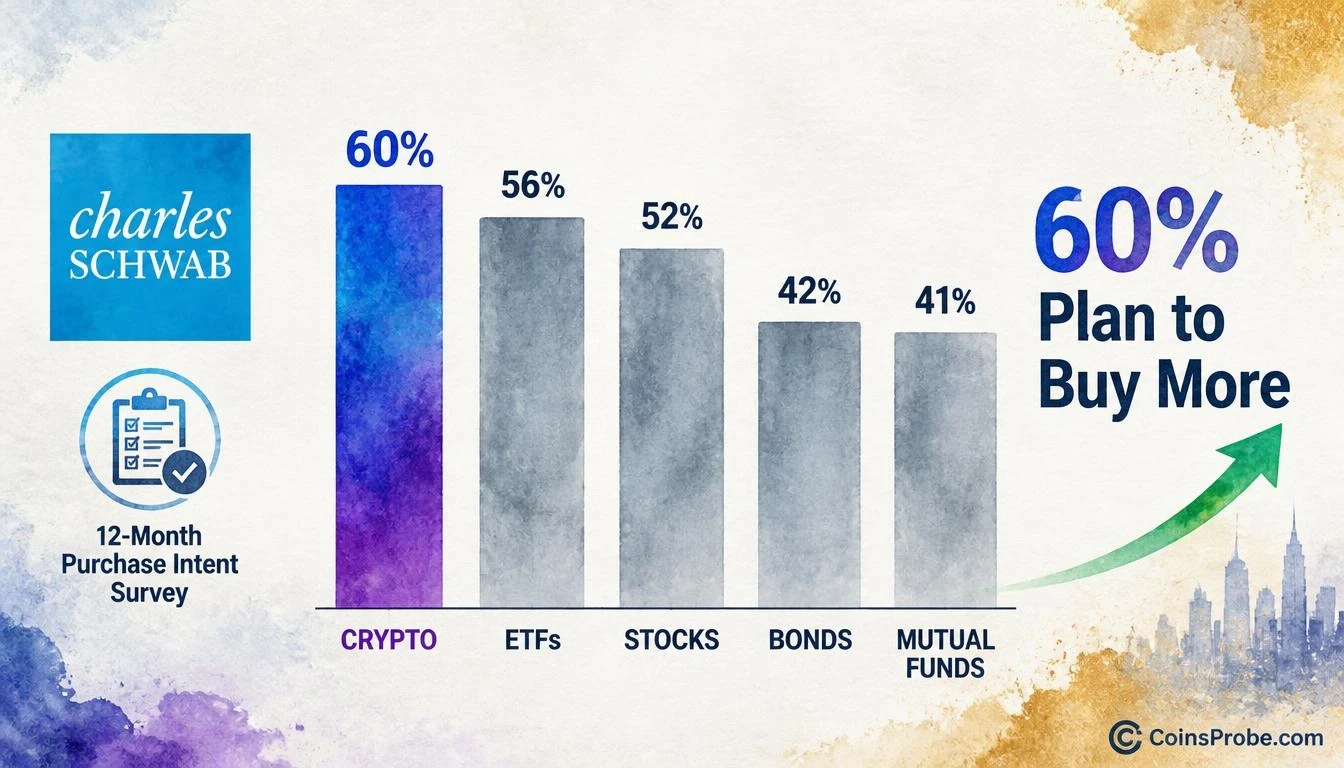
- Crypto's 60% purchase intent tops ETFs (56%), stocks (52%), bonds (42%), and mutual funds (41%) by clear margin
- Data was recorded during acknowledged 2026 market volatility — conventional theory would predict capital flight, not accumulation intent
Despite persistent price volatility in 2026, the investor base behind crypto is not retreating — it is doubling down. A Charles Schwab survey cited by analyst @alicharts on November 19, 2026, reveals that 60% of crypto investors plan to increase their exposure over the next 12 months — a figure that outpaces every traditional asset class tracked in the same survey.
The numbers are unambiguous. ETFs came in at 56% planned purchase intent, stocks at 52%, bonds at 42%, and mutual funds at 41%. Crypto leads the entire field by a four-percentage-point margin over the second-placed category — and by nearly 20 points over the bottom of the table.

Crypto Leads Every Asset Class in 12-Month Purchase Intent
The Charles Schwab survey captures forward-looking behavior: what investors say they plan to buy over the coming year. Among all five asset classes surveyed — crypto, ETFs, stocks, bonds, and mutual funds — crypto recorded the highest purchase intent at 60%. The descending order is sharp and unambiguous:
| Asset Class | Planned Purchase Intent (12 Months) |
|---|---|
| Crypto | 60% |
| ETFs | 56% |
| Stocks | 52% |
| Bonds | 42% |
| Mutual Funds | 41% |
Source: Charles Schwab survey, via @alicharts (X)
What makes this finding structurally significant is the context in which it was recorded. The 2026 crypto market has seen sharp swings — a point the analyst explicitly acknowledges in the post. Standard asset allocation theory would predict capital flight from the most volatile category during turbulent periods. The data shows the opposite: crypto sits at the top of forward purchase intent while bonds and mutual funds — the conventional safe havens — are at the bottom.
What the Survey Measures — and What It Doesn’t
Survey data captures stated intent, not executed trades. A 60% planning figure means 60% of respondents in the crypto investor cohort said they intend to buy more within the next 12 months — it does not confirm they have already purchased, nor does it specify the size of planned allocations. Intent can shift if macro conditions deteriorate significantly, as readers of our earlier coverage of Bitcoin’s systemic 22% drop and Bitcoin’s $1.1B leverage flush will recognize.
What the data does confirm with precision: at the moment this survey was conducted, investor intent tilted more decisively toward crypto than toward any conventional financial instrument — including ETFs, which have been the dominant institutional entry point in this cycle. That is not a marginal difference. It is a 4-point gap at the top of the table and a 19-point gap against mutual funds at the bottom.
Why This Reading Matters Beyond Price
Price action reflects current supply and demand. Survey-based purchase intent reflects future demand structure. When 60% of an existing crypto investor base states plans to add exposure over the next 12 months — during a period of acknowledged volatility — it signals that the conviction holding the asset class is not eroding at the retail level.
Compare this to bonds at 42% and mutual funds at 41%. These are the instruments typically associated with capital preservation during uncertain periods. Their lower ranking in forward purchase intent, while crypto leads, suggests investors are not rotating out of risk assets into safety in the way that classic volatility narratives would predict.
This dynamic is relevant for understanding broader market structure. Even in cycles where shorter-term sentiment data like funding rates and open interest fluctuate, long-horizon purchase intent of this magnitude provides a structural demand floor. The data point aligns with the patterns discussed in our broader coverage of retail resilience during dip zones.
The Structural Takeaway
One survey is a data point, not a verdict. But when that data point is sourced from Charles Schwab — one of the largest retail brokerage platforms in the United States — it carries weight beyond anecdotal sentiment. This is not a Twitter poll or crypto-native survey of already-committed enthusiasts. It is a cross-asset comparison against equities, fixed income, and fund products, conducted by a mainstream financial institution.
The result: 60% crypto purchase intent versus 41% for mutual funds. The gap between the most aggressive risk asset and the most conservative traditional vehicle is 19 percentage points — in favor of crypto. That is the number the data produces, and it stands without editorial adjustment.
Watch whether on-chain accumulation data from platforms like Glassnode begins to confirm this stated intent in the months ahead — that is where survey signal becomes market structure.
Frequently Asked Questions
What does the Charles Schwab survey reveal about crypto investor behavior in 2026?
Does high purchase intent in a survey guarantee actual crypto price increases?
Why is crypto leading even traditional safe-haven assets like bonds in purchase intent?
What is the difference between purchase intent data and on-chain accumulation metrics?
Source: Ali Charts · Published by CoinsProbe Markets Desk
The opinions and market insights shared on CoinsProbe represent the views of individual authors based on prevailing market conditions at the time of publication. Cryptocurrency investments carry significant risk and volatility. Readers are encouraged to conduct their own research and seek professional financial advice before making investment decisions. CoinsProbe and its contributors do not accept responsibility for financial losses or decisions made based on published content.
CoinsProbe may publish sponsored articles, affiliate links, or promotional collaborations. All sponsored material is clearly labeled to maintain transparency with our audience. Our editorial decisions remain fully independent, and advertising partnerships do not influence reviews, rankings, or published opinions.
Since 2023, CoinsProbe has delivered reliable insights on cryptocurrency, blockchain, and digital assets. Our content is created by experienced researchers and analysts who follow strict editorial standards focused on accuracy, transparency, and credibility. Every article is carefully reviewed and verified using trusted sources and current market data. We provide unbiased analysis and timely updates covering everything from emerging crypto projects to major industry developments.