
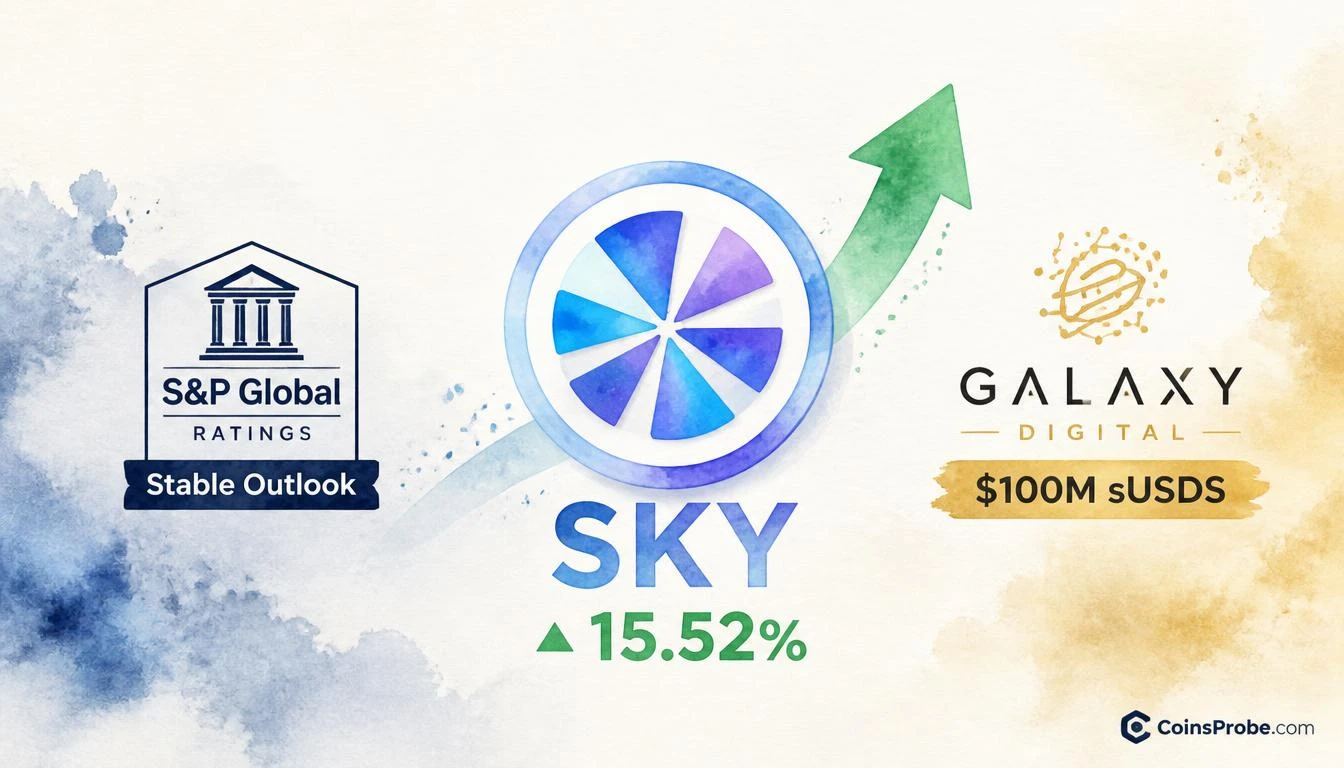

- SKY is up 15.52% to $0.0914 with $39M in 24h volume driven by three simultaneous institutional catalysts
- S&P Global published its Oct 2 annual review of Sky Protocol citing strengthened treasury, raised capital reserves, and stable outlook
- Galaxy Digital holds a $100M sUSDS balance sheet position as institutional collateral confirmed Oct 1
- Sky Protocol carries $6.07B TVL and $27.07M in 30-day fees per DeFiLlama
SKY is trading at $0.0914 — up 15.52% in 24 hours — with a market cap of $2.14 billion and $39 million in 24-hour volume. The move is not speculative noise. Three named institutional catalysts landed within 48 hours, each independently capable of moving a $2 billion protocol. Together, they represent the most concentrated institutional validation Sky Protocol has received in a single 48-hour window.
The primary catalyst is structural: S&P Global Ratings published its annual review of Sky Protocol on October 2, citing strengthened Treasury Management, expanded financial reporting, raised capital reserves, a disciplined capital-allocation framework, and a stable outlook. This is the first independent institutional-grade credit assessment of Sky Protocol in 2026 — and it arrived the same day the token printed its largest single-day gain in months.
Catalyst 1 — S&P Global’s Annual Review: Institutional-Grade Validation
S&P Global Ratings is not a crypto-native platform. It is the same ratings agency that grades sovereign debt, corporate bonds, and structured financial products for the world’s largest capital allocators. When it publishes an annual review of a DeFi protocol and concludes with a stable outlook, the signal it sends to institutional investors is categorical: Sky Protocol meets the disclosure and governance standards that matter to regulated capital.
The specific findings — confirmed by the official @SkyEcosystem post on October 2 — include five distinct improvements: strengthened Treasury Management, expanded financial reporting, raised capital reserves, a disciplined capital-allocation framework, and a stable outlook designation. Each of these maps directly to the concerns that have historically kept institutional allocators away from DeFi protocols: opacity, reserve adequacy, and governance rigor.
This is not a partnership announcement or a listing. It is a third-party institutional verdict — the kind of external validation that does not require trusting the project’s own communications.
Catalyst 2 — Galaxy’s $100M sUSDS Position: Direct Capital Commitment
Galaxy Digital holds a $100 million balance sheet position in sUSDS — Sky Protocol’s yield-bearing stablecoin — deployed as institutional collateral. This was confirmed by the official @SkyEcosystem post on October 1.
The mechanism matters here. sUSDS is not a speculative token. It is a yield-bearing stablecoin instrument. When Galaxy deploys $100 million of it as balance sheet collateral, it is making a structural statement: sUSDS is treated as institutional-grade collateral within Galaxy’s treasury operations. That treatment requires internal risk approval, counterparty vetting, and a determination that the underlying protocol — Sky — meets Galaxy’s standards for capital deployment.
Sky Protocol’s on-chain data context reinforces this. Per DeFiLlama, the protocol carries $6.07 billion in total value locked, generated $908,000 in fees in the last 24 hours, and $27.07 million in fees over the trailing 30 days. Galaxy’s $100 million position represents approximately 1.6% of total protocol TVL — a meaningful but not outsized commitment that signals confidence without overconcentration.
$defillama_table$Catalyst 3 — Singapore Capital Summit, October 6: Institutional Pipeline
Sky Ecosystem is confirmed for The Capital Summit x Asia Stablecoin Conference in Singapore on October 6, with John Conneely presenting on stablecoin growth and institutional adoption. The event runs alongside LayerZero and Spark, per the @SkyEcosystem post from October 1. The conference is positioned as a venue for Asian institutional capital allocation conversations — not a retail event.
The timing is deliberate. An S&P Global stable outlook published on October 2 and a $100 million Galaxy position confirmed on October 1 give Sky Protocol a concrete institutional narrative to present at Singapore four days later. Conference appearances in isolation are soft catalysts. Conference appearances backed by an S&P rating and a nine-figure institutional commitment are a different category of event.
This is the three-catalyst convergence that explains the 15.52% move: a rating, a capital commitment, and a live institutional audience — in that order, within 48 hours.
Why This Is Structurally Different From Standard DeFi Token Rallies
| Standard DeFi Rally Driver | This Rally’s Driver |
|---|---|
| TVL increase from native users | $100M institutional capital from Galaxy |
| Team announcement of roadmap | Third-party S&P Global annual review |
| Retail conference sponsorship | Institutional capital summit with named speakers |
| Protocol-authored progress report | External ratings agency governance assessment |
The distinction is source credibility. Every driver in this rally originates from a named third party — S&P Global or Galaxy Digital — not from Sky Protocol’s own marketing. That separation between self-reported progress and externally validated progress is precisely what institutional capital allocators require before increasing exposure. Investors following institutional DeFi momentum may also note similar dynamics driving Bittensor (TAO)’s current institutional positioning.
Risks That Remain Real
Four risks require explicit acknowledgment. First, regulatory changes impacting stablecoin collateral treatment could directly undermine the value of Galaxy’s sUSDS position and reduce institutional demand for the instrument. Second, if Galaxy unwinds or reduces its $100 million position — for any reason including internal portfolio rebalancing — that reversal would be a named negative catalyst for SKY. Third, the Singapore conference appearance is a pipeline event, not a commitment. Conference attendance without subsequent capital conversion produces no lasting fundamental change. Fourth, a broader crypto market correction would erode the 15.52% gain regardless of protocol fundamentals.
The S&P rating is not a price target. It is a governance assessment. It tells institutional investors that Sky Protocol meets reporting and treasury standards — it does not guarantee continued TVL growth, fee generation, or token price appreciation.
Bullish Scenario
The Singapore conference on October 6 generates additional institutional commitments to sUSDS. New allocators follow Galaxy’s model, treating sUSDS as balance sheet collateral. Protocol TVL expands beyond the current $6.07 billion. The S&P stable outlook is cited in institutional research as a basis for DeFi allocation. SKY sustains gains above current levels as institutional demand compounds.
Bearish Scenario
The conference produces no new capital commitments. Galaxy’s position is later reduced. Regulatory scrutiny of stablecoin collateral classification increases. The 15.52% gain partially or fully reverses as the three catalysts are priced in without follow-through. The S&P rating, while real, does not translate into new institutional inflows within the near term.
Sky Protocol received three simultaneous forms of institutional validation within 48 hours — an S&P Global stable outlook, a $100 million Galaxy balance sheet commitment in sUSDS, and a confirmed speaking slot at a Singapore institutional capital conference on October 6. Those three facts explain the 15.52% move in full. The protocol carries $6.07 billion in TVL and generated $27.07 million in fees over 30 days, providing the underlying fundamentals that made each catalyst credible. What happens next depends entirely on whether the Singapore conference converts institutional attention into capital commitments. Watch Galaxy’s sUSDS position as the live signal — any expansion or contraction in that $100 million figure will be the first indication of whether institutional momentum is building or reversing.
Frequently Asked Questions
What did S&P Global say about Sky Protocol in its October 2 review?
What is sUSDS and why does Galaxy’s $100M position matter?
What is happening at the Singapore conference on October 6?
What are the key risks that could reverse SKY’s 15% gain?
Source: @SkyEcosystem (X) · Published by CoinsProbe Markets Desk
The opinions and market insights shared on CoinsProbe represent the views of individual authors based on prevailing market conditions at the time of publication. Cryptocurrency investments carry significant risk and volatility. Readers are encouraged to conduct their own research and seek professional financial advice before making investment decisions. CoinsProbe and its contributors do not accept responsibility for financial losses or decisions made based on published content.
CoinsProbe may publish sponsored articles, affiliate links, or promotional collaborations. All sponsored material is clearly labeled to maintain transparency with our audience. Our editorial decisions remain fully independent, and advertising partnerships do not influence reviews, rankings, or published opinions.
Since 2023, CoinsProbe has delivered reliable insights on cryptocurrency, blockchain, and digital assets. Our content is created by experienced researchers and analysts who follow strict editorial standards focused on accuracy, transparency, and credibility. Every article is carefully reviewed and verified using trusted sources and current market data. We provide unbiased analysis and timely updates covering everything from emerging crypto projects to major industry developments.