



- Bitcoin is trading at $76,613 (-2.19% in 24h) as stablecoin market cap falls for over 30 consecutive days per CryptoQuant
- Total stablecoin market cap dropped from $270.3B on Oct 1 to $263.4B — a net outflow of $6.9B, equal to ~90,000 BTC in buying power at current prices
- CryptoQuant analyst @CW8900: "For a rebound to occur, stablecoins must flow back into the market" — net inflow above $270.3B is the key reversal signal
Bitcoin is trading at $76,613 — down 2.19% in the past 24 hours and sitting well below its prior cycle peak — while an on-chain signal that has historically preceded every meaningful crypto rebound remains absent: stablecoin market cap growth. The dry powder that fuels crypto rallies is not accumulating. It is leaving.
An on-chain analyst publishing under the handle @CW8900 on CryptoQuant identified a sustained net outflow trend in the total stablecoin market capitalization that has now persisted for over a month. The conclusion was direct: “For a rebound to occur, stablecoins must flow back into the market.” CryptoQuant’s official channel amplified the note on November 2, 2026.
The Data: $6.9B Drained From Stablecoin Supply in 30 Days
According to the published CryptoQuant analysis by @CW8900, the total stablecoin market capitalization stood at $270.3B on October 1, 2026. By the time the note was published, that figure had declined to $263.4B — a net outflow of $6.9B over the course of one month. DeFiLlama data places the current stablecoin total market cap at approximately $297.7B, reflecting a broader dataset, but the directional signal is consistent: the trend has been one of persistent net outflows rather than accumulation.
To understand the magnitude of that $6.9B drain in buying-power terms: at Bitcoin’s current price of roughly $76,700, $6.9B represents approximately 90,000 BTC worth of potential buying capacity that has exited the ecosystem rather than rotated into risk assets. That is not a marginal shift — it is a structural withdrawal of liquidity from the market.
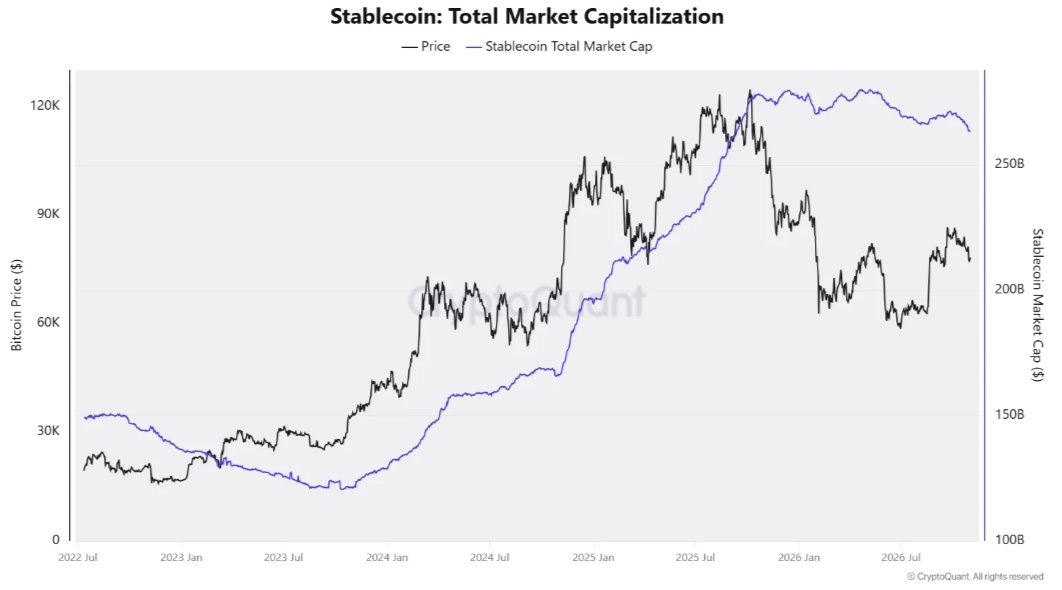
The chart shared via CryptoQuant plots total stablecoin market capitalization against Bitcoin price from mid-2022 through late 2026. The stablecoin supply line — tracing a prolonged uptrend from 2022 through early 2025 — shows a clear rollover and declining slope persisting for several months. Bitcoin’s price, meanwhile, remains in a compressed, choppy range well below its prior peak. The directional correlation is plain: stablecoin growth has historically tracked and preceded Bitcoin’s bullish phases. The current divergence — stablecoins declining while Bitcoin grinds sideways to lower — removes the fuel source that prior recoveries relied upon.
Why Stablecoin Flows Are the Leading Indicator, Not a Lagging One
Stablecoins function as the primary on-ramp into crypto markets. When investors intend to buy Bitcoin, Ethereum, or any digital asset, they typically park capital in stablecoins first — USDT, USDC, DAI — before deploying. An expanding stablecoin supply therefore represents potential demand waiting to enter the market. A contracting supply represents the opposite: capital exiting the ecosystem entirely, either to fiat or to off-chain instruments.
The analyst’s note frames this precisely. As @CW8900 writes in the published CryptoQuant quicktake: “Bullish trends typically emerge when fund flows into the market. Throughout the last month, funds have consistently exited, and Bitcoin has also remained in a bearish phase.” The correlation is not coincidental — it reflects the mechanical relationship between available liquidity and price. You cannot sustain a rally on thin stablecoin supply. Historically, every meaningful Bitcoin recovery has coincided with — and often been preceded by — a net expansion in stablecoin market capitalization.
This connects directly to a broader pattern tracked across recent months. USDT supply had already contracted by $1B in a prior episode, flagging the same liquidity stress that is now amplified in the full stablecoin picture.
What a Reversal Would Require — and What to Watch
The CryptoQuant note does not specify a precise stablecoin inflow threshold that would trigger a Bitcoin rebound. What it does establish is the necessary condition: stablecoin net flows must shift from negative to positive. A single day of inflows is insufficient — the analyst’s framing implies a regime shift, from persistent outflow to consistent re-accumulation.
The specific metric to monitor is the 7-day or 30-day rolling net flow into the total stablecoin market cap. DeFiLlama updates this in real time. A sustained reversal above the October 1 baseline of $270.3B would be the first quantitative confirmation that fresh capital is re-entering the ecosystem — not recycling within it.
It is worth noting what the on-chain picture does not say. The absence of stablecoin inflows does not guarantee continued Bitcoin decline — prices can move on leverage, derivatives positioning, and spot demand from existing holders. What it does say is that the structural fuel for a sustained recovery is not yet present. One-day bounces are possible. A durable trend reversal, historically, has required the stablecoin supply to be growing, not shrinking.
Against this backdrop, Bitcoin whales have been accumulating through the dip, with large-wallet holders adding 16,010 BTC — a sign of conviction among long-term participants even as stablecoin liquidity remains under pressure.
The Current State: Bearish Phase Confirmed by Flows
At $76,613, Bitcoin is down more than 2% in 24 hours with a market capitalization of approximately $1.54 trillion and $26.7B in 24-hour trading volume. The stablecoin supply trend — negative for over 30 consecutive days according to CryptoQuant — corroborates what the price action already reflects: this is a bearish phase, not a base-building one, until the flow data shifts.
The analyst’s conclusion is not ambiguous. Once stablecoin flows turn net positive and sustain that direction, a market rebound becomes structurally probable. Until then, the liquidity mechanism that powers crypto recoveries is running in reverse. Watch the total stablecoin market cap on DeFiLlama — specifically, a confirmed return above $270.3B on a sustained basis — as the first quantitative signal that the rebound condition has been met.
Source: x.comFrequently Asked Questions
How much have stablecoins declined and what does it mean for Bitcoin?
What stablecoin level would signal a Bitcoin rebound is likely?
Why does stablecoin supply matter more than Bitcoin price action alone?
Does the stablecoin outflow mean Bitcoin will definitely continue falling?
Source: CryptoQuant · Published by CoinsProbe Markets Desk
The opinions and market insights shared on CoinsProbe represent the views of individual authors based on prevailing market conditions at the time of publication. Cryptocurrency investments carry significant risk and volatility. Readers are encouraged to conduct their own research and seek professional financial advice before making investment decisions. CoinsProbe and its contributors do not accept responsibility for financial losses or decisions made based on published content.
CoinsProbe may publish sponsored articles, affiliate links, or promotional collaborations. All sponsored material is clearly labeled to maintain transparency with our audience. Our editorial decisions remain fully independent, and advertising partnerships do not influence reviews, rankings, or published opinions.
Since 2023, CoinsProbe has delivered reliable insights on cryptocurrency, blockchain, and digital assets. Our content is created by experienced researchers and analysts who follow strict editorial standards focused on accuracy, transparency, and credibility. Every article is carefully reviewed and verified using trusted sources and current market data. We provide unbiased analysis and timely updates covering everything from emerging crypto projects to major industry developments.