


- CryptoQuant CEO Ki Young Ju argues on-chain ledgers give real-time visibility into every wallet flow — something traditional finance has never achieved
- Spot Bitcoin ETF custody addresses have been trackable live since January 2024, providing verifiable AUM without relying on issuer self-reporting
- Tools including Arkham, Nansen, and Chainalysis enable institutional-scale wallet clustering — capabilities documented publicly since 2019–2020
- BNB is trading at $746.80 (-0.34% 24h) with a $99.5B market cap at time of writing
Traditional finance has always operated on assumptions — because no one could see the full picture of where money moves. CryptoQuant CEO Ki Young Ju (@ki_young_ju) argues that public blockchains have fundamentally changed that, and the implications extend far beyond any single asset class.

“Finance has always run on assumptions, because no one could see the whole picture of where money moves,” Ki Young Ju wrote on October 12, 2026. “On-chain, you can. Every flow, every wallet, in real time. Crypto’s biggest contribution may not be a new asset class, but a financial system you measure instead of guess.” The statement reframes the entire debate about cryptocurrency’s value proposition — not as speculative returns, but as structural transparency that traditional finance has never achieved.
The Measurement Argument — Why On-Chain Visibility Changes Everything
The mechanism Ki Young Ju is describing is not theoretical. Every transfer on a public ledger — Bitcoin, Ethereum, and others — is timestamped, amount-specific, and address-linked by default. There is no equivalent in traditional finance. Bank ledgers are private. Custodian AUM figures are self-reported. Settlement delays obscure real-time positioning. On-chain, none of those limitations apply.
The practical consequence is already observable. Spot Bitcoin ETF custody addresses have been tracked live since January 2024, providing verifiable AUM data without relying solely on issuer disclosures. Tools including Arkham Intelligence, Nansen, and Chainalysis enable wallet clustering and flow tracing at institutional scale — capabilities that have been publicly documented since 2019–2020 but have accelerated sharply with ETF adoption and the growth of on-chain analytics dashboards.
This is the core of Ki Young Ju’s argument: the ledger is the audit. When capital moves, the blockchain records it. When institutions accumulate, the wallet data confirms it. The guesswork that defines traditional macro analysis — estimating fund flows, inferring positioning from derivatives data, waiting for quarterly reports — becomes a secondary exercise when the primary data is natively public.
Why This Thesis Matters for How Markets Are Read
The implications are structural, not just philosophical. If on-chain data is the most accurate real-time representation of capital allocation in crypto markets, then analysts who read that data have an informational edge that did not exist in prior financial systems. Ki Young Ju’s firm, CryptoQuant, has built its entire product thesis around this premise — aggregating on-chain signals into composite readings that reflect actual market behavior rather than surveyed sentiment or estimated positioning.
This distinction matters particularly when evaluating market turning points. An on-chain signal that shows exchange inflows rising, long-term holder distribution accelerating, or miner capitalization compressing carries a different evidentiary weight than a technical indicator derived from price alone. The data is not modeled — it is recorded. As CryptoQuant’s on-chain analysis has previously shown, these signals have preceded measurable market inflection points with documented historical accuracy.
The Contrast With Traditional Finance
In equity markets, fund flows are estimated through monthly surveys, 13F filings with 45-day delays, and proprietary prime brokerage data that is never public. In bond markets, the Federal Reserve’s Z.1 Flow of Funds report — the closest equivalent to an aggregate ledger — is published quarterly with a three-month lag. In foreign exchange, daily volume figures are estimates, not measured totals, because there is no central ledger.
On-chain, the equivalent data is available in blocks — roughly every ten minutes for Bitcoin, roughly every twelve seconds for Ethereum. The latency between a capital movement occurring and that movement being observable on a public dashboard is measured in seconds, not months. Ki Young Ju’s framing — “a financial system you measure instead of guess” — is a precise description of that architectural difference, not a marketing claim.
What This Means for Market Analysis
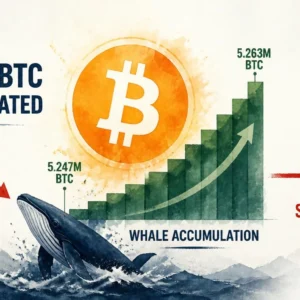
The practical takeaway for analysts and investors is that on-chain data should be treated as primary evidence, not corroborating color. When exchange reserves decline while price holds, that is a measurable fact. When whale wallets accumulate during a price drawdown, that is a recorded event. When stablecoin supply on exchanges rises ahead of a price move, that is timestamped and address-attributed.
Ki Young Ju’s argument is that this level of transparency represents a structural upgrade to financial infrastructure — one that happens to be packaged inside an asset class that most of the world still associates primarily with price volatility. The volatility is real. But so is the ledger underneath it.
BNB is trading at $746.80, down 0.34% over the past 24 hours, with a market cap of approximately $99.5 billion and $721 million in 24-hour volume at the time of writing.
Frequently Asked Questions
What does Ki Young Ju mean by ‘a financial system you measure instead of guess’?
How are Bitcoin ETF flows tracked on-chain?
Which platforms currently offer institutional-scale on-chain flow analysis?
Does on-chain transparency make crypto markets more predictable than traditional markets?
Source: Ki Young Ju · Published by CoinsProbe Markets Desk
The opinions and market insights shared on CoinsProbe represent the views of individual authors based on prevailing market conditions at the time of publication. Cryptocurrency investments carry significant risk and volatility. Readers are encouraged to conduct their own research and seek professional financial advice before making investment decisions. CoinsProbe and its contributors do not accept responsibility for financial losses or decisions made based on published content.
CoinsProbe may publish sponsored articles, affiliate links, or promotional collaborations. All sponsored material is clearly labeled to maintain transparency with our audience. Our editorial decisions remain fully independent, and advertising partnerships do not influence reviews, rankings, or published opinions.
Since 2023, CoinsProbe has delivered reliable insights on cryptocurrency, blockchain, and digital assets. Our content is created by experienced researchers and analysts who follow strict editorial standards focused on accuracy, transparency, and credibility. Every article is carefully reviewed and verified using trusted sources and current market data. We provide unbiased analysis and timely updates covering everything from emerging crypto projects to major industry developments.