

- Humanity Protocol ($H) suffered a sophisticated multi-stage exploit on June 8, 2026 — crashing -80.46% in 24 hours from a high of $0.7320 to a low of $0.07471 — currently trading at $0.1386 with a market cap of $392.6 million.
- The attack involved a 3-of-5 multisig takeover — the attacker obtained 3 signatures, replaced the token contract with a malicious implementation, and minted 200 million $H from nothing before draining existing wallets simultaneously.
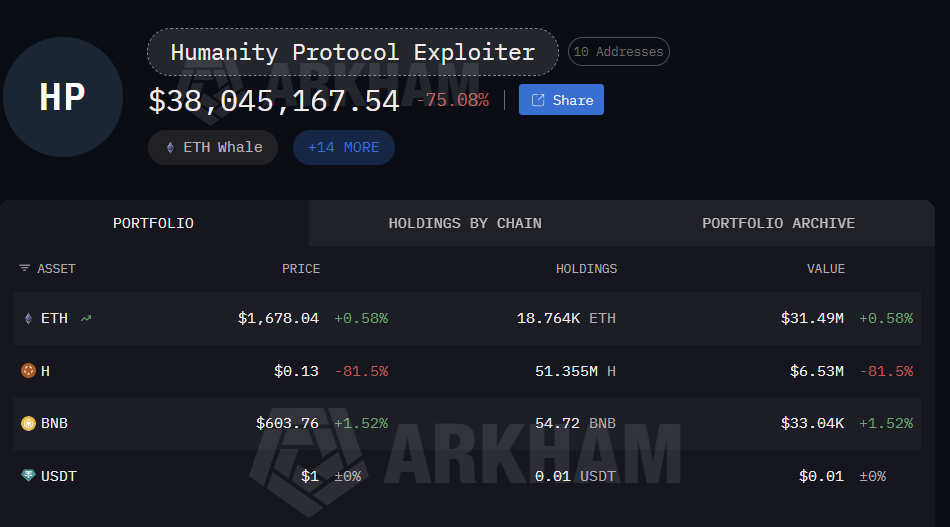
- Total extracted: $31M+ (17,800 ETH + 2,700 BNB) — all routed exclusively through DEXes — with the attacker still holding a significant unsold $H position and on-chain liquidity severely depleted.
- Four specific red flags — coordinated wallets pre-funded weeks in advance, perfect unlock timing, DEX-only routing, and the difficulty of stealing 3 multisig signatures externally — are fuelling serious community suspicions of insider involvement.
On June 8, 2026, Humanity Protocol ($H) suffered one of the most shocking exploits of the year. The token crashed over 80% in hours — from a 24-hour high of $0.7320 to a low of $0.07471 — currently trading at $0.1386 with a market cap of approximately $392.6 million.

What Humanity Protocol described as a “private key compromise” was something significantly more sophisticated — and significantly more damaging. The June 9, 2026 exploit was not a single key breach. It was a full contract takeover — involving multisig signature compromise, proxy contract replacement, and coordinated wallet draining across hundreds of addresses — all executed with a level of precision and preparation that the on-chain evidence suggests was not improvised.
As we covered in our first $H collapse article — ZachXBT flagged possible market maker involvement and on-chain analysts documented nearly 300 pre-funded wallets selling from two separate unlock cohorts. This follow-up provides the complete technical picture of how the attack was actually executed — step by step — based on the detailed analysis published by GoPlus Security.
For context on how minting exploits of this nature have played out on other chains — we covered similar mechanics in our Hyperbridge exploit analysis — where an attacker minted 1 billion bridged DOT tokens through a gateway vulnerability — and our KelpDAO exploit article. The $H attack follows the same fundamental exploit architecture — but with the addition of a coordinated multi-wallet draining operation that significantly amplified the total damage.
The Official Statement — and Why It Falls Short
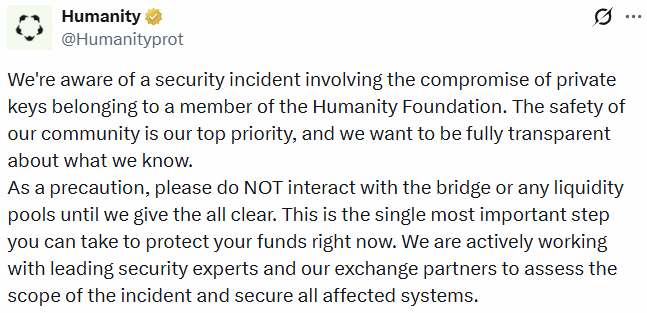
The project’s official account @Humanityprot announced:
“We’re aware of a security incident involving the compromise of private keys belonging to a member of the Humanity Foundation… Please do NOT interact with the bridge or any liquidity pools.”
The team confirmed they are working with security experts and exchange partners. But framing this as a “private key compromise” significantly understates what the on-chain evidence shows actually happened. This was not a single key being stolen. It was a systematic dismantling of the token contract’s security architecture — followed by coordinated extraction across hundreds of wallets simultaneously.
Here is exactly how it unfolded.
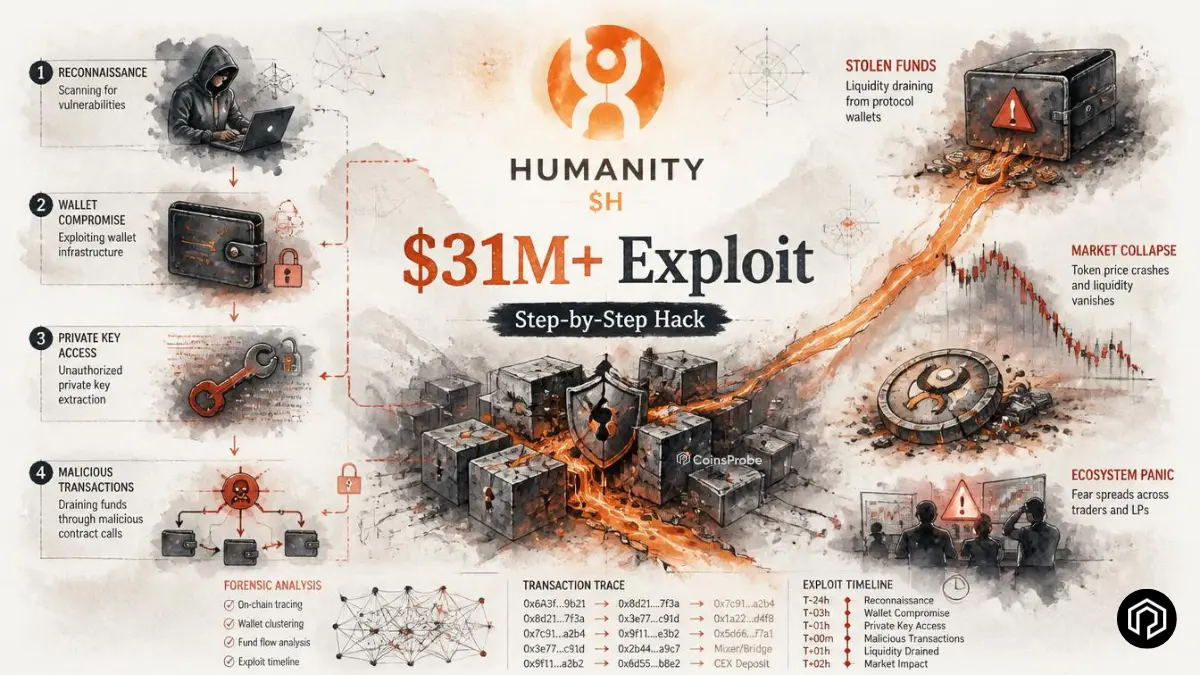
The Humanity ($H) Hack— Step by Step
Source: GoPlus Security analysis
Step 1 — Compromising the Multisig Wallet
The $H token contract on BNB Chain used a 3-of-5 Safe multisig wallet as its access control mechanism — meaning any administrative action required signatures from 3 of the 5 designated owners.
The attacker obtained 3 signatures — the exact threshold required — and used them to change the owner of the ProxyAdmin contract (0xd73Cd111). How exactly 3 of 5 signatures were obtained is the central unresolved question — and the one that most directly informs the insider vs external debate.
Obtaining 3 of 5 multisig signatures from genuinely independent parties through an external attack is extraordinarily difficult. Each signer would need to be independently compromised through separate attack vectors — hardware compromise, phishing, or social engineering — without any of the 5 signers noticing or alerting others. The probability of this occurring externally without any insider involvement is low — which is precisely why the community’s suspicion of insider access to multiple signing keys is not unreasonable.
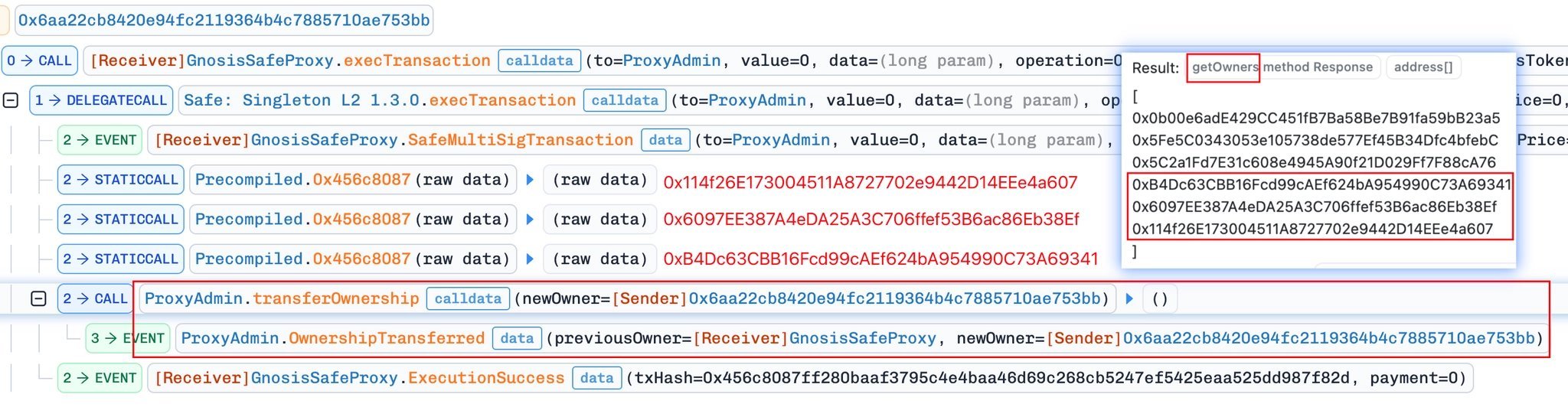
Step 2 — Taking Full Ownership of the Token Contract
With ProxyAdmin ownership secured — the attacker’s wallet:
0x6aa22cb8420e94fc2119364b4c7885710ae753bb
became the new owner of the official $H proxy contract (0x44F161aE) — giving complete administrative control over the token’s core infrastructure.
This is the point of no return. Once an attacker holds proxy contract ownership — they can do anything the legitimate contract admin could do — including replacing the entire implementation logic.
Step 3 — Upgrading to a Malicious Contract
With full admin rights — the attacker replaced the legitimate $H token implementation with their own malicious contract (0xD18cDc9F). This upgrade preserved the token’s external appearance — existing holders still saw their $H balances — but the underlying logic now served the attacker rather than the protocol.
This technique — proxy contract replacement via compromised admin access — is one of the most dangerous attack vectors in upgradeable smart contract architecture. It is why smart contract security audits specifically focus on access control mechanisms and why multisig thresholds exist. In this case both protections were circumvented.

Step 4 — Minting 200 Million New $H Tokens
With the malicious contract in place — the attacker called the mint function in two tranches:
- First mint: 100 million $H
- Two hours later: Another 100 million $H
200 million tokens created from nothing — added to the circulating supply of a token with existing market liquidity. The dilution impact on existing holders was immediate and catastrophic — and the newly minted tokens provided additional selling ammunition on top of the existing wallets being drained simultaneously.
As we covered in our Hyperbridge minting exploit — fresh token minting combined with DEX liquidation bypasses the supply constraints that would normally limit insider selling. The economic damage is amplified beyond what pre-existing token holdings alone would produce.

Step 5 — Draining Existing Tokens From Multiple Wallets
Simultaneously with the minting operation — attackers accessed 7 major wallets plus hundreds of smaller addresses — including recently unlocked team and foundation allocations — and dumped approximately 249 million existing $H tokens into the market.
The scale of this coordinated wallet access — across addresses with different unlock histories spanning weeks and months — is what makes the single private key narrative structurally implausible. As documented in our first $H article — the selling wallets had their gas fees withdrawn from Gate.io and Bybit three weeks before the event — a preparation timeline that is definitionally inconsistent with reactive exploitation of an unexpectedly discovered vulnerability.
Step 6 — Cashing Out Everything Through DEXes
All tokens — the 200 million freshly minted plus the 249 million drained from existing wallets — is systematically being swapped on decentralised exchanges for BNB and ETH:
| Asset Received | Amount | Approximate Value |
|---|---|---|
| ETH | ~17,800 ETH | ~$29.7M |
| BNB | ~2,700 BNB | ~$1.6M |
| Total | — | $31M+ |
Every sale was routed exclusively through DEXes — deliberately avoiding any centralised exchange where KYC requirements, account monitoring, or transaction freezing could identify or interrupt the extraction. The operational discipline of routing hundreds of wallet sales exclusively through DEXes — across the entire operation — is consistent with participants who understood exactly how to execute a clean exit.

The Four Red Flags That Don’t Fit an External Hack
The GoPlus Security analysis and community investigations have identified four specific characteristics that are each individually unusual — and collectively build a strong circumstantial case for insider involvement:
1. Gas pre-funded weeks in advance The selling wallets withdrew gas fees from Gate.io and Bybit three weeks before the exploit. External attackers discovering a vulnerability do not prepare their exit infrastructure weeks in advance. Insiders planning an exit do.
2. Perfect timing with major token unlocks The attack occurred immediately before significant scheduled token unlocks — maximising the amount of supply available for extraction while minimising the time between unlock and exit. This timing precision suggests awareness of the unlock schedule from the inside.
3. DEX-only routing across all wallets Every single sale — across hundreds of wallets — avoided centralised exchanges entirely. This level of consistent operational discipline across a distributed wallet set suggests coordinated participants following a shared protocol rather than an external attacker improvising.
4. 3-of-5 multisig compromise Obtaining 3 signatures from a 3-of-5 multisig through purely external means — without any insider access to the signing infrastructure — requires independently compromising 3 separate hardware or software environments belonging to 3 different individuals. The probability of achieving this without any insider cooperation is extremely low.
Current Status and What Remains at Risk
| Item | Status |
|---|---|
| Attacker’s remaining $H | Significant unsold position |
| DEX liquidity | Severely depleted |
| Bridge and liquidity pools | Do NOT interact |
| Official investigation | Ongoing |
| Funds recovered | None confirmed |
The attacker still holds a significant unsold $H position — and with DEX liquidity severely depleted — any attempt to sell the remaining tokens would produce catastrophic price impact on an already devastated market.
What Holders Must Do Right Now
Revoke all contract approvals immediately — Use Revoke.cash or a similar tool to remove every $H-related approval from your wallet. This is the single most important protective action available.
Do not interact with the bridge or liquidity pools — Both remain compromised until the project confirms a full resolution and security audit.
Follow only verified official channels — Monitor @Humanityprot for official updates — ignore community speculation about recovery plans or token burns until officially confirmed.
Do not buy the dip — With the attacker holding a significant unsold position and liquidity severely depleted — any apparent price stabilisation is fragile and immediately susceptible to reversal on further selling.
Bottom Line
The Humanity Protocol exploit was not a simple private key compromise. It was a sophisticated multi-stage attack — multisig takeover, proxy contract replacement, fresh token minting, and coordinated wallet draining across hundreds of addresses — executed with preparation that began at least three weeks before the event.
Whether the 3-of-5 multisig signatures were obtained through external attack or insider access is the central unresolved question. The on-chain evidence — gas wallets pre-funded weeks in advance, perfectly timed unlock exploitation, DEX-only routing discipline, and the operational complexity of coordinating hundreds of wallets — builds a circumstantial case that the community and investigators like ZachXBT are taking seriously.
$31M has been extracted. The attacker still holds tokens. Liquidity is depleted. Until the investigation produces verified findings — extreme caution is the only appropriate response.
Humanity ($H) Crash FAQ
What happened to Humanity ($H) token?
Humanity ($H) experienced a massive crash on June 8-9, 2026, dropping 90% in just 24 hours. The token fell from a daily high of $0.7320 to a low of $0.07471.
How did the Humanity $H hack happen?
Hackers compromised a 3/5 multisig wallet, took ownership of the token contract, upgraded it to a malicious version, minted 200 million new $H tokens, and also drained existing tokens from multiple wallets.
How much money was stolen in the Humanity hack?
Over $31 million was extracted (approximately 17.8k ETH + 2.7k BNB). The attackers still hold a large bag of $H tokens.
Will Humanity ($H) price recover?
Short-term recovery is unlikely. Heavy sell pressure, lost trust, and remaining attacker tokens make further downside probable.
Is Humanity Protocol a scam?
The project’s reputation is severely damaged. While not officially declared a scam, the scale and nature of the exploit have led to widespread rug pull accusations.
The opinions and market insights shared on CoinsProbe represent the views of individual authors based on prevailing market conditions at the time of publication. Cryptocurrency investments carry significant risk and volatility. Readers are encouraged to conduct their own research and seek professional financial advice before making investment decisions. CoinsProbe and its contributors do not accept responsibility for financial losses or decisions made based on published content.
CoinsProbe may publish sponsored articles, affiliate links, or promotional collaborations. All sponsored material is clearly labeled to maintain transparency with our audience. Our editorial decisions remain fully independent, and advertising partnerships do not influence reviews, rankings, or published opinions.
Since 2023, CoinsProbe has delivered reliable insights on cryptocurrency, blockchain, and digital assets. Our content is created by experienced researchers and analysts who follow strict editorial standards focused on accuracy, transparency, and credibility. Every article is carefully reviewed and verified using trusted sources and current market data. We provide unbiased analysis and timely updates covering everything from emerging crypto projects to major industry developments.