
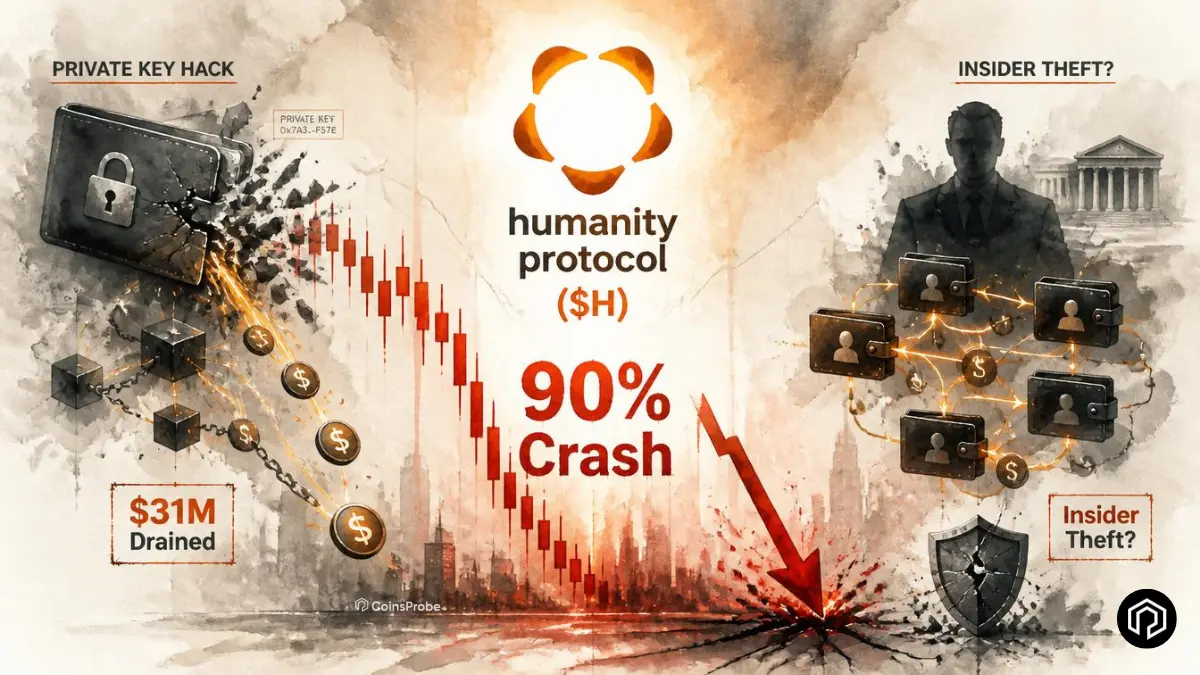

- Humanity ($H) has collapsed 90% in 24 hours — falling from a high of $0.7320 to a low of $0.07471 — currently trading at $0.1288 with a market cap of approximately $364.8 million.
- The official account claims a private key compromise by a foundation member — but on-chain evidence shows nearly 300 coordinated wallets dumping tokens from two separate unlock cohorts — extracting approximately $31.3 million in under 7 hours.
- Lookonchain confirmed the attacker minted 200 million $H on BSC and cashed out 18,510 ETH (~$30.83M) + 1,548 BNB (~$924K) through DEX sales — with 111.36 million $H (~$14M) still held and on-chain liquidity nearly exhausted.
- ZachXBT flagged possible market maker involvement given supply concentration — while on-chain data shows gas fees pre-funded from Gate.io and Bybit 3 weeks before the event — making the private key narrative extremely difficult to accept.
Humanity Protocol — a project positioning itself as “Humanity’s Standard of Trust” — is facing one of the most devastating single-day collapses in recent crypto history. The token has lost more than 81% of its value in 24 hours — and the on-chain evidence surrounding the event is raising serious questions about whether this was a genuine external hack or a coordinated extraction of liquidity by insiders.
This is not the first time the crypto ecosystem has faced a crisis where official narratives and on-chain reality diverge sharply. As we covered in our Hyperbridge exploit article — where an attacker minted 1 billion bridged DOT tokens through a gateway vulnerability — and our KelpDAO exploit analysis — the combination of minting exploits and coordinated DEX-only liquidation has become a recognisable pattern in DeFi security incidents. The $H collapse follows that pattern — but with on-chain evidence suggesting the source may be closer to home.
$H at a Glance — June 9, 2026

From $0.7320 to $0.07471 at the session low — $H lost approximately 90% of its value at the worst point before a partial recovery to the current $0.1288. Even at the current price — the token has lost more than 82% from yesterday’s high — with on-chain liquidity nearly exhausted and the attacker still holding a significant position.
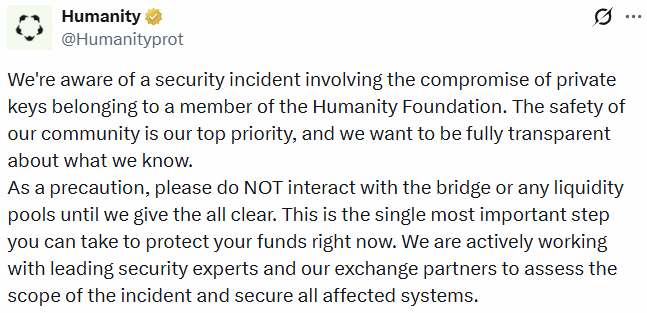
The Official Response — Private Key Compromise
The project’s official account @Humanityprot announced a security incident — stating that the private keys belonging to a member of the Humanity Foundation had been compromised. The statement urged users to avoid interacting with the bridge or liquidity pools and confirmed the team is working with security experts and exchange partners.
On the surface — a private key compromise is a recognised and documented attack vector. It has happened to legitimate projects before. But the on-chain data surrounding this specific incident tells a story that is significantly more difficult to reconcile with a simple external key breach.
The On-Chain Humanity $H Crash Reality
Two independent on-chain analysts have documented the mechanics of what occurred — and the picture they describe is not consistent with a single private key hack.
Lookonchain’s findings:
The attacker did not simply sell existing tokens. They minted 100 million $H on BSC — then minted another 100 million $H — creating 200 million tokens from nothing before selling them into the market.

The total extracted to date:
- 18,510 ETH (~$30.83 million)
- 1,548 BNB (~$924,000)
- All routed exclusively through DEX sales — avoiding any centralised exchange with KYC requirements
The attacker still holds 111.36 million $H — worth approximately $14 million at current prices — with on-chain liquidity nearly depleted. Any attempt to sell this remaining position into an illiquid market would produce severe additional downside.
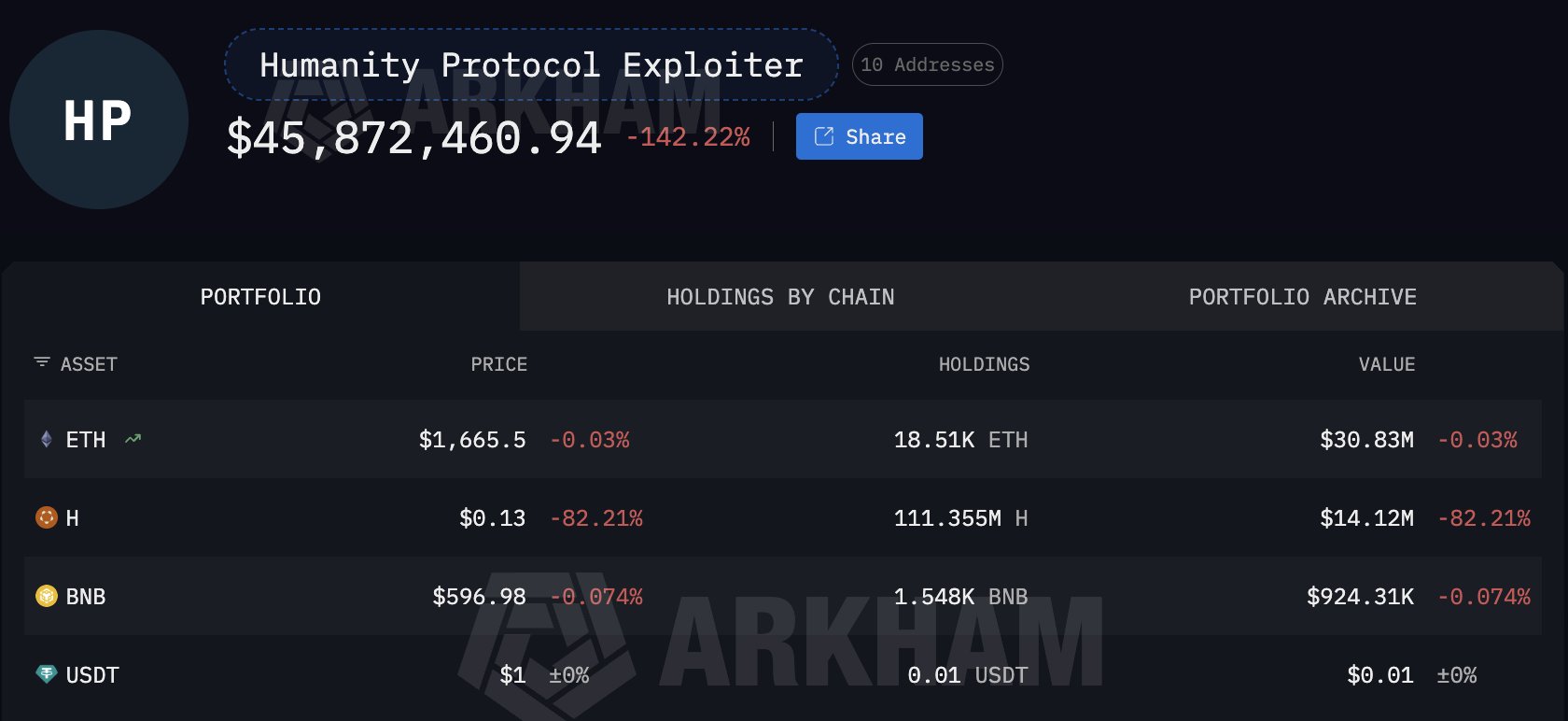
The broader wallet picture — nearly 300 addresses drained:
The on-chain investigation reveals that excluding the 100 million $H freshly minted in the final hour — the over 200 million $H sold in the preceding hours was not sold from a single compromised wallet. It was aggregated and sold from nearly 300 separate wallets — wallets that fell into two distinct categories:
- Wallets that had unlocked tokens two weeks ago
- Wallets that had received tokens 11 months ago
These two cohorts have completely different histories — different unlock dates, different token acquisition events, and different on-chain fingerprints. A single compromised private key cannot simultaneously control nearly 300 wallets with two entirely different token histories. The only explanation that fits the on-chain evidence is that the selling was coordinated across multiple parties with advance access to all of these wallets.
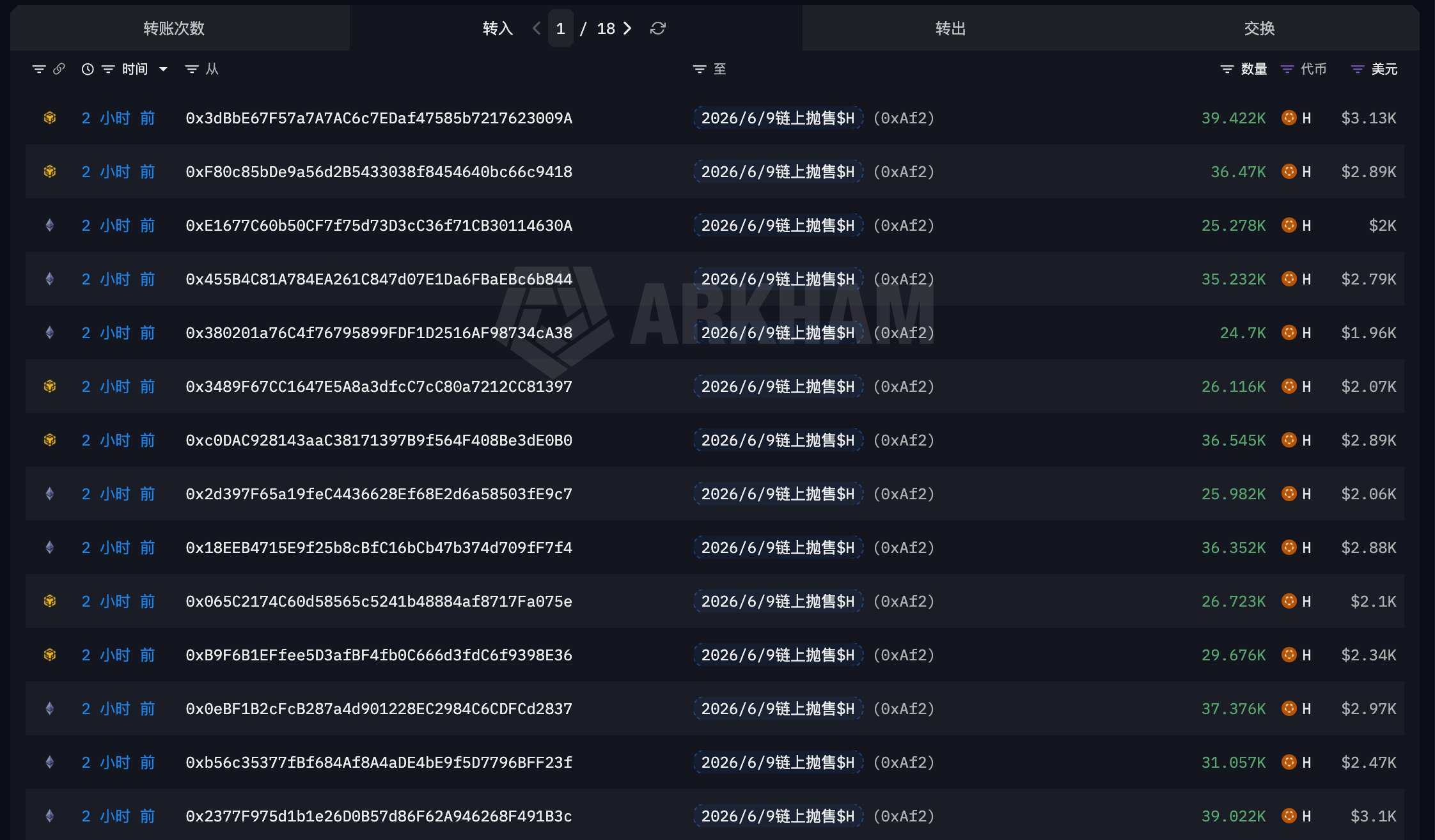
The gas pre-funding detail — the most damning evidence:
The detail that most directly contradicts the external hack narrative: the nearly 300 selling wallets had their gas fees withdrawn from Gate.io and Bybit three weeks before the event.
Pre-funding gas wallets three weeks in advance of an “unexpected hack” is not consistent with reactive exploit behaviour. It is consistent with deliberate preparation — building the operational infrastructure for a planned exit while the project was still actively trading at elevated prices. As we covered in our KelpDAO exploit analysis, pre-positioning of operational wallets weeks before an incident is one of the clearest indicators that separates planned insider exits from opportunistic external attacks.
DEX-only routing:
Every single token sale — across all nearly 300 wallets — was executed exclusively on decentralised exchanges. No selling occurred on any centralised venue where KYC, transaction monitoring, or account freezing could identify or interrupt the exit. This level of operational discipline across nearly 300 wallets simultaneously is not consistent with an unprepared external attacker discovering a vulnerability — it is consistent with coordinated participants who understood exactly which venues to use and which to avoid.
ZachXBT — Market Maker Angle Flagged
Prominent on-chain investigator ZachXBT offered a measured but equally concerning assessment:
“Unsure whether it’s a theft or MM. Check the chart and it seems H team was possibly working with an active MM given supply concentration. However all H was sold on DEX vs CEX.”
ZachXBT stops short of definitively calling it an insider job — instead raising a specific alternative: the Humanity team may have been working with an active market maker given the highly concentrated token supply visible on-chain. Whether this is characterised as theft or a market maker exit — the observable fact ZachXBT highlights is consistent with the broader on-chain picture: all selling occurred on DEX rather than CEX — deliberately avoiding KYC-linked centralised exchanges.
The distinction between theft and a market maker coordination matters from a legal perspective — but for token holders the outcome is identical. $31.3 million has been extracted from the protocol and on-chain liquidity is nearly exhausted.
The supply concentration angle ZachXBT raises also explains how nearly 300 wallets could be coordinated simultaneously — if a small number of insiders or market maker partners controlled the distribution across those wallets, the apparent complexity of the operation becomes significantly more manageable.
Why This Pattern Is Familiar — And Why It Keeps Working
The mechanics of the $H collapse follow a well-documented playbook that the DeFi ecosystem has seen before. As we covered in our Hyperbridge minting exploit — fresh token minting combined with immediate DEX liquidation is one of the most effective extraction mechanisms in DeFi because it bypasses the supply constraints that would normally limit insider selling.
When an attacker or insider can mint tokens rather than only sell existing supply — the economic damage is amplified beyond what on-chain token holdings alone would suggest. The $H attacker minted 200 million tokens — tokens that did not exist before the event — and sold them into a market that had no mechanism to absorb the sudden supply expansion.
The pattern works because:
DEX liquidity cannot be frozen — Unlike CEX accounts which can be suspended by operators — DEX liquidity pools execute automatically. Once the selling begins on a DEX — there is no intervention mechanism.
The exit is already complete by the time the community reacts — The $31.3 million was extracted within hours of the event beginning. By the time the community understood what was happening — the overwhelming majority of the damage had already been done.
The official narrative creates a delay — Framing the event as an external hack rather than an insider exit gives the remaining sellers additional time to complete their exit while the community focuses on the official statement rather than on-chain data.
What Remaining $H Holders Face
111.36 million $H still with the attacker — At current prices approximately $14 million in additional potential selling pressure on a market with nearly exhausted liquidity.
Liquidity nearly exhausted — Thin on-chain liquidity means even modest additional selling will produce outsized price impact far beyond what the dollar value of remaining tokens would normally suggest.
No confirmed resolution — The project has not addressed the specific on-chain evidence — the nearly 300 wallets, the 3-week gas pre-funding, or the coordinated DEX-only routing — that contradicts the single private key narrative.
What Holders Should Do Right Now
Revoke all contract approvals immediately — Use Revoke.cash or a similar tool to remove any $H contract approvals from your wallet. The official project account has explicitly advised this.
Do not interact with the bridge or liquidity pools — As stated in the official announcement — both remain at risk.
Do not buy the dip — With liquidity nearly exhausted and 111.36 million tokens still held by the attacker — any apparent price stabilisation is fragile and immediately susceptible to reversal.
Monitor the attacker’s wallet — Any movement of the 111.36 million $H toward exchange deposit addresses signals another wave of selling is imminent.
Bottom Line
The $H collapse on June 9, 2026 presents a stark divergence between the official narrative and the on-chain evidence. Nearly 300 coordinated wallets from two separate unlock cohorts — gas fees pre-funded from centralised exchanges three weeks in advance — DEX-only routing across the entire operation — and fresh minting of 200 million tokens on top of the pre-existing supply.
ZachXBT is uncertain whether it is theft or market maker coordination. EmberCN’s on-chain data shows the operations are extremely hard to explain with a private key leak “unless it’s insiders stealing from the inside.” The community has drawn its own conclusion.
Whether the official investigation produces evidence that changes this picture — or confirms what the on-chain data already shows — $31.3 million has left the protocol. The 111.36 million tokens that remain with the attacker are the next risk to watch.
Humanity ($H) Crash FAQ
Why did Humanity crypto crash?
The Humanity team announced that private keys of a Foundation member were compromised. However, on-chain analysis reveals that 7 wallets dumped 249 million $H tokens, draining over $31.3 million in ETH and BNB. Large quantities of new $H tokens were also minted during the incident, raising serious questions about the official narrative.
What happened to Humanity ($H) token
Humanity ($H) experienced a massive crash on June 8-9, 2026, dropping 90% in just 24 hours. The token fell from a daily high of $0.7320 to a low of $0.07471.
Was the Humanity $H hack real or an insider job?
This remains the most debated question. While the official statement claims a private key hack, prominent on-chain analysts (Lookonchain, EmberCN) and the crypto community strongly suspect an insider attack (“rug pull by team”). Key red flags include coordinated selling across multiple wallets, pre-funded gas fees, and perfectly timed dumps just before major unlocks.
How much money was stolen in the Humanity hack?
Attackers have already extracted approximately $31–33 million (roughly 17.8k ETH + 2.7k BNB). They still hold over 111 million $H tokens, currently valued at around $14 million.
What should I do if I hold Humanity ($H) tokens?
Immediately revoke all contract approvals using tools like Revoke.cash.
Avoid interacting with the Humanity bridge or liquidity pools.
Do not buy the dip until the situation is fully resolved.
Monitor official announcements and on-chain updates closely.
Will Humanity ($H) price recover?
Short-term recovery looks highly unlikely. With destroyed trust, exhausted liquidity, and a large remaining attacker bag, $H faces heavy selling pressure. Most analysts expect the price to remain volatile and suppressed until transparency improves and stolen funds are addressed.
Is Humanity Protocol a scam?
The project’s reputation has been severely damaged. Although Humanity Protocol was positioned as a digital identity and trust infrastructure project, today’s events have led to widespread accusations of an exit scam or insider theft. Investors are advised to exercise extreme caution.
The opinions and market insights shared on CoinsProbe represent the views of individual authors based on prevailing market conditions at the time of publication. Cryptocurrency investments carry significant risk and volatility. Readers are encouraged to conduct their own research and seek professional financial advice before making investment decisions. CoinsProbe and its contributors do not accept responsibility for financial losses or decisions made based on published content.
CoinsProbe may publish sponsored articles, affiliate links, or promotional collaborations. All sponsored material is clearly labeled to maintain transparency with our audience. Our editorial decisions remain fully independent, and advertising partnerships do not influence reviews, rankings, or published opinions.
Since 2023, CoinsProbe has delivered reliable insights on cryptocurrency, blockchain, and digital assets. Our content is created by experienced researchers and analysts who follow strict editorial standards focused on accuracy, transparency, and credibility. Every article is carefully reviewed and verified using trusted sources and current market data. We provide unbiased analysis and timely updates covering everything from emerging crypto projects to major industry developments.