
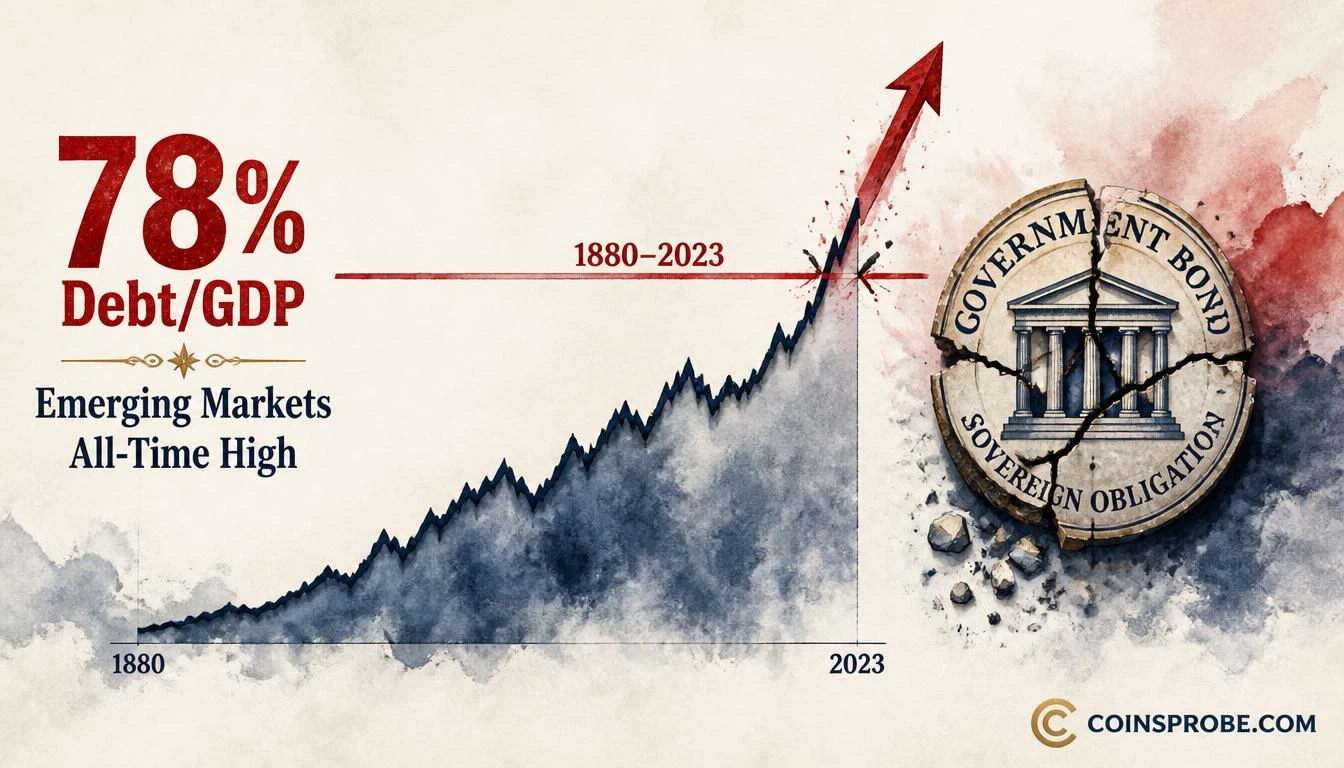

- Emerging market debt-to-GDP reaches ~78% — highest in 143 years of data back to 1880
- The ratio has more than doubled since the 2008 Financial Crisis, surpassing the prior ~45% all-time peak
- Advanced economy debt sits near ~110% GDP — near WWII highs with no post-crisis deleveraging
- Bitcoin trading at $85,814 (-0.16%) as macro debt risk hits unprecedented peacetime levels
Emerging market government debt has broken through every historical ceiling on record. The debt-to-GDP ratio for emerging market economies has climbed to approximately 78% — the highest reading in data stretching back to 1880, according to The Kobeissi Letter.
That single number rewrites 143 years of fiscal history. The ratio has more than doubled since the 2008 Financial Crisis, when it stood near 37–38%, and has now surpassed the previous all-time peak of roughly 45% — a ceiling that held through two World Wars and the Great Depression.
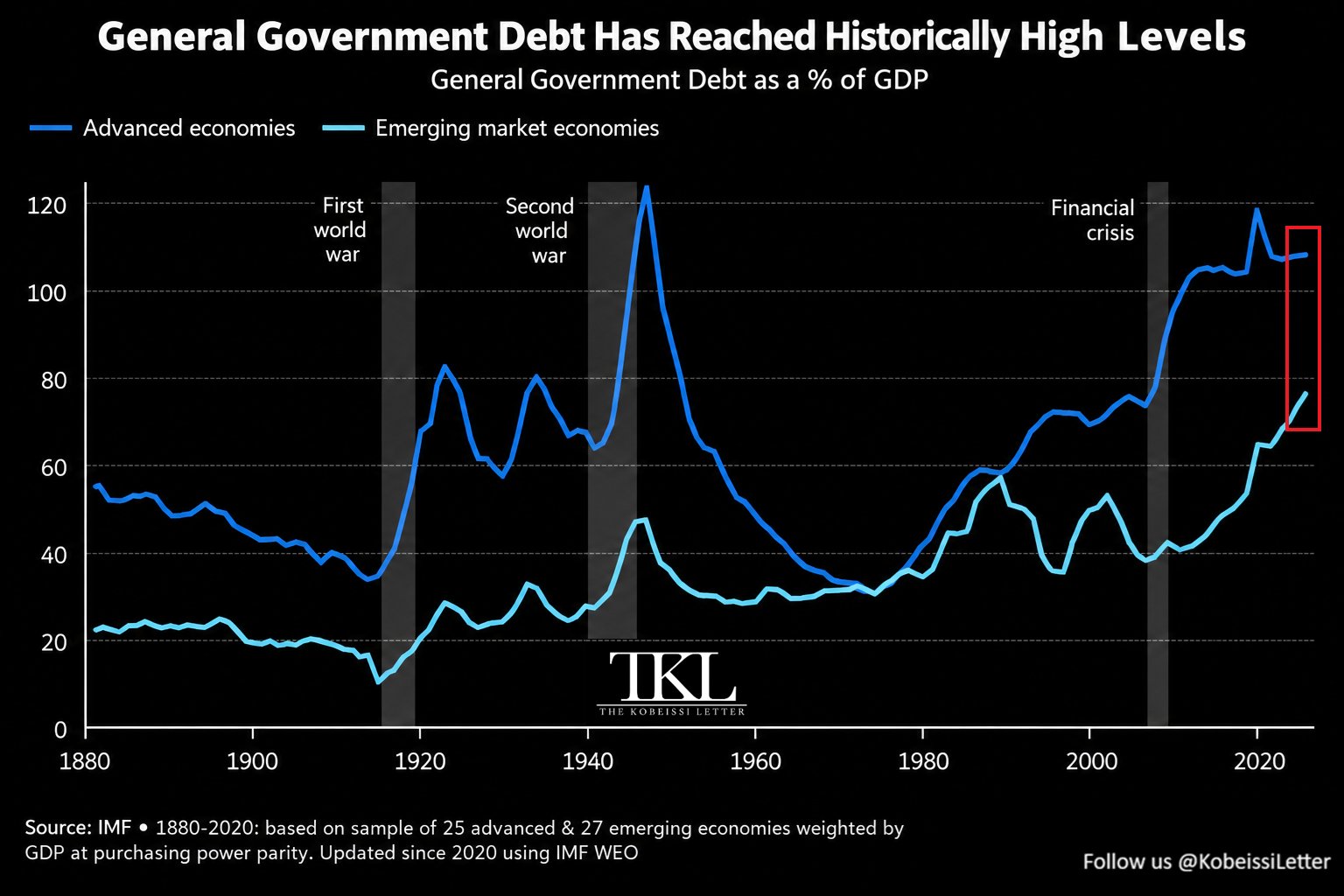
Advanced economies are not in better shape. Their debt-to-GDP stands at approximately 110% — just below the ~120% peak hit in 2020 during COVID-era fiscal expansion, and dangerously close to the ~125% reached during World War II. Unlike every prior debt spike in the historical record, there has been no meaningful post-crisis deleveraging. The chart shows three prior major debt surges — WWI, WWII, and post-2008 — each followed by a reduction. The current cycle has produced none.
The macro implications are direct. Elevated sovereign debt at these levels has historically pressured currency devaluation and compressed the fiscal space governments need to respond to the next shock. For hard assets, the dynamic is well-documented — this is precisely the macro backdrop that underpins the Bitcoin vs. global liquidity framework explored in Bitcoin vs. Global M2: A Ratio That Has Called Every Cycle Top.
The immediate risk flagged by the data is interest rate sustainability. High debt levels combined with elevated rates create a fiscal stress loop — higher borrowing costs consume a larger share of government revenue, forcing either more borrowing or austerity. At 78% debt-to-GDP, emerging markets have less buffer than at any prior point in modern recorded history to absorb that pressure. Contagion risk from an emerging market sovereign stress event rises in direct proportion to that vulnerability.
Bitcoin is trading at $85,814 at the time of writing, down 0.16% over the past 24 hours, with a market cap of $1.72 trillion.
Source: x.comFrequently Asked Questions
Why does the 78% emerging market debt-to-GDP figure matter more than previous peaks?
How does record sovereign debt levels affect Bitcoin specifically?
What is the critical risk if interest rates stay elevated alongside this debt load?
Source: Kobeissiletter · Published by CoinsProbe Markets Desk
The opinions and market insights shared on CoinsProbe represent the views of individual authors based on prevailing market conditions at the time of publication. Cryptocurrency investments carry significant risk and volatility. Readers are encouraged to conduct their own research and seek professional financial advice before making investment decisions. CoinsProbe and its contributors do not accept responsibility for financial losses or decisions made based on published content.
CoinsProbe may publish sponsored articles, affiliate links, or promotional collaborations. All sponsored material is clearly labeled to maintain transparency with our audience. Our editorial decisions remain fully independent, and advertising partnerships do not influence reviews, rankings, or published opinions.
Since 2023, CoinsProbe has delivered reliable insights on cryptocurrency, blockchain, and digital assets. Our content is created by experienced researchers and analysts who follow strict editorial standards focused on accuracy, transparency, and credibility. Every article is carefully reviewed and verified using trusted sources and current market data. We provide unbiased analysis and timely updates covering everything from emerging crypto projects to major industry developments.