
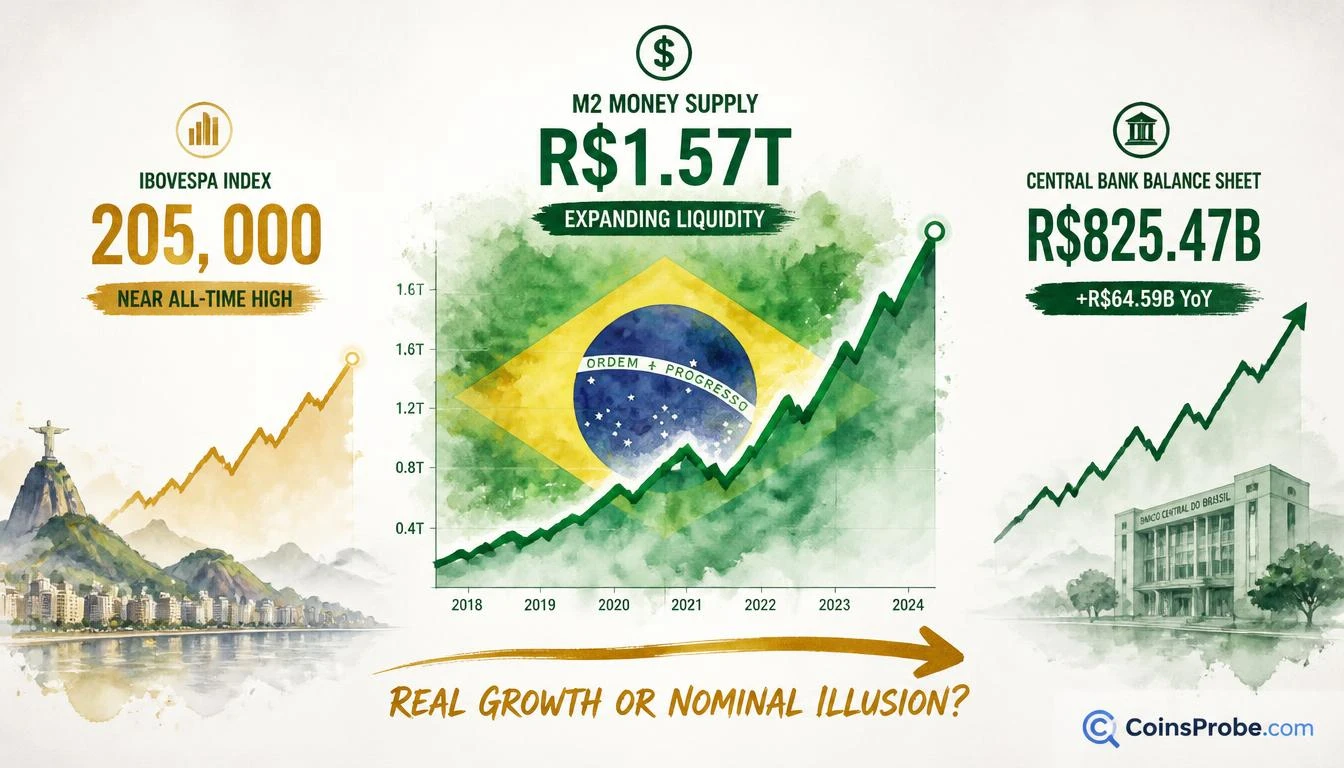

- Brazil M2 reaches R$1.57T — up R$239.28B YoY — signaling return to monetary expansion per Alphractal
- Central Bank of Brazil balance sheet hits R$825.47B, up R$64.59B YoY, confirming broad liquidity increase
- Ibovespa near 205,000 points — close to historical highs — as Alphractal flags inflation vs. real growth risk
- Analysis published on Brazil presidential election day, flagging policy shift as key variable for cycle trajectory
Brazil’s monetary base is expanding at a pace that has historically preceded major turning points in the country’s equity market. Alphractal, the on-chain analytics platform, published a macro liquidity analysis on October 25, 2026, documenting two headline figures: Brazil’s M2 money supply has reached R$1.57 trillion, reflecting a year-on-year expansion of R$239.28 billion, while the Central Bank of Brazil’s balance sheet stands at R$825.47 billion, up R$64.59 billion over the same period. The Ibovespa, Brazil’s benchmark equity index, was trading near 205,000 points — close to historical highs — at the time of the analysis.
The analysis, published by Alphractal (@Alphractal) on the day of Brazil’s presidential election, frames the monetary data through more than two decades of historical context. The central question Alphractal poses is not simply whether markets are rising — it is whether the gains are driven by genuine economic growth or by monetary expansion inflating nominal asset values.
Twenty Years of Monetary Cycles and Ibovespa Turning Points
Alphractal’s framework maps YoY changes in both Brazil’s M2 and the Central Bank balance sheet against Ibovespa price action across three major cycle events: the 2008 Global Financial Crisis, the 2015–2016 Brazilian recession, and the 2020 pandemic shock. In each instance, transitions between monetary contraction and expansion aligned with significant turning points in the index — either accelerating drawdowns on the way down or confirming recoveries on the way up.
The current return to positive YoY growth in both M2 and the Central Bank balance sheet represents a shift from the prior contractionary phase. Based on the historical pattern Alphractal documents across these three prior cycles, renewed liquidity conditions have consistently been associated with renewed asset appreciation — though the firm explicitly flags the distinction between real economic growth and inflation-driven nominal gains as the key analytical variable.
The Inflation vs. Real Growth Question
This is the analytical core of Alphractal’s note: when M2 expands by R$239 billion in a single year, asset prices measured in that same currency will tend to rise in nominal terms regardless of whether underlying economic productivity justifies the move. The Ibovespa at 205,000 points looks like a record — but the relevant question for any investor is how much of that level reflects genuine value creation versus monetary dilution compressing the purchasing power of the real.
This is not a new problem. It is the same dynamic that has made emerging market equity analysis structurally more complex than developed market equivalents. Central bank balance sheet expansion in Brazil has a direct transmission mechanism into domestic asset prices — equities, real estate, and, increasingly, digital assets. Analysts who ignore the monetary baseline when interpreting Ibovespa performance risk attributing monetary inflation to fundamental improvement. This kind of macro-monetary lens is also relevant for crypto market participants — particularly those tracking how fiat liquidity cycles have historically correlated with Bitcoin and risk asset performance, a dynamic CoinsProbe has explored in the context of Bitcoin’s political and election-cycle sensitivity.
Election Day Context
Alphractal published the analysis on the day of Brazil’s presidential election — a deliberate choice that adds a layer of forward-looking relevance. Election outcomes in Brazil have historically had an immediate and significant impact on the Ibovespa, with investor sentiment responding sharply to perceived fiscal and monetary policy implications of incoming administrations. The monetary baseline Alphractal documents — R$1.57T in M2, R$825.47B on the Central Bank balance sheet — provides the liquidity floor against which any post-election market move should be evaluated.
If the incoming administration signals tighter fiscal policy, the trajectory of M2 growth could decelerate, which based on Alphractal’s historical cycle mapping would represent a headwind for the Ibovespa’s current proximity to all-time highs. Conversely, continued or accelerated monetary expansion would, by the same historical framework, provide fundamental support for nominal asset prices — regardless of what real economic conditions look like.
What the Data Confirms — and What It Leaves Open
Alphractal’s analysis confirms three things with precision: the current monetary regime is expansionary, the YoY growth rates in both M2 and the Central Bank balance sheet have turned positive, and the Ibovespa is near historically elevated levels. What the analysis deliberately leaves open is whether this expansion is sufficient to drive further equity gains or whether current valuations have already priced in the liquidity premium.
The framework does not offer a price target for the Ibovespa or a directional call on Brazil equities. It provides the monetary context — the baseline against which market participants should be measuring asset performance — and flags the structural risk that nominal appreciation can mask real value destruction in high-inflation monetary environments. Investors tracking emerging market equities or broader risk-asset correlations, including digital assets such as those flagged in recent whale activity analyses, should weight this macro liquidity context accordingly.
Bullish Scenario
If Brazil’s post-election administration maintains or accelerates the current monetary expansion trajectory, M2 growth continuing above R$200B YoY would, based on Alphractal’s two-decade cycle mapping, provide structural support for Ibovespa levels at or above 205,000 points. Continued Central Bank balance sheet growth would reinforce the liquidity backdrop.
Bearish Scenario
A policy shift toward monetary tightening — a deceleration in M2 YoY growth back toward zero or negative — would, by the same historical framework, represent the same signal that preceded the 2008, 2015–16, and 2020 Ibovespa drawdowns. The Ibovespa at 205,000 near all-time highs with tightening liquidity would be the combination most consistent with prior cycle peaks.
The Alphractal monetary cycle framework documents a clear historical pattern: M2 and Central Bank balance sheet YoY growth transitions have aligned with Ibovespa turning points across three major global shocks spanning more than twenty years. The current expansion — R$1.57T in M2 and R$825.47B on the Central Bank balance sheet, both positive YoY — places Brazil’s monetary regime in the same phase that preceded asset appreciation in prior cycles. The unresolved variable, which Alphractal explicitly flags, is whether the Ibovespa at 205,000 reflects real growth or monetary inflation. Watch the YoY trend in Brazil M2 — if it decelerates toward zero, the historical pattern suggests the most significant market risk for this cycle begins there.
Frequently Asked Questions
What does Brazil M2 growth of R$239B YoY mean for equity markets?
Why is the Central Bank of Brazil balance sheet expansion relevant to investors?
How does Brazil’s presidential election affect the monetary cycle analysis?
Is Ibovespa at 205,000 points reflecting real growth or monetary inflation?
Source: Alphractal · Published by CoinsProbe Markets Desk
The opinions and market insights shared on CoinsProbe represent the views of individual authors based on prevailing market conditions at the time of publication. Cryptocurrency investments carry significant risk and volatility. Readers are encouraged to conduct their own research and seek professional financial advice before making investment decisions. CoinsProbe and its contributors do not accept responsibility for financial losses or decisions made based on published content.
CoinsProbe may publish sponsored articles, affiliate links, or promotional collaborations. All sponsored material is clearly labeled to maintain transparency with our audience. Our editorial decisions remain fully independent, and advertising partnerships do not influence reviews, rankings, or published opinions.
Since 2023, CoinsProbe has delivered reliable insights on cryptocurrency, blockchain, and digital assets. Our content is created by experienced researchers and analysts who follow strict editorial standards focused on accuracy, transparency, and credibility. Every article is carefully reviewed and verified using trusted sources and current market data. We provide unbiased analysis and timely updates covering everything from emerging crypto projects to major industry developments.