
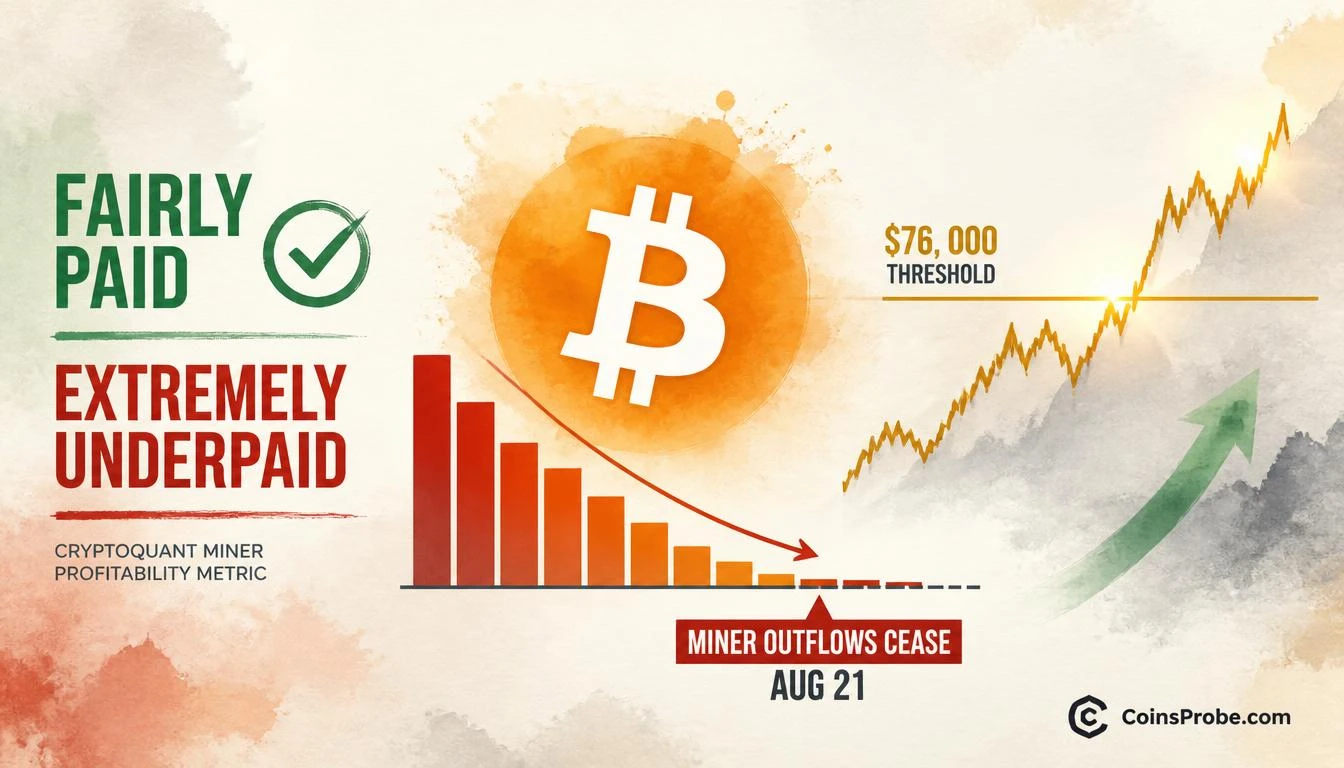

- Bitcoin is trading at $80,992 (-2.89% 24h) as CryptoQuant confirms zero extreme miner outflows since August 21, 2026
- Miners transitioned from "extremely underpaid" to "fairly paid" when BTC hit $76,000 — ending 29,000 BTC single-day outflow events
- CryptoQuant: miner selling was "one of the steadiest sources of supply" weighing on price through the 2026 bear market
- $76,000 is the documented price threshold where the miner behavioral regime changed — the level to watch for reversal
Bitcoin is trading at $80,992 — down 2.89% in the past 24 hours — but a structural shift in miner behavior identified by CryptoQuant may be more consequential than the daily candle. Since August 21, 2026, extreme miner outflows have ceased entirely. That is not a technical signal. It is an on-chain fact: one of the most persistent sources of sell-side supply in the 2026 bear market has gone quiet.
CryptoQuant (@cryptoquant_com) published the finding directly: “No extreme miner outflows since Aug 21, the day BTC hit $76K and miners flipped from ‘extremely underpaid’ to ‘fairly paid.’ That removes one of the steadiest sources of supply that weighed on price through the 2026 bear market.” The date is precise. The mechanism is named. The implication is structural.
Signal 1 — Extreme Miner Outflows Have Ceased Since August 21
Miner outflow data measures the volume of BTC transferred from mining pool wallets to external addresses — primarily exchanges. When those transfers spike, miners are liquidating newly mined coins to cover operational costs: energy bills, hardware servicing, debt obligations. During periods of sustained price compression, miners operating below their break-even cost are forced sellers. That is not speculation — it is accounting.
From May through August 2026, CryptoQuant’s data shows that extreme outflow events — the red-dot spikes that mark above-threshold selling — were a recurring feature of the market. The most recent extreme event was logged on August 21, when 29,000 BTC left miner wallets in a single day. That date aligned precisely with Bitcoin’s price touching $76,000. At that level, according to CryptoQuant’s miner profitability framework, the average miner crossed back into “fairly paid” territory — meaning revenue from block rewards and fees once again exceeded operating costs at scale.
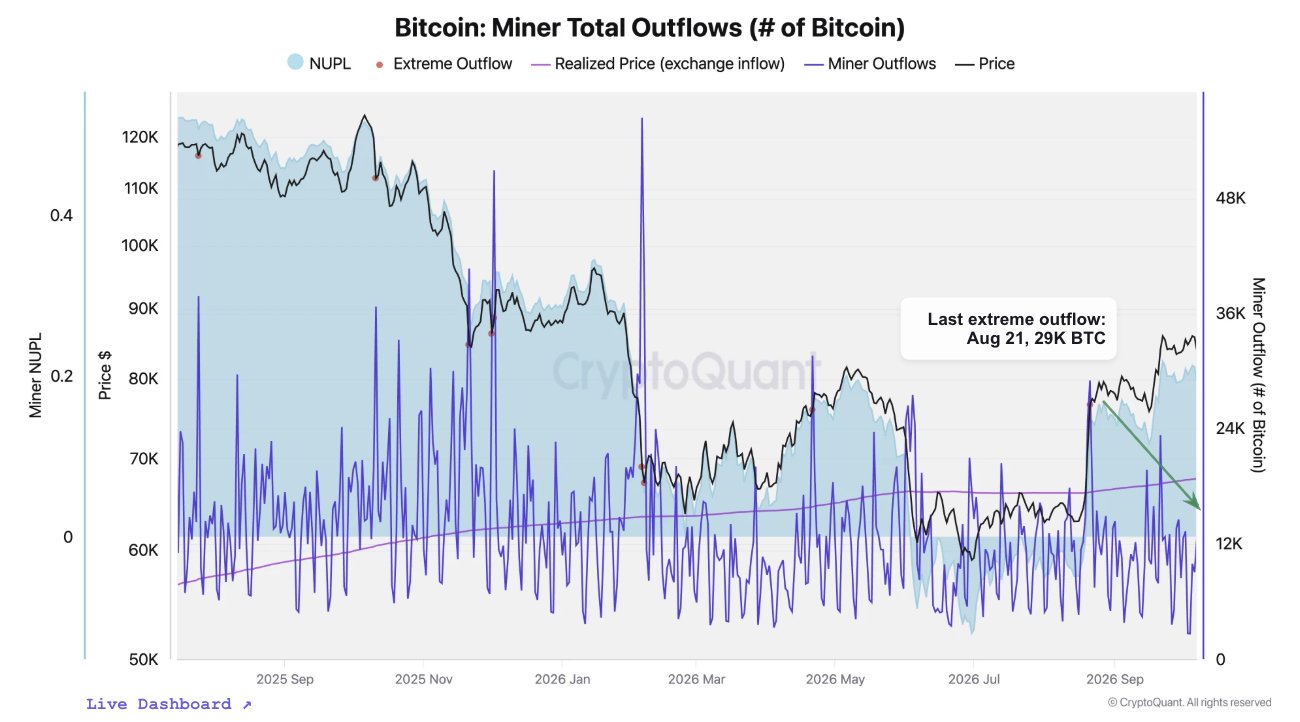
Since August 21, that pattern has not repeated. The chart shared by CryptoQuant shows miner outflow spikes declining sharply in both frequency and magnitude through September and into October 2026. The NUPL (Net Unrealized Profit/Loss) overlay, compressed near zero through the bear period, reflects this same dynamic: miners were not accumulating unrealized gains during the downturn — they were selling at or near cost. The removal of that selling pressure coincides with the outflow cessation.
For context on how significant the miner selling cycle was during the 2026 bear market, see our earlier analysis: Bitcoin Miners Shift From Sellers to Holders — Four On-Chain Signals to Watch.
Signal 2 — The “Fairly Paid” Threshold Crossed at $76K
CryptoQuant’s Miner Profit/Loss Sustainability metric tracks the cost basis of Bitcoin’s mining industry in aggregate, classifying miners as “extremely underpaid,” “fairly paid,” or profitable. The classification is not arbitrary — it is derived from hash rate, difficulty, energy cost estimates, and block reward economics.
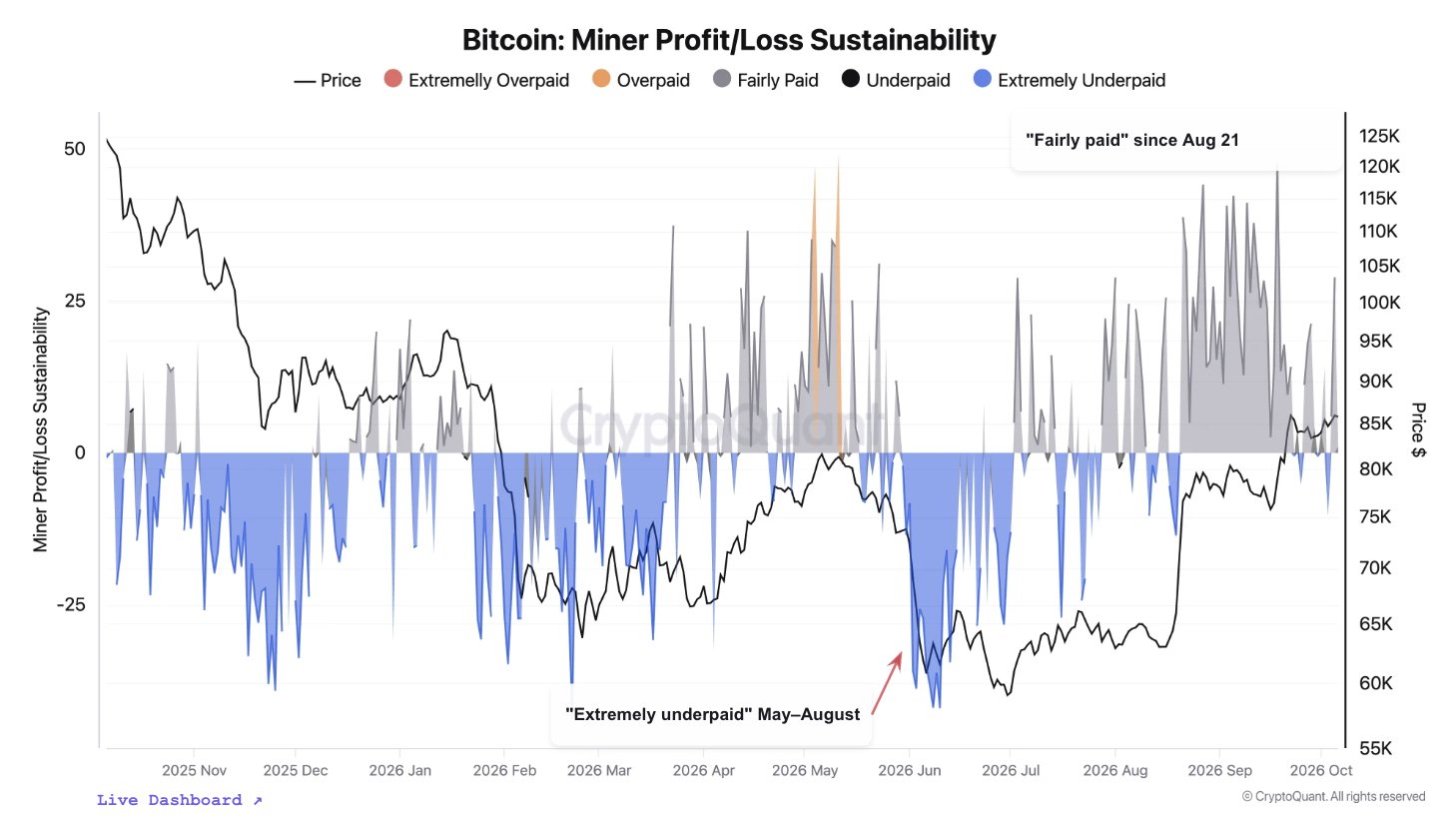
The second chart in CryptoQuant’s post shows the precise transition. From May through August 2026, blue bars dominate below the zero line — the “extremely underpaid” regime. These are the months when miner outflows were most aggressive, as operators were absorbing losses on every BTC they held and had little incentive to wait for recovery. The shift to gray “fairly paid” bars begins in late August, directly correlated with Bitcoin’s price recovery off the $76,000 low. The BTC price line on the right axis troughs in mid-period and begins climbing as the “extremely underpaid” bars disappear.
CryptoQuant annotates the chart explicitly: “Fairly paid since Aug 21.” The “Extremely underpaid May–August” period is labeled as a discrete regime. These are not analyst interpretations overlaid on ambiguous data — they are the platform’s own profitability classifications applied to the mining industry’s aggregate cost structure.
What this means operationally: miners who were previously compelled to sell BTC the moment it was mined — to avoid deepening losses — now have the option to hold. That option changes the supply equation. A miner who does not need to sell immediately is not a seller. And a market that loses a consistent, structurally motivated seller is a market with less natural overhead.
Why This Supply Dynamic Matters
Miner selling is often dismissed as a small fraction of Bitcoin’s daily volume — and in absolute terms, block rewards at current difficulty generate roughly 450 BTC per day across the network. But the significance of miner outflows is not their volume. It is their consistency and timing.
During the 2026 bear market, miners selling into every price recovery acted as a structural ceiling. Every bounce created an opportunity for cost-burdened miners to reduce exposure. That is a feedback loop: price rises → miner sells → price suppressed → further losses → more forced selling. CryptoQuant’s data shows that loop ran from May through August, with the August 21 outflow of 29,000 BTC representing the final extreme event before the transition.
With miners now classified as “fairly paid” at current price levels, that feedback loop has been interrupted. Miners operating above break-even are rational holders — they have no urgency to liquidate. The structural selling pressure that CryptoQuant describes as “one of the steadiest sources of supply” during the bear market has, by their on-chain data, been removed.
For additional context on how Bitcoin’s spot demand picture has evolved alongside this miner behavior shift, see: Bitcoin Spot Demand Weakens — $69K Identified as Key Support in Correction.
What to Watch From Here
CryptoQuant’s note does not provide upside price targets, support levels, or a forward projection — and this article will not manufacture them. What the data confirms is a regime change in one specific supply variable. Whether that regime change is sufficient to drive sustained price appreciation depends on demand-side factors that this signal does not address.
The metric to monitor in real time is miner outflow data on CryptoQuant’s platform. If BTC were to fall back toward or below $76,000 — the level at which miners crossed back into “fairly paid” territory — the risk of re-entering the “extremely underpaid” regime and reigniting forced selling would increase materially. CryptoQuant does not state $76,000 as a formal support level, but the August 21 price anchor is the documented threshold for the behavioral regime change.
Equally relevant: on-chain data from CryptoQuant updates in real time. Any resumption of extreme outflow events — red-dot spikes returning to the miner outflow chart — would signal that the supply relief identified on August 21 has been reversed.
Bullish Scenario
Miner outflows remain suppressed as Bitcoin holds above the $76,000 “fairly paid” threshold. With forced selling removed and demand-side flows recovering, the natural supply overhead from miners does not return. Price discovers levels above current $80,992 with less structural resistance from the mining industry.
Bearish Scenario
Bitcoin retraces toward $76,000 or below, pushing miners back into “extremely underpaid” territory. Extreme outflow events resume, re-establishing the consistent sell-side pressure that characterized May through August 2026. The regime change identified by CryptoQuant is reversed.
The CryptoQuant data is unambiguous on what happened on August 21: miners stopped selling, and that stopping coincides with a documented shift from extreme underpayment to fair payment at $76,000. Bitcoin is currently trading at $80,992 — approximately $4,992 above that documented behavioral threshold. Whether that buffer holds or narrows is the single variable that determines whether the supply dynamic described in this note remains intact. Watch $76,000 as the level that defines which regime Bitcoin’s miners are operating in.
Frequently Asked Questions
What does ‘extreme miner outflow’ mean and why does its absence matter for Bitcoin price?
At what Bitcoin price did miners stop being forced sellers?
How long did the extreme miner selling pressure last during the 2026 bear market?
Does the end of miner selling guarantee Bitcoin will go higher from $80,992?
Source: CryptoQuant · Published by CoinsProbe Markets Desk
The opinions and market insights shared on CoinsProbe represent the views of individual authors based on prevailing market conditions at the time of publication. Cryptocurrency investments carry significant risk and volatility. Readers are encouraged to conduct their own research and seek professional financial advice before making investment decisions. CoinsProbe and its contributors do not accept responsibility for financial losses or decisions made based on published content.
CoinsProbe may publish sponsored articles, affiliate links, or promotional collaborations. All sponsored material is clearly labeled to maintain transparency with our audience. Our editorial decisions remain fully independent, and advertising partnerships do not influence reviews, rankings, or published opinions.
Since 2023, CoinsProbe has delivered reliable insights on cryptocurrency, blockchain, and digital assets. Our content is created by experienced researchers and analysts who follow strict editorial standards focused on accuracy, transparency, and credibility. Every article is carefully reviewed and verified using trusted sources and current market data. We provide unbiased analysis and timely updates covering everything from emerging crypto projects to major industry developments.