

- Bitcoin tested $76,195 against short-term holder realized price of $75,875 — a gap of just $320 or 0.4%
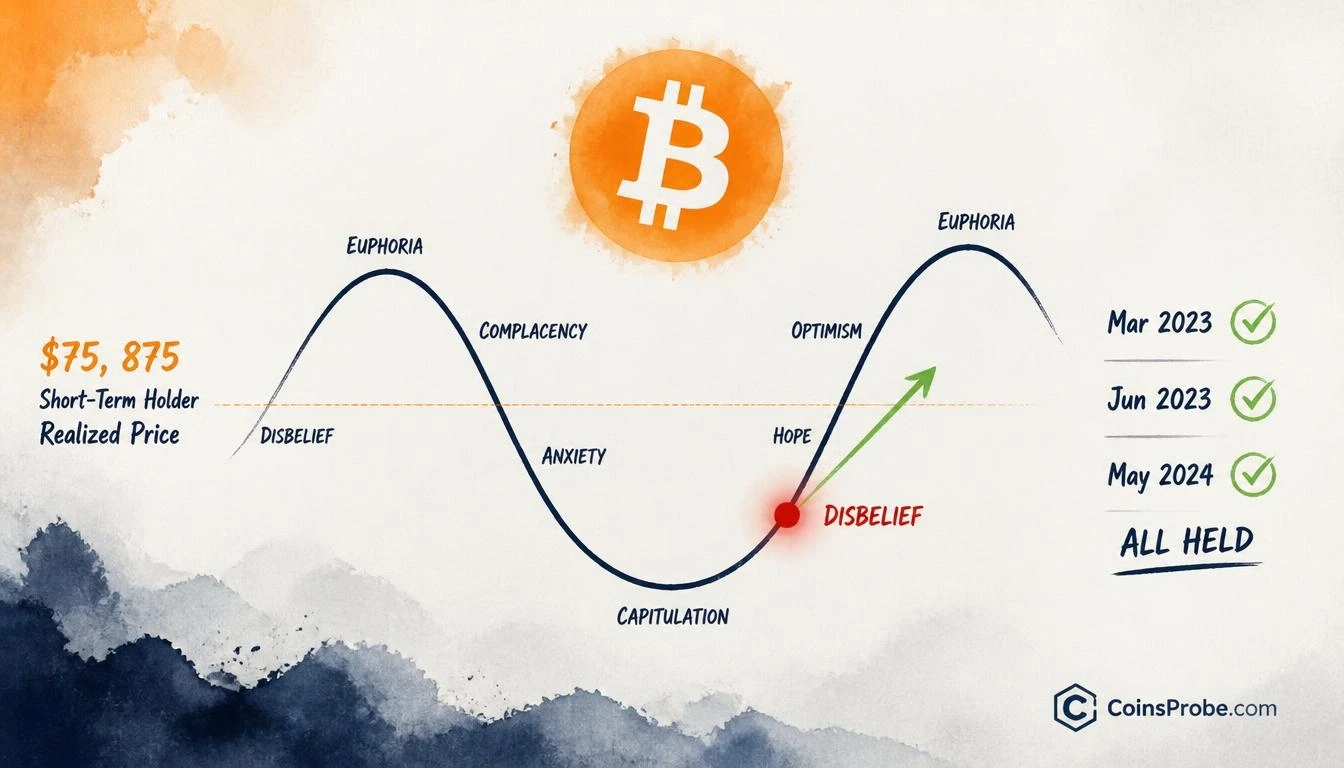
- Same on-chain threshold marked local bottoms in Mar 2023 ($19,979), Jun 2023 ($25,130), and May 2024 ($58,325)
- Analyst maps current sentiment to the Disbelief phase — historically the optimal entry zone before sustained uptrends
- $75,875 is the critical level: a sustained close below invalidates the bottom thesis
Bitcoin is holding above a critical on-chain threshold after testing $76,195 — and one analyst argues the market’s reflexive skepticism is itself the signal. When retail and short-term participants dismiss a recovery as just another failed rally, that collective disbelief has historically marked the beginning of sustained uptrends, not their end.
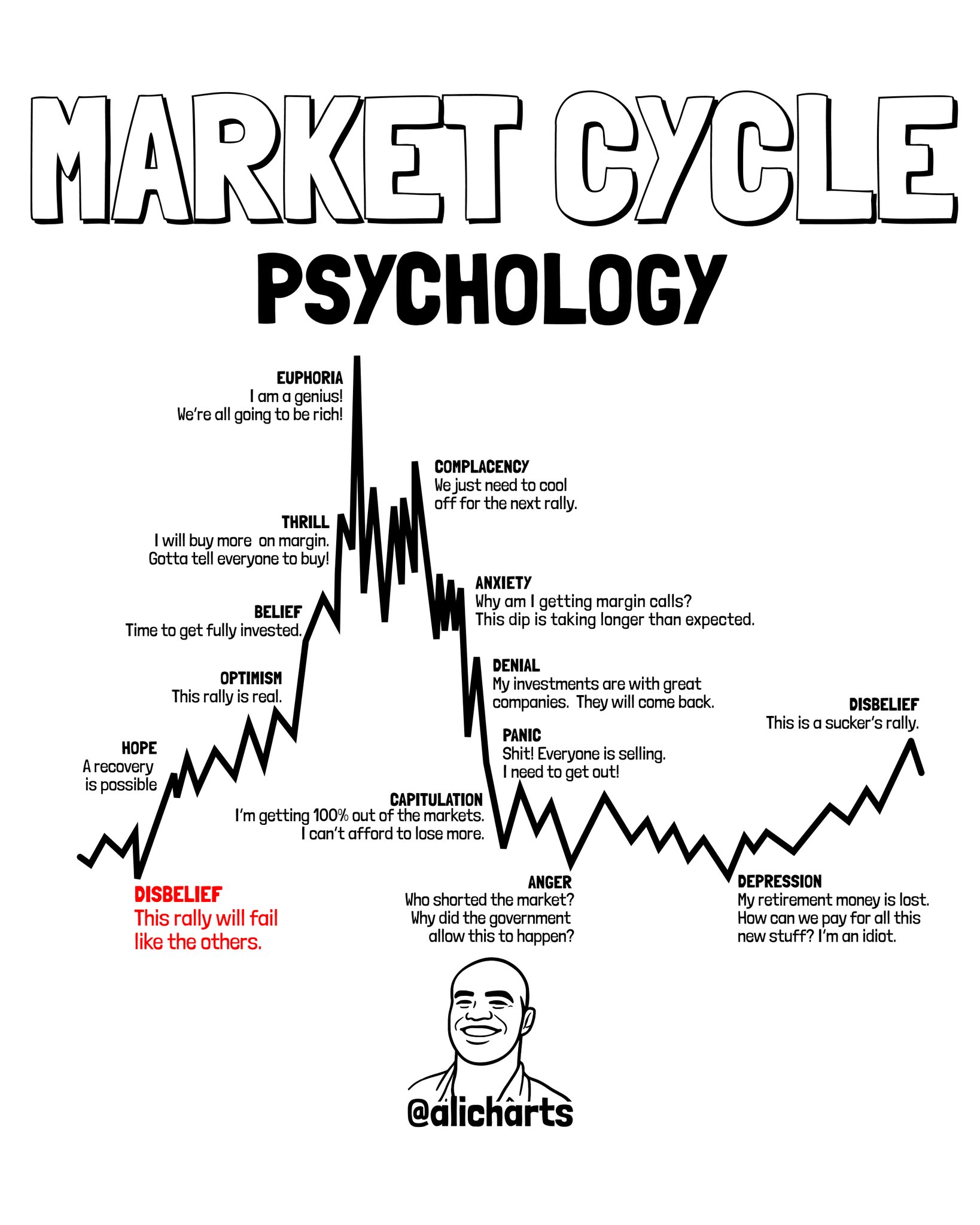
An on-chain analyst identifying as @alicharts posted on November 4, 2026: “Disbelief: This rally will fail like the others.” — a caption that quotes the prevailing sentiment, not his own view. The analyst is mapping current market psychology to the Disbelief phase of the classic market cycle: the stage where early recovery moves are dismissed as noise before a durable bull run takes hold. His on-chain anchor for this call is the short-term holder realized price, currently sitting at $75,875.
What the Short-Term Holder Realized Price Actually Measures
The short-term holder realized price is the average acquisition cost of all Bitcoin held by wallets that received coins within the past 155 days. It is not a moving average of market price — it is a cost-basis metric. When spot price dips to or below this level, short-term holders are, on aggregate, underwater. That underwater condition historically triggers panic selling, liquidations, and capitulation — which is precisely why it has repeatedly functioned as a local bottom marker rather than a breakdown trigger.
At the November 4 test, Bitcoin touched $76,195 against a short-term holder realized price of $75,875 — a gap of just $320, or roughly 0.4%. The price tested the zone and held. That dynamic — testing the realized price without closing below it — is the specific pattern the analyst is flagging.
Three Prior Instances Where This Signal Marked the Bottom
This is not the first time Bitcoin has tested the short-term holder realized price and recovered. The analyst’s research identifies three comparable historical instances:
| Date | Spot Price at Test | Short-Term Holder Realized Price | Gap |
|---|---|---|---|
| March 2023 | $19,979 | $19,794 | +$185 (~0.9%) |
| June 2023 | $25,130 | $25,600 | −$470 (brief undercut) |
| May 2024 | $58,325 | $58,570 | −$245 (brief undercut) |
| November 2026 | $76,195 | $75,875 | +$320 (~0.4%) |
Source: @alicharts (X), November 4, 2026
In each prior case, the test of the short-term holder realized price — whether a brief undercut or a close hold — preceded an uptrend resumption. The brief undercuts in June 2023 and May 2024 did not invalidate the signal; they resolved quickly and prices recovered above the level within days. The November 2026 test held above the level on the initial touch.
Why “Disbelief” Is a Technically Meaningful Label
The Disbelief phase sits at a specific position on the market cycle psychology curve: immediately after the capitulation trough, as price begins recovering, but before sentiment has shifted. At this stage, participants who bought near the top are still nursing losses, media coverage remains negative, and each rally attempt is framed as a dead-cat bounce. The analyst’s chart maps current sentiment explicitly to this zone — highlighted in red on the cycle diagram as the area of maximum skepticism.
The structural reason Disbelief is an opportunity rather than a warning: when the majority of market participants expect failure, their positioning reflects that — meaning they are already underexposed or short. Any sustained upward move forces reactive re-entry, amplifying the rally rather than dampening it. This is the mechanical feedback loop the analyst is describing when he quotes the dominant narrative back at the market.
It’s also worth noting that Bitcoin’s prior rebound faded at $76,800, and separately, stablecoin market cap recently hit a one-year low — both of which help explain why sentiment has remained compressed even as on-chain cost-basis levels suggest a floor is forming.
The Level That Matters — $75,875
The short-term holder realized price at $75,875 is the operative threshold. The analyst’s call is built around price holding above this level — not a subjective trendline or a manually drawn support zone, but a calculated aggregate cost basis derived from actual on-chain transaction data.
A sustained daily close below $75,875 would shift the signal’s interpretation: it would mean short-term holders are, on aggregate, in loss — a condition that historically precedes accelerated selling as holders capitulate to cut losses. That would reframe the current test from “Disbelief bottom” to “breakdown through support,” invalidating the analyst’s thesis.
Conversely, every session that closes above $75,875 adds time-weight to the thesis that the zone absorbed the sell pressure and held.
What the Signal Confirms — And What It Doesn’t
The short-term holder realized price test confirms: on-chain cost-basis support absorbed a $76,195 spot test without capitulation, matching the structural setup seen at three prior local bottoms.
What it does not confirm: a specific price target, a rally magnitude, or a timeline. The March 2023, June 2023, and May 2024 instances all preceded recoveries, but the magnitude of those recoveries varied substantially based on macro conditions and broader market structure. The analyst’s call is a regime identification — Disbelief bottom — not a price projection.
What to watch for continuation: Bitcoin needs to hold daily closes above $75,875 and begin establishing higher lows above that level. A reclaim of recent resistance in the $80,000–$82,000 range would shift the signal from “bottom identified” to “uptrend confirmed.”
Bullish Scenario
Bitcoin holds $75,875 on a closing basis, begins printing higher lows above the short-term holder realized price, and reclaims the $80,000–$82,000 range — consistent with the recovery path seen after the March 2023, June 2023, and May 2024 comparable tests. Sentiment completing the rotation from Disbelief toward early Belief would confirm the cycle positioning.
Bearish Scenario
A sustained daily close below $75,875 would push short-term holders into aggregate loss, historically triggering accelerated selling. That outcome would invalidate the Disbelief bottom thesis and reopen the capitulation phase of the cycle — the stage the analyst currently believes is behind us.
Three instances — March 2023, June 2023, May 2024 — all share one structural feature with the current setup: Bitcoin tested its short-term holder realized price, sentiment was at peak skepticism, and each was followed by an uptrend resumption. The November 2026 test touched $76,195 against a realized price of $75,875 and held. Whether this becomes the fourth confirmed instance or the first failed one will be determined by whether $75,875 holds on a closing basis in the sessions ahead.
Frequently Asked Questions
What is the short-term holder realized price and why does it matter for Bitcoin?
What would invalidate the Disbelief bottom thesis for Bitcoin?
What does the Disbelief phase mean in the market cycle?
What level does Bitcoin need to reclaim to confirm the uptrend after the Disbelief bottom?
Source: Ali Charts · Published by CoinsProbe Markets Desk
The opinions and market insights shared on CoinsProbe represent the views of individual authors based on prevailing market conditions at the time of publication. Cryptocurrency investments carry significant risk and volatility. Readers are encouraged to conduct their own research and seek professional financial advice before making investment decisions. CoinsProbe and its contributors do not accept responsibility for financial losses or decisions made based on published content.
CoinsProbe may publish sponsored articles, affiliate links, or promotional collaborations. All sponsored material is clearly labeled to maintain transparency with our audience. Our editorial decisions remain fully independent, and advertising partnerships do not influence reviews, rankings, or published opinions.
Since 2023, CoinsProbe has delivered reliable insights on cryptocurrency, blockchain, and digital assets. Our content is created by experienced researchers and analysts who follow strict editorial standards focused on accuracy, transparency, and credibility. Every article is carefully reviewed and verified using trusted sources and current market data. We provide unbiased analysis and timely updates covering everything from emerging crypto projects to major industry developments.