


- Binance resumes withdrawals after the largest hack in crypto history — BTC netflow -16,021 BTC (2.43% of reserves) — behaving normally per CryptoQuant
- Binance repurchased all affected assets via OTC markets, covering 100% of user losses before withdrawals reopened
- Proof of Reserves audit (Block 973895) confirms BTC at 100.04%, ETH at 100.00%, USDT at 100.00%, BNB at 101.30%
- Bitcoin trading at $77,876 (+0.12% 24h), market cap $1.565T — price stable as market digests resolution
Bitcoin is trading at approximately $77,876 — up 0.12% in the past 24 hours — as Binance resumes full withdrawal operations following what CryptoQuant analyst @gaah_im describes as “the biggest hack in market’s history.” The exchange has not only restored operations but actively covered every affected user’s losses before reopening.
Twelve hours after withdrawals resumed, CryptoQuant published a detailed on-chain breakdown confirming that the post-hack panic withdrawal scenario — feared by analysts and users alike — has not materialized. “Binance covered all funds affected by loss repurchasing the respective assets in OTC and released a new official Proof of Reserves report guaranteeing parity,” the analyst writes in a CryptoQuant Quicktake note published November 1, 2026.
What Happened — OTC Repurchase and Full Coverage
Binance’s response to the hack followed a specific sequence: rather than drawing from existing reserves or halting user access indefinitely, the exchange went to OTC markets and repurchased the exact assets lost in the breach. This mechanism — buying back specific coins in over-the-counter trades rather than spot markets — avoided triggering visible price impact that a large open-market purchase would cause. The result is that every affected user account was made whole, dollar for dollar, before withdrawals reopened.
This is materially different from the FTX collapse or smaller exchange hacks where user funds were simply absent. The OTC repurchase mechanism meant the losses were absorbed by Binance’s balance sheet, not socialized to users. For context on how crypto hacks typically unfold before exchanges intervene — or fail to — the Pando Rings incident illustrates the alternative outcome when protocol-level losses go unrecovered.
On-Chain Signal — No Bank Run in Progress
The most critical data point in CryptoQuant’s report is the Binance BTC Netflow reading taken 12 hours after withdrawal resumption. The metric recorded a net outflow of -16,021 BTC so far on the day — representing approximately 2.43% of Binance’s total BTC reserves. The analyst describes this as “behaving normally,” with no secondary security issues and withdrawals processing correctly.
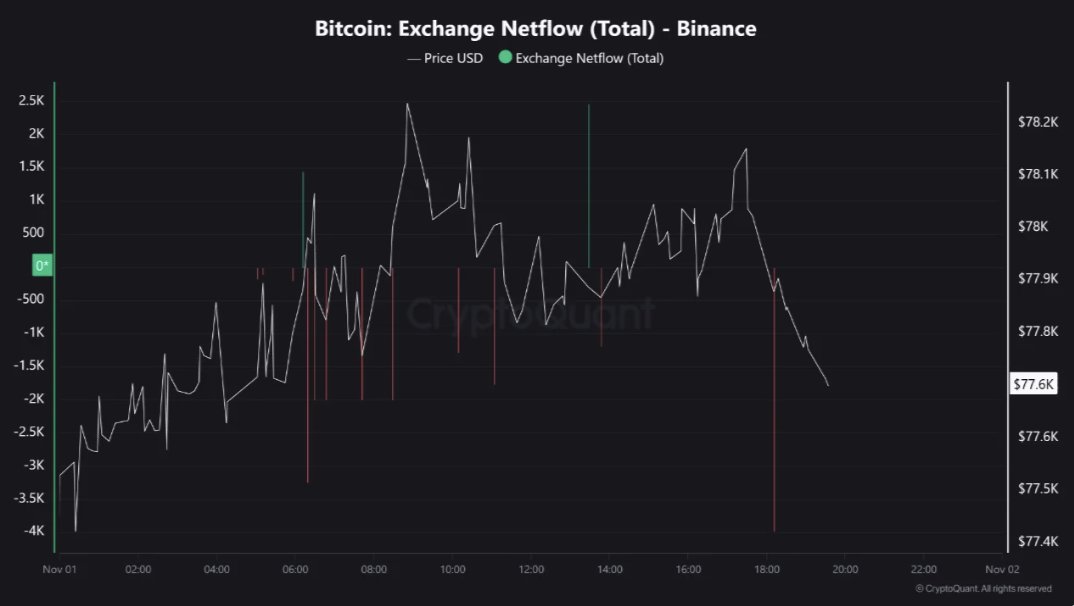
The exchange reserve chart for Binance shows the sharp spike in BTC inflows that accompanied the hack event itself — a visual signature consistent with large volumes of flagged assets moving onto the exchange. Following the resolution, the reserve curve has begun to normalize. At the time of the chart, Binance held approximately 658,500 BTC on its books, with the current price labeled at $77,900.
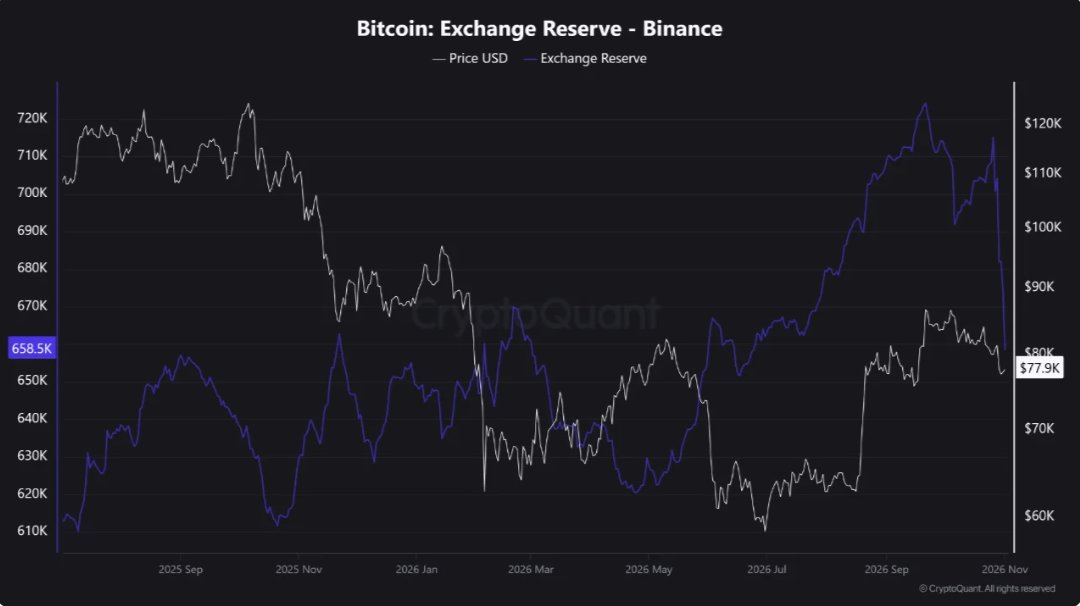
The significance of a 2.43% outflow rate should not be understated. In the hours after major exchange security events, outflow rates have historically spiked to double-digit percentages of reserves as users rush to self-custody. A 2.43% rate is within normal daily withdrawal variance for an exchange of Binance’s size — it is not a signal of a bank run.
Proof of Reserves — The Verification Layer
Alongside the withdrawal resumption, Binance published an updated Proof of Reserves report audited to block height 973895 (timestamp: 31/10/26 00:00:00 UTC). The dashboard shows reserve ratios at or above 100% across all major assets:
| Asset | Reserve Ratio | Net Account Balances | Onchain Wallet Balance |
|---|---|---|---|
| BTC | 100.04% | 692,186.737 | 692,488.864 |
| ETH | 100.00% | 3,654,919.15 | 3,654,921.842 |
| USDT | 100.00% | 29,483,062,742.4 | 29,483,062,748.463 |
| BNB | 101.30% | 42,638,275.565 | 43,192,045.152 |
Binance Proof of Reserves — Audit Block 973895 | Source: @cryptoquant_com (X)
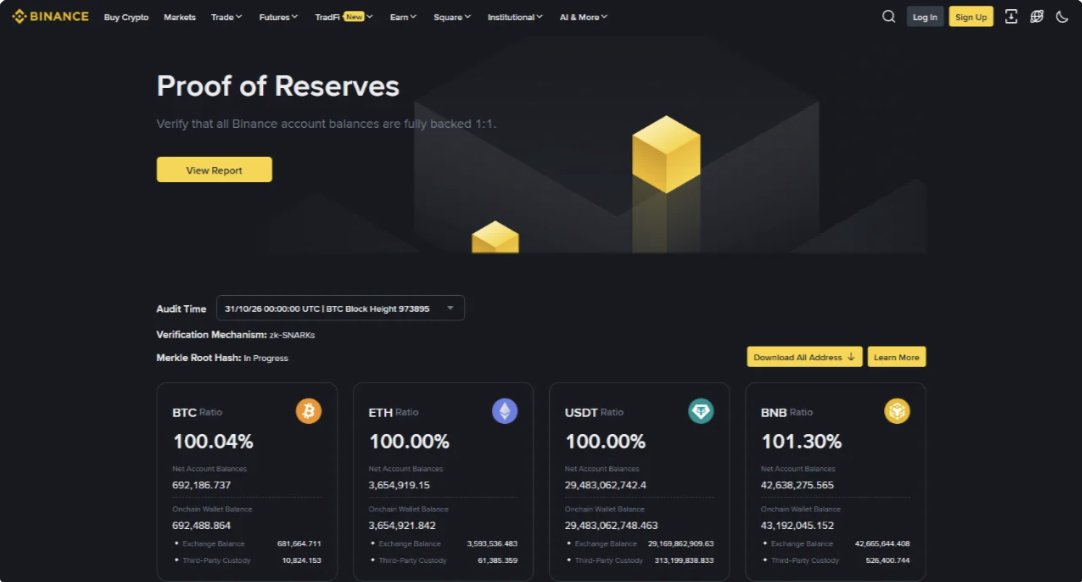
Each ratio at or above 100% means Binance holds at least as many assets on-chain as it owes to users in net account balances. The BTC ratio of 100.04% and BNB ratio of 101.30% indicate a slight surplus — the exchange holds marginally more than is owed. This is the published verification that the OTC repurchase was complete before the report was signed.
Market Context — Fear & Greed and Price Response
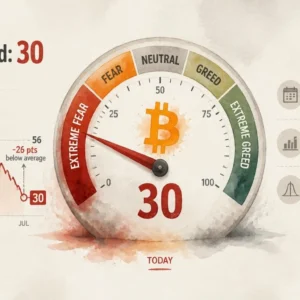
Bitcoin’s 0.12% 24-hour move at $77,876 reflects a market that has already digested the initial shock. The Bitcoin Fear & Greed Index dropped to 30 immediately following the hack — 26 points below the monthly average — representing the acute sentiment shock. The current price stability near $77,876 suggests the market is treating the OTC resolution and Proof of Reserves publication as credible closure rather than an ongoing threat.
Market cap stands at approximately $1.565 trillion. 24-hour trading volume is $17.02 billion — elevated but not extreme, consistent with a market processing a resolved headline event rather than an escalating crisis. For ETH holders monitoring broader contagion risk, ETH’s own technical position remains a separate consideration from the Binance resolution.
What Users Should Know
Withdrawals are processing normally as of the CryptoQuant report timestamp (November 2, 2026, 12:30 GMT). No further security issues have been flagged in the on-chain data. The Proof of Reserves report is publicly available on the Binance website at the audit parameters above. The -16,021 BTC net outflow recorded so far on the day confirms that funds are leaving the exchange as requested — there is no technical freeze or hidden withdrawal restriction in the on-chain data.
Users who had funds affected by the original hack are covered under Binance’s OTC repurchase mechanism. The exchange has not published a specific timeline for when individual claim resolutions will appear in user accounts — that communication should be monitored through Binance’s official channels directly.
The on-chain data as reported by CryptoQuant shows Binance exiting this event with reserves intact, a published audit, and withdrawal infrastructure functioning at normal flow rates. The 2.43% reserve outflow rate and the ≥100% Proof of Reserves ratios across BTC, ETH, USDT, and BNB are the two numbers that define the current status. Watch Binance’s daily BTC netflow — if it accelerates sharply beyond the current -16,021 BTC baseline, that would signal renewed user concern. If it remains at current rates, the market has absorbed the event.
Frequently Asked Questions
Did Binance users lose money in the hack?
How much BTC has left Binance since withdrawals resumed?
What is a Proof of Reserves report and why does it matter here?
What on-chain metric should users watch to monitor Binance’s recovery status?
Source: CryptoQuant · Published by CoinsProbe Markets Desk
The opinions and market insights shared on CoinsProbe represent the views of individual authors based on prevailing market conditions at the time of publication. Cryptocurrency investments carry significant risk and volatility. Readers are encouraged to conduct their own research and seek professional financial advice before making investment decisions. CoinsProbe and its contributors do not accept responsibility for financial losses or decisions made based on published content.
CoinsProbe may publish sponsored articles, affiliate links, or promotional collaborations. All sponsored material is clearly labeled to maintain transparency with our audience. Our editorial decisions remain fully independent, and advertising partnerships do not influence reviews, rankings, or published opinions.
Since 2023, CoinsProbe has delivered reliable insights on cryptocurrency, blockchain, and digital assets. Our content is created by experienced researchers and analysts who follow strict editorial standards focused on accuracy, transparency, and credibility. Every article is carefully reviewed and verified using trusted sources and current market data. We provide unbiased analysis and timely updates covering everything from emerging crypto projects to major industry developments.