
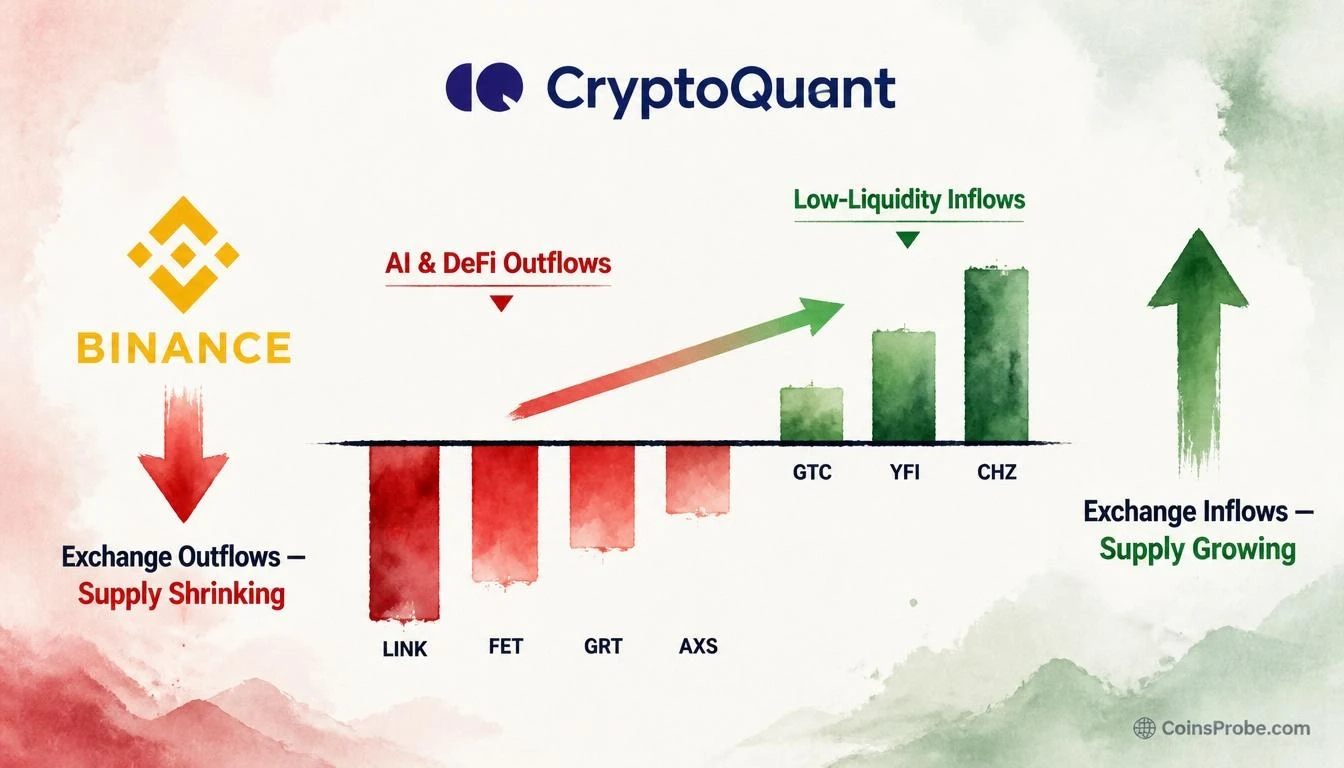

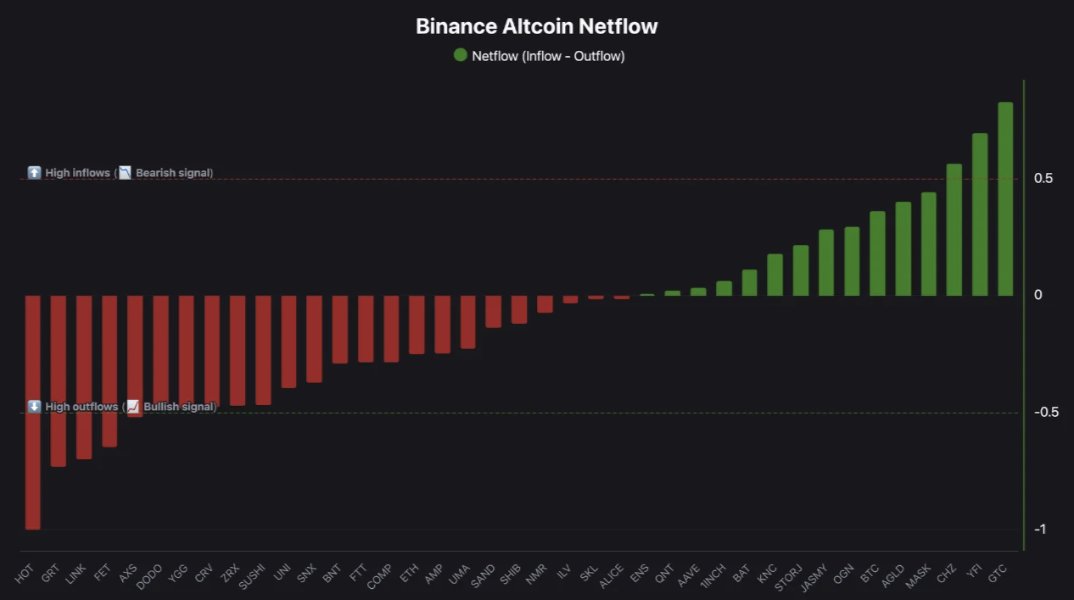
- Binance netflow data shows HOT, GRT, LINK, FET, and AXS recording the deepest exchange outflows per CryptoQuant analyst @Fundingvest
- GTC, YFI, and CHZ are logging strong net inflows — growing exchange-available supply and increasing potential selling pressure
- Analyst condition: if AI and DeFi token outflows persist over the next few days, that supports the case for a rally in those names
- Bitcoin is trading at $64,194 (-0.42% 24h) as the altcoin netflow divergence takes shape
A divergence is forming on Binance — and on-chain data is making it visible. AI tokens like FET and GRT, alongside infrastructure and DeFi names including LINK, AXS, and AAVE, are seeing meaningful outflows from the exchange. At the same time, low-liquidity altcoins — specifically GTC, YFI, and CHZ — are recording net inflows. Bitcoin is trading at approximately $64,194 at the time of writing, down 0.42% over the past 24 hours.
The observation comes from an on-chain analyst publishing through CryptoQuant’s Quicktake platform, who frames the divergence directly: “Outflows are concentrated mostly in AI and infrastructure/DeFi tokens, while inflows are showing up in low-liquidity coins.” The report, dated November 16, 2026, was shared by CryptoQuant’s official account and attributed to analyst @Fundingvest.
What Binance Altcoin Netflow Actually Measures
Exchange netflow is the net difference between tokens moving onto an exchange (inflows) and tokens leaving an exchange (outflows) over a given period. It is a supply-side metric — it does not measure price directly. What it measures is exchange-available supply: how much of a token is sitting on Binance and is therefore immediately available to be sold.
An outflow means tokens are being withdrawn from Binance — typically into self-custody wallets or cold storage. This shrinks the exchange-available supply and indicates that holders are choosing not to sell at current prices. An inflow means tokens are being deposited onto Binance — positioning them to be sold. This grows exchange-available supply and can increase selling pressure if demand does not absorb it.
The chart from CryptoQuant ranks altcoins along a waterfall from most negative netflow (deepest outflows, left side) to most positive netflow (highest inflows, right side). The result is a clear visual split: a large cohort of red bars concentrated on the left — dominated by AI and DeFi names — and a smaller cluster of green bars on the right, representing low-liquidity tokens.
Who Is Leaving — and Who Is Arriving
According to the CryptoQuant report, the tokens showing the most pronounced outflows include HOT, GRT, LINK, FET, and AXS. These sit at the far left of the ranked chart — the deepest outflow readings. DODO, YGG, and CRV appear near the outflow threshold. ETH is registering slight outflows. On the inflow side, GTC, YFI, and CHZ are recording strong net inflows — meaning supply on Binance for these tokens is actively growing. MASK, AGLD, and BTC appear close to the inflow threshold, with BTC specifically logging moderate inflows per the same analysis.
The sectoral pattern is not random. The tokens exiting Binance — LINK, FET, GRT, AAVE, AXS — represent what the broader market has categorized as quality infrastructure plays: decentralized oracle networks, AI-integrated protocols, and established DeFi primitives. The tokens entering Binance — GTC, YFI, CHZ — are lower-liquidity names with thinner market depth. This is a capital quality divergence, not just a flow divergence.
What This Signals — and What It Does Not
The CryptoQuant report is precise about what exchange outflows do and do not imply. For tokens seeing outflows, the analyst notes that “the shrinking supply on Binance indicates that selling has slowed.” Holders are not rushing to the exit — they are pulling coins off the exchange entirely. However, the report explicitly cautions: “Reduced selling pressure alone is not a trigger for a rally in the short term.” Outflows improve the supply-side setup, but they do not create immediate price catalysts by themselves.
For the tokens seeing inflows, the picture is structurally the opposite. The analyst states that growing exchange supply “puts them in a position ready to be sold and can increase selling pressure.” If a rally does materialize across the altcoin market, GTC, YFI, and CHZ would be starting from a heavier supply position — meaning they would need to absorb more exchange-side selling to generate the same price appreciation as tokens with leaner on-exchange supply.
The Conditional That Matters
The CryptoQuant analysis includes a specific forward condition. The analyst states: “If outflows continue over the next few days, that would support the case for a rally in these altcoins.” This is not a price call — it is a supply-side confirmation threshold. Sustained outflows over the coming sessions in HOT, GRT, LINK, FET, AXS, and the DeFi names would signal that accumulation is extending, not reversing. That persistence of outflows is the metric that converts a current snapshot into a structural setup worth monitoring.
The inverse holds for inflow tokens. If GTC, YFI, and CHZ continue registering net inflows, any price appreciation in those names would occur against a backdrop of rising exchange supply — a headwind that historically compresses the magnitude of altcoin rallies. The analyst frames this directly: coins seeing inflows “would enter a rally under heavier pressure and rise less.”
This dynamic is relevant context for anyone evaluating altcoin exposure across different sectors. As Bitcoin navigates its own technical pressure zones, the composition of altcoin exchange flows provides one of the cleaner signals for where institutional-grade supply is being removed from the market versus where it is being staged for sale.
Reading the Divergence as a Market Structure Signal
Taken together, the netflow picture on Binance as of November 16, 2026 reflects a market where the tokens most closely associated with real protocol utility — AI, decentralized infrastructure, DeFi — are being withdrawn from exchange supply. The tokens seeing inflows are concentrated in lower-liquidity names with less fundamental backing. That is not a coincidence — it is capital rotation behavior: holders with conviction in AI and DeFi names are removing them from sale; holders managing lower-conviction positions in thinner tokens are positioning for potential exits.
This divergence does not predict a timeline. What it does establish is an asymmetric supply-side setup: AI and DeFi tokens entering any rally with leaner exchange supply, low-liquidity tokens entering the same rally with heavier exchange supply. All else being equal, the former group has the structural advantage in terms of price-impact-per-unit-of-demand. Watch CryptoQuant’s daily Binance netflow data for whether the outflow pattern in HOT, GRT, LINK, FET, and AXS sustains — that continuation is the analyst’s stated condition for the supply setup to translate into a meaningful price argument.
Frequently Asked Questions
What does exchange outflow mean for AI tokens like FET and LINK?
Why are GTC, YFI, and CHZ seeing inflows while AI tokens see outflows?
What is the specific condition the analyst gives for a potential altcoin rally?
Does BTC showing moderate inflows on Binance contradict the broader analysis?
Source: CryptoQuant · Published by CoinsProbe Markets Desk
The opinions and market insights shared on CoinsProbe represent the views of individual authors based on prevailing market conditions at the time of publication. Cryptocurrency investments carry significant risk and volatility. Readers are encouraged to conduct their own research and seek professional financial advice before making investment decisions. CoinsProbe and its contributors do not accept responsibility for financial losses or decisions made based on published content.
CoinsProbe may publish sponsored articles, affiliate links, or promotional collaborations. All sponsored material is clearly labeled to maintain transparency with our audience. Our editorial decisions remain fully independent, and advertising partnerships do not influence reviews, rankings, or published opinions.
Since 2023, CoinsProbe has delivered reliable insights on cryptocurrency, blockchain, and digital assets. Our content is created by experienced researchers and analysts who follow strict editorial standards focused on accuracy, transparency, and credibility. Every article is carefully reviewed and verified using trusted sources and current market data. We provide unbiased analysis and timely updates covering everything from emerging crypto projects to major industry developments.