

- PI trades near $0.0826, down 28.5% over the past month as selling pressure persists.
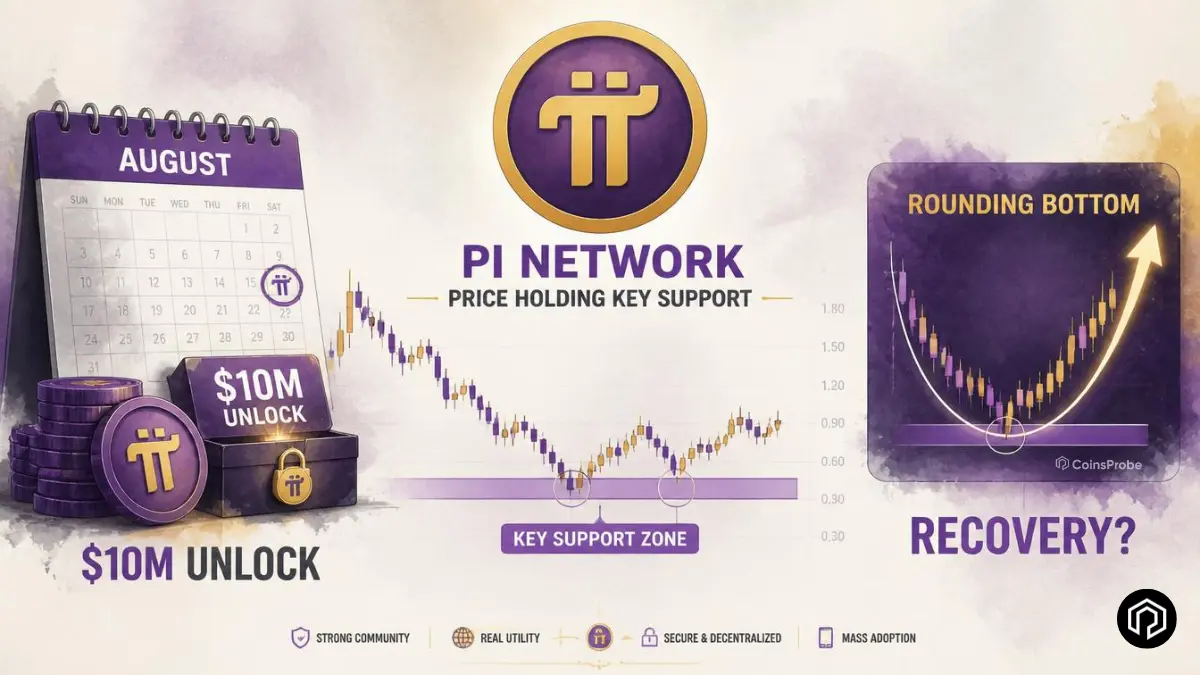
- August will unlock 127.96 million PI (~$10.56M), with even larger unlocks scheduled through November.
- Around 1.7 billion PI (~$140.7M) is set to unlock over the next 12 months, increasing supply pressure.
- PI is forming a potential rounding bottom, with $0.0702 as key support and $0.1044 as the first major resistance.
Pi Network’s price decline is one of the more structurally clear stories in the current crypto market — a combination of accelerating token unlocks creating consistent supply expansion and insufficient demand to absorb it, playing out against the backdrop of a challenging broader altcoin environment. Understanding the unlock schedule is essential to understanding the price trajectory.
PI is trading at $0.08261 — down -4.03% in 24 hours, -28.51% over 30 days, and -59.63% year-to-date — with a market cap of approximately $908 million. Despite meaningful ecosystem development progress throughout 2026 — including the Pi2Day SoloHost, Pi Sign-in, and PiVerify launches, the Protocol v26.1 upgrade, and the SLICE Launchpad distribution — the token price has continued declining as supply growth consistently outpaces demand.

The Core Problem — Accelerating Token Unlocks
The most concrete and data-backed explanation for PI’s sustained price weakness is its token unlock schedule — which is not merely continuing but accelerating through the remainder of 2026 and beyond.
Monthly unlock comparison:
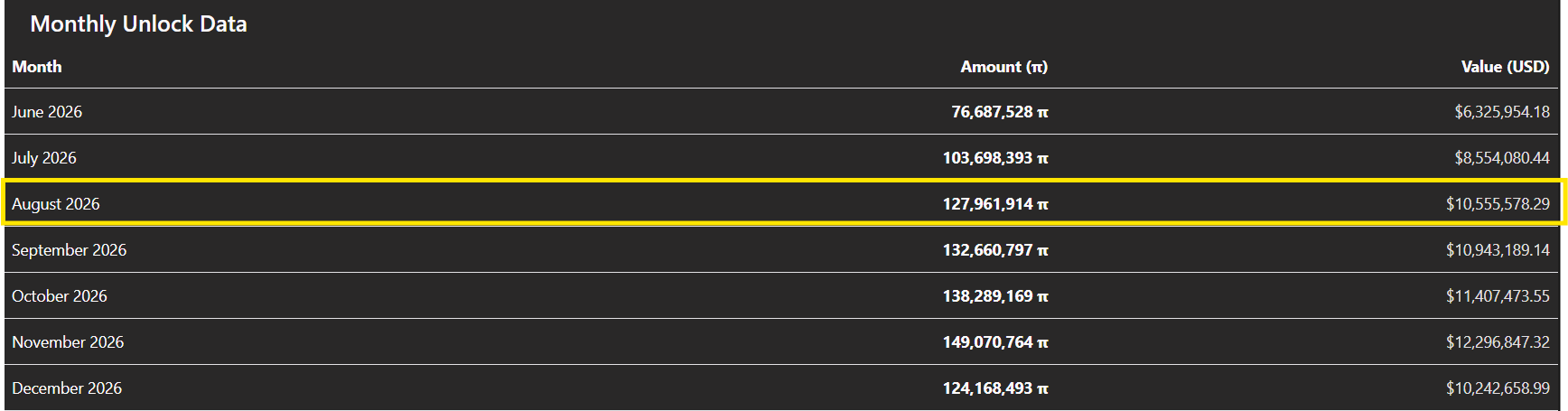
The trend is unmistakable: Monthly unlocks have grown from $6.33M in June to a projected $12.30M in November — a +94% increase in monthly supply addition over six months. Each month brings more new PI into circulation than the month before.
The 12-month picture:
Over the next 12 months, a total of 1.705 billion PI tokens will unlock — worth approximately $140.7 million at current prices. The average monthly unlock across this period is approximately 17.2 million PI (~$1.42 million per month), with the largest single-month event expected in December 2027 at over 432 million PI (~$35.7 million).

Why this matters for price:
Token unlocks matter because they increase the circulating supply available for selling. Many of the recipients of PI unlocks — early miners, ecosystem participants, and investors who received tokens at effectively zero cost — have a profit incentive at virtually any price above zero. As each month brings additional supply without a corresponding increase in buyer demand, the price faces persistent downward pressure.
As we covered in detail in our PI all-time low and market cap below $1 billion article — this supply-demand imbalance has been the primary structural driver of PI’s decline from its $2.9816 all-time high. Until either unlock pace slows materially or demand grows significantly to absorb the supply, the structural headwind persists.
August 2026 — The Unlock to Watch
The August unlock of 127,961,914 PI (~$10.56 million) represents a +23.4% increase from July’s 103,698,393 PI — the largest month-over-month step-up in the near-term schedule.
At the current price of $0.08261, $10.56 million in new PI entering the market represents approximately 1.16% of the current total market cap being unlocked in a single month — a meaningful float expansion that, absent equivalent new buying demand, creates direct mathematical downward pressure on price.
The unlock does not mean all 127 million PI will be immediately sold — recipient behaviour varies, and some holders will retain tokens with long-term conviction. But even if only a fraction of recipients sell, the supply addition into current thin demand conditions is a consistent price headwind.
PI Coin Technical Analysis
Despite the challenging fundamental backdrop, the daily chart is showing a technical structure worth monitoring — a potential rounding bottom pattern forming after PI’s extended downtrend.
What a rounding bottom means:
A rounding bottom (also called a “saucer bottom”) is a bullish reversal pattern characterised by a gradual, U-shaped price curve — where the rate of decline slows, price stabilises at a low, and then begins a symmetric gradual recovery. Unlike sharp V-shaped reversals, rounding bottoms form over extended periods and reflect a slow but genuine shift in the balance between sellers and buyers.
For a rounding bottom to be valid, the pattern requires:
- A clearly defined low area (the bottom of the U)
- Gradual, symmetric recovery from that low
- A confirmed breakout above the neckline resistance level
PI’s current rounding bottom stage:
PI appears to be in the base-formation phase of this pattern — with the price action gradually stabilising in the $0.07–$0.09 zone after the extended downtrend. The pattern is not yet confirmed — confirmation requires specific level reclaims detailed below.
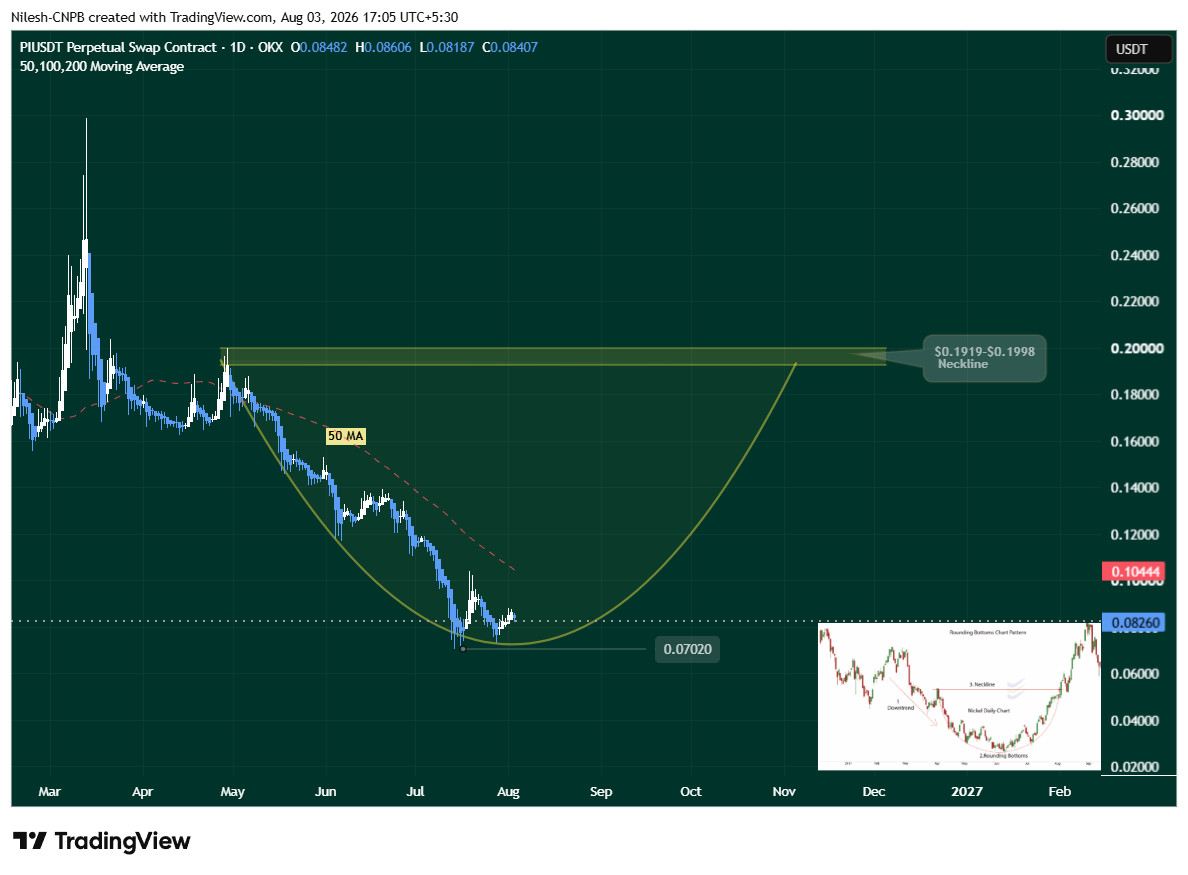
Critical support — $0.07020 (All-Time Low):
This is the single most important level in PI’s current chart structure. The all-time low at $0.07020 represents both the technical support floor and the psychological level whose break would signal that the decline has not yet found its true bottom. A sustained daily close below $0.07020 would invalidate the current rounding bottom thesis and significantly weaken the bullish structure — putting a new all-time low in focus without a clear support reference below.
First resistance — 50-day MA at $0.10444:
The 50-day moving average at approximately $0.10444 is the first meaningful resistance PI needs to overcome for the rounding bottom to develop constructively. A sustained reclaim of the 50 MA — ideally accompanied by rising volume — would be the first technical signal that the bottom formation is transitioning toward the recovery phase.
From the current price of $0.08261, reaching the 50 MA requires approximately +26.4% upside — a meaningful move but achievable if demand conditions improve.
Neckline resistance — $0.1919–$0.1998:
A decisive break and sustained hold above the $0.1919–$0.1998 neckline zone would complete the rounding bottom pattern — representing approximately +130% to +140% upside from the current price. This level is also significant as the zone where our prior analysis identified key support that PI needs to reclaim for meaningful recovery.
Bullish Scenario
PI holds the $0.07020 all-time low support — the rounding bottom base completes — and price begins a gradual recovery toward the 50-day MA at $0.10444. A sustained reclaim of the 50 MA with rising volume would confirm the pattern is developing and open the path toward the $0.1919–$0.1998 neckline zone as the full pattern target. This scenario requires either a slowdown in unlock-driven selling pressure or a significant increase in demand — potentially from a Tier-1 exchange listing, accelerated KYC completion, or broader altcoin market recovery.
Bearish Scenario
A sustained daily close below the $0.07020 all-time low would invalidate the rounding bottom structure — confirming that the current stabilisation is insufficient to absorb the ongoing unlock supply and that PI has not yet found its true bottom. In this scenario, the bullish setup requires a complete reset to a lower base before any recovery attempt becomes technically credible.
What Would Change the Narrative
As we covered extensively in our PI recovery above $1 analysis — the path to recovery requires demand catalysts that match or exceed the scale of the supply pressure from unlocks. The most likely candidates:
Tier-1 exchange listing: A Binance or Coinbase listing would bring a significant new buyer audience and create the kind of demand spike that could absorb multiple months of unlock supply simultaneously. This remains the most frequently cited near-term catalyst that has not yet materialised.
Accelerated KYC completion: Reducing the KYC backlog that has been one of the most consistent Pioneer frustrations throughout 2026 would activate a larger proportion of the existing community as active participants — as we covered in our Protocol v25 and Dark Mode article.
Ecosystem adoption: If the App Studio, SoloHost, PiVerify, or Pi Sign-in tools attract genuine external developer and business adoption — generating real PI utility demand — the supply-demand dynamic would begin shifting.
Broader altcoin recovery: A risk-on rotation into altcoins would lift PI alongside the broader market, providing the macro tailwind that individual token-specific catalysts cannot fully substitute for.
Bottom Line
Pi Network’s position at $0.08261 reflects a structurally clear market dynamic: accelerating token unlocks — growing from $6.33M in June to a projected $12.30M in November — consistently adding supply into a market where demand has not kept pace. The August unlock of $10.56 million is the latest and largest step in this acceleration.
The daily chart’s potential rounding bottom offers a technically defined recovery framework — but it requires the $0.07020 all-time low to hold and the 50-day MA at $0.10444 to be reclaimed before the pattern carries genuine confirmatory weight. Until either the supply dynamic changes or a significant demand catalyst materialises, the structural headwind persists.
Frequently Asked Questions
Why is Pi Network (PI) declining in 2026?
Two primary factors: consistent, accelerating token unlocks adding new supply every month — growing from $6.33M in June to a projected $12.30M in November — combined with insufficient buyer demand to absorb that supply, resulting in a -59.63% YTD decline.
How many PI tokens will be unlocked in August 2026?
127,961,914 PI (~$10.56 million) — the largest monthly unlock of 2026 so far — representing a +23.4% increase from July’s unlock.
What does the 12-month unlock schedule look like for PI?
1.705 billion PI tokens (~$140.7 million) over the next 12 months — averaging approximately 17.2 million PI per month — with a peak single-month event of over 432 million PI expected in December 2027.
Has Pi Network made ecosystem progress despite the price decline?
Yes — Pi2Day delivered SoloHost, Pi Sign-in, and PiVerify; Protocol v26.1 upgraded the network; the SLICE Launchpad completed distribution; and App Studio added backend support. Development has continued throughout the price decline — the challenge is translating infrastructure progress into sufficient token demand.
The opinions and market insights shared on CoinsProbe represent the views of individual authors based on prevailing market conditions at the time of publication. Cryptocurrency investments carry significant risk and volatility. Readers are encouraged to conduct their own research and seek professional financial advice before making investment decisions. CoinsProbe and its contributors do not accept responsibility for financial losses or decisions made based on published content.
CoinsProbe may publish sponsored articles, affiliate links, or promotional collaborations. All sponsored material is clearly labeled to maintain transparency with our audience. Our editorial decisions remain fully independent, and advertising partnerships do not influence reviews, rankings, or published opinions.
Since 2023, CoinsProbe has delivered reliable insights on cryptocurrency, blockchain, and digital assets. Our content is created by experienced researchers and analysts who follow strict editorial standards focused on accuracy, transparency, and credibility. Every article is carefully reviewed and verified using trusted sources and current market data. We provide unbiased analysis and timely updates covering everything from emerging crypto projects to major industry developments.