
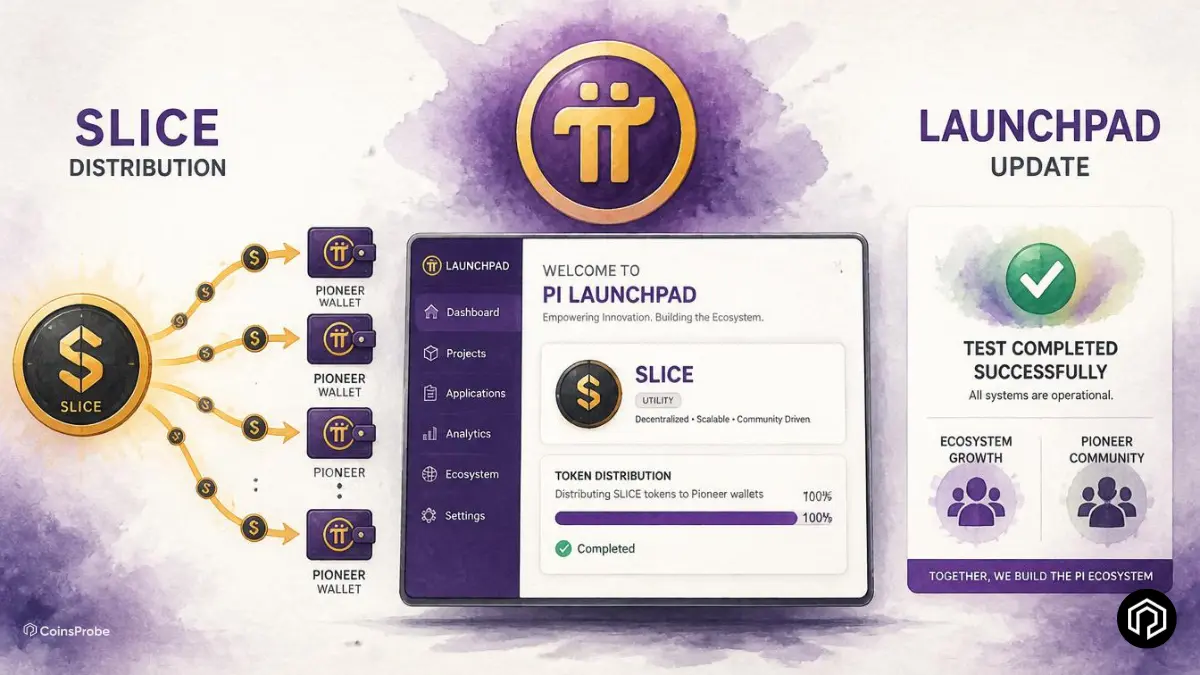

- Pi Network completed the SLICE Test token distribution, with 242,000+ Pioneers committing 15.92M Test-Pi for 10M SLICE tokens.
- SLICE is linked to the Slice of Pi game, allowing Pi to test real-world engagement rewards.
- Pi Launchpad now offers live liquidity pool price tracking for hands-on DeFi testing.
- The raised Test-Pi was added to a liquidity pool, providing immediate trading liquidity rather than funding the project team.
Pi Network’s second Launchpad test token — SLICE — has completed its distribution phase and entered the post-launch exploration period, introducing the community to one of the most important DeFi mechanics they will encounter in future Mainnet token launches: the automated market maker liquidity pool. Today’s update adds live price tracking to that pool, completing the full educational loop from token commitment to real-time market dynamics.
SLICE Launch — By the Numbers
Between June 11 and June 28, 2026, the SLICE test token launch ran through Pi Launchpad with the following results:
| Metric | Data |
|---|---|
| Total Pioneers participated | 242,000+ |
| Total Test-Pi committed | 15.92 million |
| Total SLICE tokens issued | 10 million |
| Connected application | Slice of Pi (real third-party game) |
| Testnet only | Yes — will not move to Mainnet |
The participation scale — over 242,000 Pioneers committing Test-Pi across an 18-day window — demonstrates the depth of community engagement with Pi’s ecosystem token mechanics, even at the testnet stage where no real monetary value is at stake. This data provides Pi’s core team with meaningful signal about how the Mainnet version of Launchpad will function at scale.
What Made SLICE Different From the First Test Token
The first Pi Launchpad test token was a standalone exercise — a token without a connected application, used purely to test the launch mechanism itself. SLICE represents a meaningful step forward: it is connected to Slice of Pi, a real third-party game operating within the Pi ecosystem.
This distinction matters for one specific reason: the engagement bonus feature — which rewards Pioneers with additional SLICE based on their actual usage of the connected application — could only be meaningfully tested with a real product. A dummy app cannot generate genuine engagement signals. Slice of Pi can.
As we covered in our Pi Launchpad SLICE testnet launch article — the engagement bonus is one of the most innovative elements of Pi’s Launchpad model, specifically designed to reward active ecosystem participants over passive token farmers. Testing it with a real application for the first time provides data that the first launch could not generate.
The participation process itself was also simplified compared to the first launch. Pioneers committed Test-Pi directly, and the Launchpad automatically calculated the fair-access hold and applied engagement bonuses as a percentage increase on the SLICE received — reducing the manual steps required and moving closer to the frictionless experience that Mainnet participation will require for mass adoption.
How the SLICE Liquidity Pool Works — A Plain English Explanation
The most important educational element of the SLICE launch — and the feature that most directly prepares Pioneers for Mainnet DeFi participation — is the liquidity pool model and the Automated Market Maker (AMM) that powers it.
The key design principle:
In the Pi Launchpad model, the Test-Pi raised during a token launch does not go to the project team. Instead, it is deposited directly into a liquidity pool alongside the newly issued token — in this case, SLICE paired with Test-Pi. This creates healthy, immediate liquidity from day one and reinforces Pi’s product-first ecosystem philosophy: token launches are about utility, user acquisition, and engagement, not pure capital extraction by project founders.
How the AMM pricing works:
The pool uses a constant-product formula — the mathematical foundation of most DeFi automated market makers:
SLICE reserve × Test-Pi reserve = constant product
This formula means that as one asset is removed from the pool, the other must increase proportionally to keep the product constant — which is what drives price changes in response to buying and selling activity.
A simplified example to make it concrete:
| Step | SLICE Reserve | Test-Pi Reserve | Product | SLICE Price |
|---|---|---|---|---|
| Pool starts | 10 SLICE | 10 Test-Pi | 100 | 1 Test-Pi |
| Pioneer buys 5 SLICE | 5 SLICE | ? | 100 (must hold) | Rises |
| To keep product = 100 | 5 SLICE | 20 Test-Pi | 100 | 4 Test-Pi |
When a Pioneer buys SLICE with Test-Pi — Test-Pi is added to the pool and SLICE is removed. With less SLICE in the pool, each remaining SLICE is more expensive — the price rises. When Pioneers sell SLICE back — the opposite occurs, SLICE is added and Test-Pi is removed, and the price falls.
This mechanism means the SLICE price is driven entirely by actual pool activity — no central authority sets the price, and it reflects the real-time balance between buyers and sellers within the pool.
The New Feature — Live Price Chart in Launchpad
The update announced today adds a live SLICE/Test-Pi price chart directly within the Pi Launchpad interface — tracking price changes based on actual pool activity in real time.
This addition completes the educational loop: Pioneers can now not only participate in the token launch and explore the liquidity pool, but also watch price movements happen in response to their own and other Pioneers’ interactions with the pool — experiencing the core DeFi mechanic of AMM-driven price discovery directly rather than reading about it abstractly.
What the Launchpad interface now shows:
- Individual allocation details — how much SLICE each Pioneer received and at what effective price
- Launch price and effective token price — allowing comparison of entry versus current pool price
- Direct access to the SLICE liquidity pool — enabling swaps between SLICE and Test-Pi
- Real-time price chart relative to Test-Pi — the new addition showing price history driven by pool activity
What This Means for Future Mainnet Launches
SLICE exists only on Testnet and will never migrate to Mainnet — its purpose is educational and infrastructural, not monetary. But the lessons, mechanics, and data generated by the SLICE launch directly inform how Pi’s Mainnet Launchpad will function when real value is at stake.
As we covered in our Pi2Day 2026 SoloHost, Pi Sign-in, and PiVerify release article — Pi Network has been systematically building the infrastructure layers required for genuine utility: compute through SoloHost, identity through PiVerify, and now DeFi mechanics through Launchpad test launches. Each iteration adds real operational data and community familiarity with the mechanisms that will define how the Mainnet ecosystem actually functions.
A Pioneer who has committed Test-Pi through Launchpad, watched SLICE’s AMM-driven price chart, and experimented with swapping in the liquidity pool is significantly better prepared to participate effectively in a Mainnet token launch — where actual Pi value will be at stake — than one encountering these mechanics for the first time with real money on the line.
How to Explore SLICE Right Now
The full SLICE post-launch experience is available immediately through the Pi Launchpad inside the Pi Browser. Pioneers can:
View their individual allocation — including exact SLICE received and effective price relative to committed Test-Pi
Access the live price chart — tracking SLICE/Test-Pi price movements driven by real pool activity
Interact with the liquidity pool — experimenting with swaps to experience AMM price dynamics directly
Review engagement bonus details — understanding how Slice of Pi usage affected their final SLICE allocation
Bottom Line
The SLICE test token launch has achieved what Pi Network designed it to achieve: 242,000+ Pioneers have hands-on experience with fair-access token launches, engagement bonuses, liquidity pool mechanics, and AMM-driven pricing — all through a safe, no-real-value Testnet environment before these mechanics go live on Mainnet with actual Pi.
The addition of live price tracking closes the educational loop — making the entire Launchpad experience from commitment to real-time market dynamics accessible and understandable through direct participation rather than abstract explanation.
Whether PI’s price can recover above $1 — as we analysed in our PI recovery analysis — will depend significantly on whether the Mainnet version of these mechanisms generates the genuine ecosystem activity and token demand that the Testnet iterations are being built to support.
Frequently Asked Questions (FAQ)
What is the SLICE test token on Pi Network?
SLICE is Pi Network’s second Testnet token launched through Pi Launchpad — connected to the real third-party game Slice of Pi — used to test engagement bonuses, liquidity pool mechanics, and AMM pricing in a safe Testnet environment with no real monetary value.
How many Pioneers participated in the SLICE launch?
Over 242,000 Pioneers committed a total of 15.92 million Test-Pi to acquire 10 million SLICE tokens between June 11–28, 2026.
What happens to the Test-Pi committed during a Launchpad launch?
It is not sent to the project team — it is deposited directly into a liquidity pool alongside the issued token, creating immediate day-one liquidity and supporting Pi’s product-first ecosystem philosophy.
What is the new price tracking feature?
A live SLICE/Test-Pi price chart inside the Pi Launchpad interface — showing real-time price movements driven by actual AMM pool activity, completing the hands-on DeFi education experience.
Will SLICE ever move to Mainnet?
No — SLICE exists only on Testnet and will never migrate to Mainnet. Its purpose is educational and infrastructural, preparing Pioneers and the Pi team for future Mainnet token launches.
How can Pioneers access SLICE right now?
Through the Pi Launchpad inside the Pi Browser — showing individual allocations, the live price chart, direct liquidity pool access, and engagement bonus details.
The opinions and market insights shared on CoinsProbe represent the views of individual authors based on prevailing market conditions at the time of publication. Cryptocurrency investments carry significant risk and volatility. Readers are encouraged to conduct their own research and seek professional financial advice before making investment decisions. CoinsProbe and its contributors do not accept responsibility for financial losses or decisions made based on published content.
CoinsProbe may publish sponsored articles, affiliate links, or promotional collaborations. All sponsored material is clearly labeled to maintain transparency with our audience. Our editorial decisions remain fully independent, and advertising partnerships do not influence reviews, rankings, or published opinions.
Since 2023, CoinsProbe has delivered reliable insights on cryptocurrency, blockchain, and digital assets. Our content is created by experienced researchers and analysts who follow strict editorial standards focused on accuracy, transparency, and credibility. Every article is carefully reviewed and verified using trusted sources and current market data. We provide unbiased analysis and timely updates covering everything from emerging crypto projects to major industry developments.