

- CryptoRank found that 6 of 8 major crypto airdrops have lost 90–99% of their value since launch.
- Hyperliquid (HYPE) is the standout, with a $130 median airdrop now worth about $4,700—a 36x (+3,515%) return.
- Uniswap (UNI) is the only other token to hold its value, while APT, OP, ARB, APE, STRK, and DYDX have all declined 92–99%.
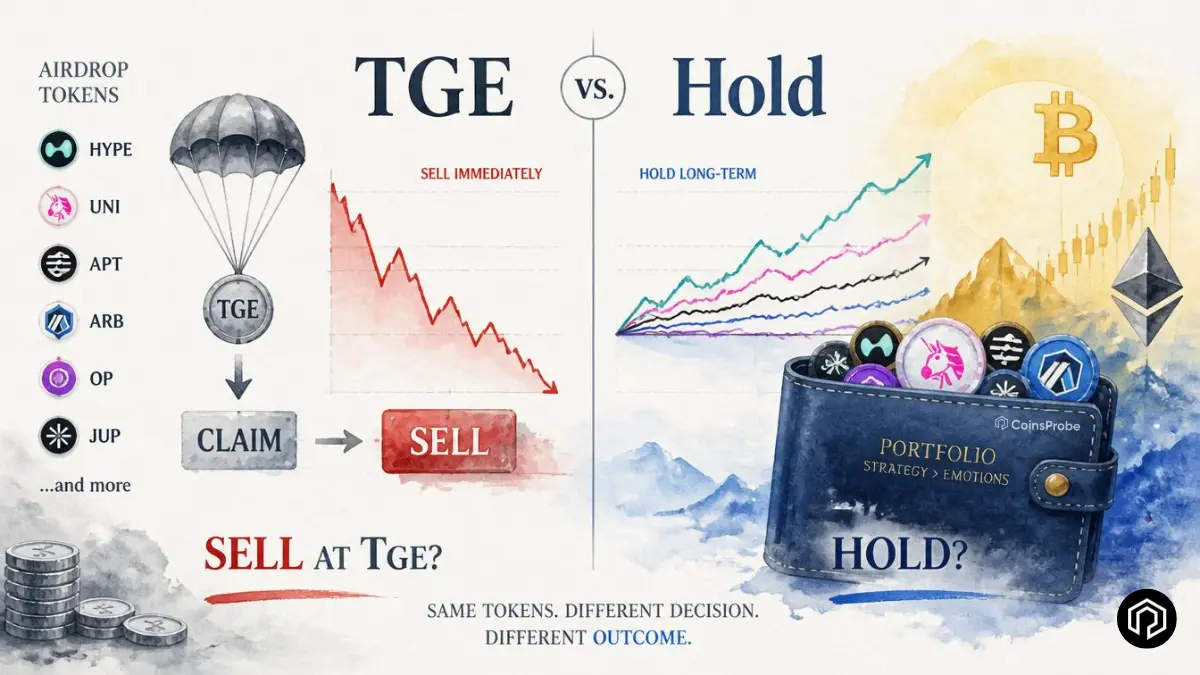
- The data suggests selling at TGE has historically outperformed holding for most airdrops, with HYPE being the rare exception.
One of the most persistent debates in crypto is deceptively simple: when you receive an airdrop, should you sell immediately at TGE or hold for potential long-term upside? The answer that most people assume — that holding is better for quality projects — turns out to be wrong for the vast majority of cases. CryptoRank.io’s analysis of eight major airdrops provides the clearest data-based answer this debate has yet produced.
The Data — 8 Major Airdrops: Claim Day vs. Today
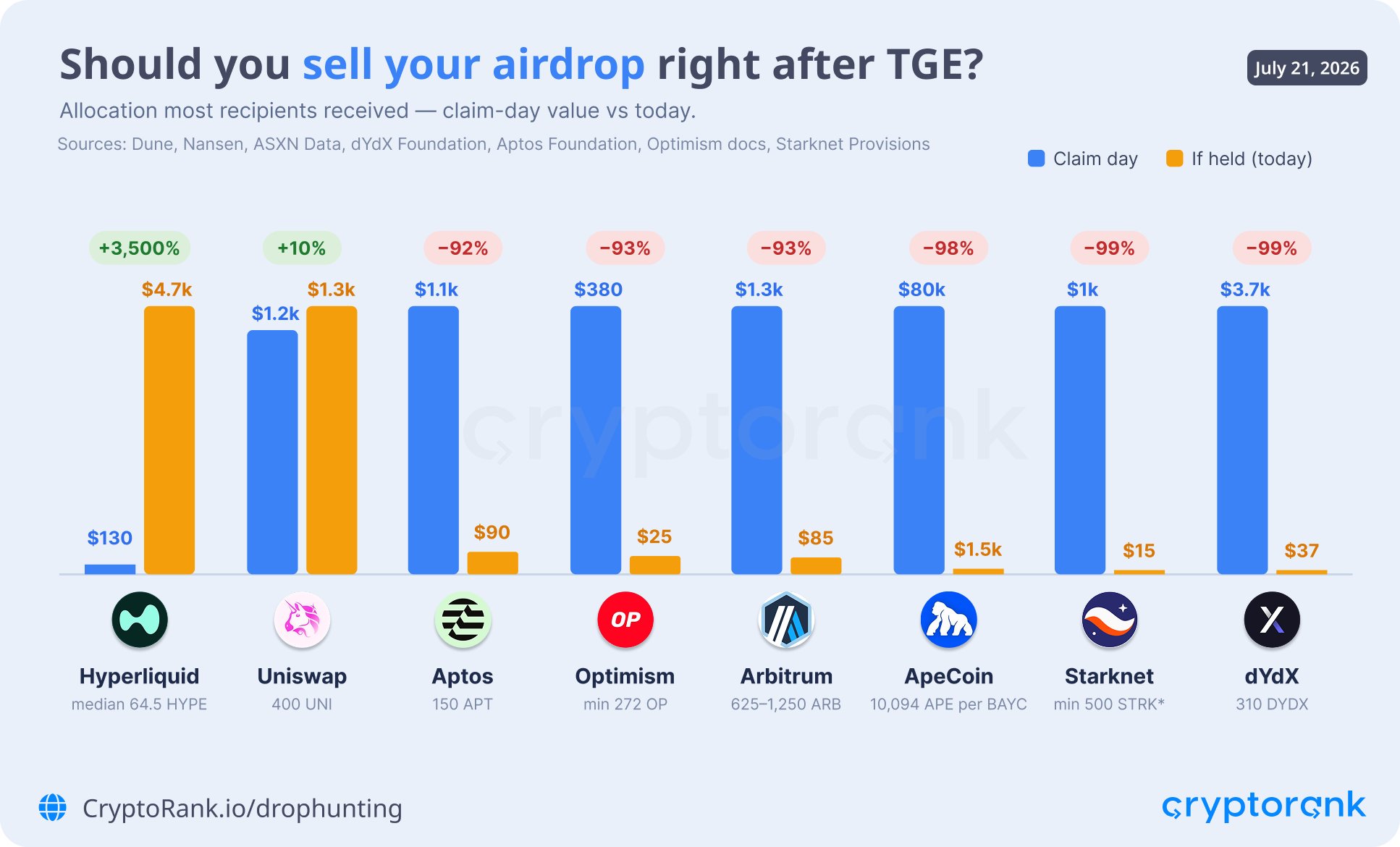
The chart above is the entire argument. Six of eight projects have destroyed between 92% and 99% of their claim-day value for holders. One has stayed roughly flat. One — Hyperliquid — has delivered a 36x return. The numbers are not ambiguous.
The One Exception — Why $HYPE Is Different
$HYPE is the only project in this dataset where holding the airdrop produced extraordinary returns — and understanding specifically why it succeeded is more useful than simply noting that it did.
A median airdrop allocation worth $130 on claim day has grown to approximately $4,700 — a +3,515% return for those who held from TGE to today. This is not a marginal outperformance. It is a 36x multiple against a backdrop where every other project in the same dataset lost 92–99% of its value.
The reasons Hyperliquid succeeded where others failed:
Genuine, measurable product-market fit — Hyperliquid rapidly established itself as the dominant decentralised perpetuals exchange, climbing to the top of Perp DEX volume rankings and sustaining that position through consistent product improvement rather than initial hype alone.
Real, protocol-level revenue — As we have covered extensively throughout 2026 — including the AQAv2 USDC yield mechanism and HIP-3 open interest records — Hyperliquid generates substantial, verifiable fee revenue that funds its buyback program and creates genuine token demand independent of speculative inflows.
Continued execution post-TGE — Unlike most airdropped tokens where the team delivers the token and development momentum fades, Hyperliquid continued shipping meaningful product updates — Portfolio Margin, new market listings, expanding institutional adoption — maintaining the attention and usage that drives organic demand.
The development pipeline continues: Most recently, Hyperliquid announced HIP-4 — a proposal introducing permissionless prediction markets on the platform, further expanding its utility beyond perpetual futures. Deployers can create and deploy their own prediction markets by staking 500,000 $HYPE for 6 months — with up to 50% of generated fees returned to the deployer. Markets require validator approval for quality control, and stakes can be slashed for poor definitions or settlement failures.
Currently being tested on testnet, HIP-4 represents Hyperliquid’s next major product expansion — the kind of continued post-TGE execution that is precisely why its airdrop has produced 36x returns while others in this dataset lost 90–99%.
The Other Side — Why 6 of 8 Projects Destroyed Value
The -92% to -99% losses across $APT, $OP, $ARB, $APE, $STRK, and $DYDX are not random — they reflect a consistent set of structural factors that apply to most airdrops:
Initial hype and concentrated selling pressure
Most airdrop recipients — particularly farmers who participated in multiple protocols specifically to earn tokens — have zero long-term conviction in the project. They are there for the airdrop, not for the product. This creates an enormous wave of sell pressure at TGE from thousands of wallets simultaneously converting their airdrop value into stablecoins or Bitcoin. This supply surge at launch creates downward price pressure that, for projects without genuine sustained demand, never fully recovers.
Token unlock and vesting schedules
The recipient airdrop is typically just the first wave of supply hitting the market. Team tokens, investor tokens, and advisor allocations generally unlock on 1–4 year vesting schedules — creating ongoing, predictable future supply additions that cap recovery rallies even when sentiment improves. Projects like $ARB and $OP have faced sustained selling from investor unlocks that have consistently offset any recovery attempt.
Project execution risk post-TGE
The airdrop moment is, by design, the peak of attention for most protocols. The announcement, the claim process, the community excitement — all concentrate at TGE and then dissipate. Projects that do not have a clear product roadmap with sustained execution after the airdrop moment lose the narrative momentum that temporary price support requires. The -99% on $DYDX and -98.5% on $STRK reflect protocols that had genuine technology but could not sustain the attention and usage needed to maintain token value over time.
Market cycle exposure
Many of these airdrops occurred during or near market peaks — exposing holders not just to project-specific risk but to the full magnitude of the subsequent bear market drawdown. Tokens that launched at peak cycle valuations started with an additional structural disadvantage that compound their fundamental challenges.
$UNI — The Flat Exception
Uniswap’s +8% from claim day across nearly six years is a notable data point precisely because of what it represents: a project with genuine, durable product-market fit and consistent usage — the largest decentralised exchange by most metrics — that has nonetheless failed to generate meaningful returns for airdrop holders over a multi-year horizon.
This illustrates an important nuance in the data: even genuine product quality does not automatically translate into token appreciation. Protocol usage does not equal token value accrual without a clear mechanism connecting the two — a lesson Uniswap holders have learned over six years while the protocol itself has thrived.
The Practical Framework — What the Data Actually Suggests
The data does not support two of the most commonly held positions in airdrop strategy debates:
“Always sell immediately at TGE” — This would have caused you to miss Hyperliquid’s 36x. For the one project in eight with genuine sustainable fundamentals, immediate selling destroyed the majority of the potential return.
“Always hold quality projects” — This would have resulted in -92% to -99% losses across six of eight projects, including ones that had strong teams, genuine technology, and real narratives at TGE.
What the data does support — a fundamentals-first approach:
Take partial profits at TGE or shortly after. Locking in a portion of the claim-day value removes the risk of watching $80,000 become $1,500 (as ApeCoin holders experienced) while leaving upside exposure if the project executes.
Hold a portion only with genuine fundamental conviction. The difference between Hyperliquid and every other project in this dataset is not luck — it is measurable, verifiable execution on real product metrics. If you cannot identify specific, data-backed reasons why a project will sustain and grow its user base and revenue post-TGE, the data suggests the base case is significant loss rather than significant gain.
Monitor actively post-TGE before deciding on the remaining position. On-chain metrics — trading volume, active users, protocol revenue, token unlock schedules — provide the signals that distinguish a Hyperliquid from a $DYDX in the months after TGE. Passive holding without monitoring is the strategy that produced the -99% outcomes in this dataset.
Bottom Line
CryptoRank.io’s eight-airdrop dataset delivers a clear statistical verdict: for six of eight projects, selling at TGE would have preserved between 92% and 99% of the claim-day value that holding destroyed. The one project where holding produced exceptional returns — Hyperliquid — succeeded specifically because it continued to execute on measurable, verifiable fundamentals in the months and years after TGE.
The practical implication is not “always sell everything immediately” — it is “never hold passively without a specific, evidence-based reason to believe the project is building toward Hyperliquid-style sustained execution.” In the absence of that evidence, the data says the base case for airdrop holding is loss, not gain.
Frequently Asked Questions
What does the crypto airdrops data show?
Of 8 major airdrops analysed, 6 lost between 92% and 99% of their claim-day value for holders — only $HYPE delivered exceptional returns (+3,515%, ~36x) and $UNI stayed roughly flat (+8%).
Which crypto airdrop performed best for holders?
Hyperliquid ($HYPE) — a median claim-day allocation worth $130 grew to approximately $4,700, a +3,515% return and roughly 36x multiple for those who held from TGE.
Which crypto airdrop performed worst for holders?
dYdX ($DYDX) — a median claim-day allocation worth $3,700 is now worth approximately $37, a -99% loss for holders from TGE to today.
Why did most crypto airdrops lose 90%+ of their value?
Four primary factors: concentrated selling pressure from farmers at TGE, ongoing token unlock supply from investors and teams, project execution risk post-TGE, and market cycle exposure during bear market conditions.
Why did Hyperliquid airdrop succeed where others failed?
Genuine product-market fit as the dominant Perp DEX, measurable real revenue funding token buybacks, and continued product development post-TGE — creating organic, sustained demand rather than relying on initial hype.
The opinions and market insights shared on CoinsProbe represent the views of individual authors based on prevailing market conditions at the time of publication. Cryptocurrency investments carry significant risk and volatility. Readers are encouraged to conduct their own research and seek professional financial advice before making investment decisions. CoinsProbe and its contributors do not accept responsibility for financial losses or decisions made based on published content.
CoinsProbe may publish sponsored articles, affiliate links, or promotional collaborations. All sponsored material is clearly labeled to maintain transparency with our audience. Our editorial decisions remain fully independent, and advertising partnerships do not influence reviews, rankings, or published opinions.
Since 2023, CoinsProbe has delivered reliable insights on cryptocurrency, blockchain, and digital assets. Our content is created by experienced researchers and analysts who follow strict editorial standards focused on accuracy, transparency, and credibility. Every article is carefully reviewed and verified using trusted sources and current market data. We provide unbiased analysis and timely updates covering everything from emerging crypto projects to major industry developments.