

- Key Highlights
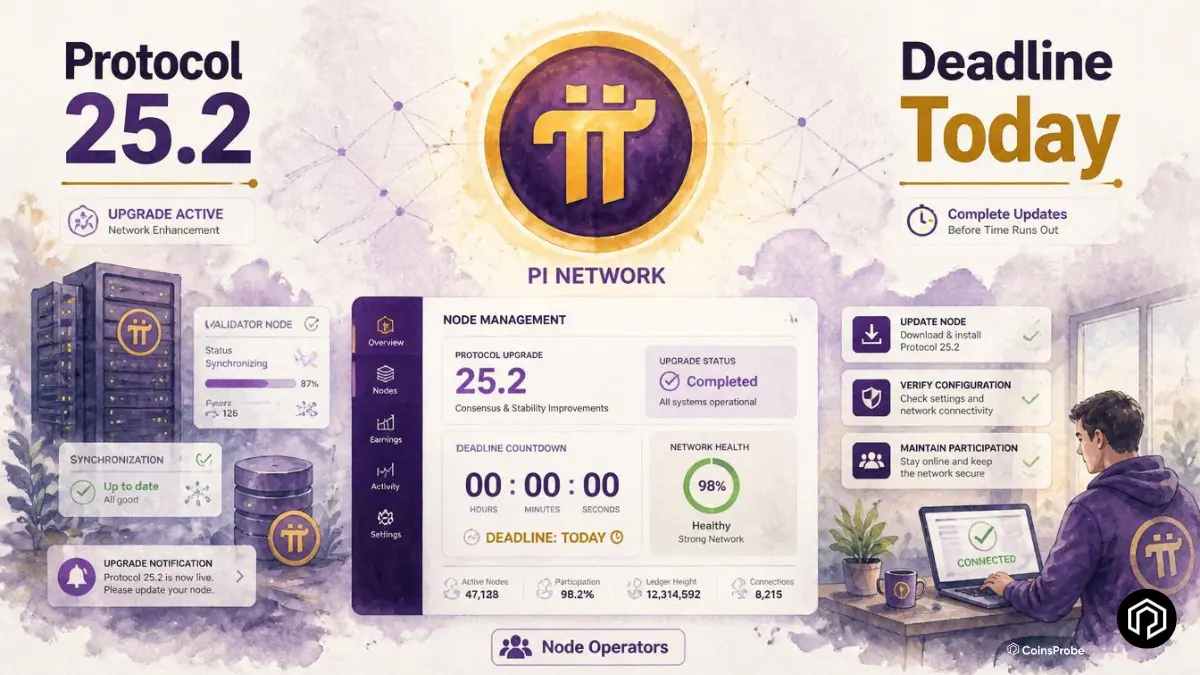
- Today, June 18, 2026, is the mandatory deadline for all Pi Network Mainnet nodes to complete the Protocol 24.1 → 25.2 upgrade — nodes that miss this deadline risk temporary disconnection from the network.
- This is the eighth of nine sequential upgrade steps in Pi's v19-to-v26 roadmap — with the prior step (23.0 → 24.1) successfully completed on June 2, 2026.
- The upgrade is a very quick migration with expected downtime under 5 minutes — but node operators must follow strict sequencing rules to avoid network disruption.
- Only one step remains after today — the 25.2 → 26.0 upgrade — which is explicitly marked "Do NOT start" with a deadline still TBD.
The clock has run out. Today — June 18, 2026 — is the day Pi Network node operators must have their nodes running Protocol version 25.2 to remain connected to Mainnet. This marks the eighth of nine upgrade steps in Pi’s methodical journey from v19 to v26 — and the network is now firmly in the final stretch of its most significant infrastructure transformation since launch.
As we covered in our Protocol 25.2 rollout and deadline article — this deadline was set immediately after the v24.1 step completed successfully on June 2 — giving node operators a 16-day window to complete the migration before today’s cutoff.
Current Node Upgrade Status — Where Pi Network Stands
Source: Pi Network Official Documentation
| Upgrade Step | Status | Deadline | Notes |
|---|---|---|---|
| 23.0 → 24.1 | Completed successfully | June 2, 2026 | Very quick — under 15 min downtime |
| 24.1 → 25.2 | Upgrade in progress | June 18, 2026 (Today) | Very quick — under 5 min downtime |
| 25.2 → 26.0 | Do NOT start | TBD | Final step — locked |
This is the eighth step in the full sequential upgrade path that began with 19.1 → 19.6 and runs through to the final 25.2 → 26.0 transition. Every step in this sequence has been completed successfully and on schedule — a track record that reflects positively on both Pi’s technical execution and its node operator community’s reliability.
The Full Upgrade Journey So Far
For context on how far the network has come — here is the complete picture of every step completed before today’s deadline:
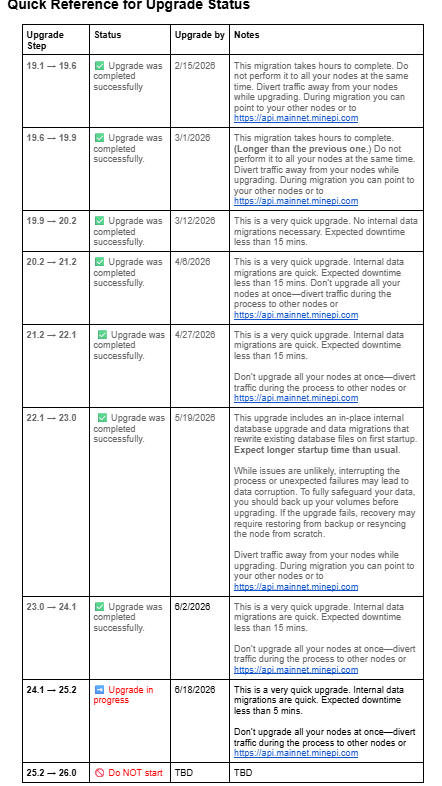
Seven steps fully completed without a single reported network-wide failure. The 22.1 → 23.0 migration in May stands out as the most technically complex of the entire sequence — involving an in-place internal database upgrade that rewrote existing database files on first startup, requiring node operators to back up their data beforehand as a precaution against the longer-than-usual startup time. That step’s successful completion demonstrated the network’s ability to handle its most demanding migrations.
Today’s Upgrade — What Node Operators Need to Know
Expected downtime: Under 5 minutes
Today’s 24.1 → 25.2 migration is classified as a very quick upgrade — internal data migrations are fast, and node operators should expect less than 5 minutes of downtime during the process. This is actually faster than the prior several steps in the sequence — most of which carried an expected downtime of under 15 minutes.
Critical rules for executing the upgrade:
Do NOT upgrade all nodes simultaneously — If you operate multiple nodes, stagger the upgrade process across them rather than taking your entire infrastructure offline at once.
Divert traffic during migration — While a node is upgrading, redirect traffic to your other nodes or to the official endpoint at https://api.mainnet.minepi.com to maintain continuous network availability.
Do not start unauthorised upgrades — The next step (25.2 → 26.0) remains explicitly locked. Attempting to start it before official activation could cause synchronisation issues with the broader network.
Monitor your node’s status — Use the command watch pi-node status to track your node’s upgrade progress in real time and confirm successful completion.
How to Complete the Upgrade — By Setup Type
The upgrade process varies depending on how your node is configured:
Pi Desktop (Windows/macOS) — The upgrade applies automatically the next time you restart your node. No manual command execution is required — simply restarting your desktop node application should trigger the update.
Pi Linux Node CLI — Run the command:
pi-node update-protocolThis manually triggers the protocol update process on Linux-based node installations.
Self-managed Docker — Update your Docker image to the latest version and restart the container. This applies to operators running custom or self-hosted Docker deployments rather than the standard desktop or CLI installations.
Why This Deadline Matters
Missing today’s deadline carries a concrete consequence: nodes that fail to complete the upgrade to version 25.2 risk being temporarily disconnected from the network. For node operators, this means lost participation in network validation and consensus until the upgrade is completed and the node successfully resynchronises.
Beyond the individual operator impact — each completed step in this sequence is building toward the production-grade infrastructure that the broader Pi ecosystem depends on. As we covered in our CiDi Games launch article and our Pi App Studio vibe coding article — the application ecosystem and developer tools that Pi is building all run on top of this same Mainnet infrastructure. Even the improved Pi Launchpad participation flow and SLICE testnet token depends on this same underlying network reliability. Every successful protocol upgrade strengthens the foundation those applications depend on.
What Comes Next — The Final Step
With today’s 24.1 → 25.2 deadline being met, Pi Network will have completed eight of nine total upgrade steps in its v19-to-v26 sequence. Only the final transition — 25.2 → 26.0 — remains, and it is currently marked “Do NOT start” with a deadline still to be determined.
The Pi Core Team has consistently followed a pattern throughout this upgrade sequence: announce the next deadline only after the current step is confirmed complete network-wide. Node operators should expect official communication regarding the 26.0 timeline once today’s 25.2 deadline has been fully processed and verified across the network.
Bottom Line
Today is decision day for Pi Network node operators. The 24.1 → 25.2 upgrade is the eighth of nine steps in Pi’s comprehensive infrastructure overhaul — and with expected downtime under 5 minutes, it should be among the smoothest migrations in the entire sequence for operators who follow the proper staggered process.
Seven prior steps have been completed successfully without major incident — including the technically demanding May database migration. That track record suggests today’s deadline should pass similarly smoothly for operators who divert traffic appropriately and avoid upgrading all nodes simultaneously.
One step remains after today. The finish line for Pi’s v19-to-v26 journey is now genuinely close — and a more capable, fully upgraded Mainnet is also the infrastructure question many Pioneers are weighing as they track whether $PI can recover above $1 again.
Frequently Asked Questions (FAQ)
What is today’s deadline for Pi Network nodes?
All Mainnet nodes must complete the Protocol 24.1 → 25.2 upgrade by June 18, 2026 — today — or risk temporary disconnection from the network.
How do I upgrade my node?
Pi Desktop: automatic on restart. Pi Linux Node CLI: run pi-node update-protocol. Self-managed Docker: update the Docker image and restart the container.
How many upgrade steps has Pi Network completed?
Seven of nine steps fully completed — with today’s 24.1 → 25.2 marking the eighth step. Only the final 25.2 → 26.0 transition remains, with a TBD deadline.
The opinions and market insights shared on CoinsProbe represent the views of individual authors based on prevailing market conditions at the time of publication. Cryptocurrency investments carry significant risk and volatility. Readers are encouraged to conduct their own research and seek professional financial advice before making investment decisions. CoinsProbe and its contributors do not accept responsibility for financial losses or decisions made based on published content.
CoinsProbe may publish sponsored articles, affiliate links, or promotional collaborations. All sponsored material is clearly labeled to maintain transparency with our audience. Our editorial decisions remain fully independent, and advertising partnerships do not influence reviews, rankings, or published opinions.
Since 2023, CoinsProbe has delivered reliable insights on cryptocurrency, blockchain, and digital assets. Our content is created by experienced researchers and analysts who follow strict editorial standards focused on accuracy, transparency, and credibility. Every article is carefully reviewed and verified using trusted sources and current market data. We provide unbiased analysis and timely updates covering everything from emerging crypto projects to major industry developments.