
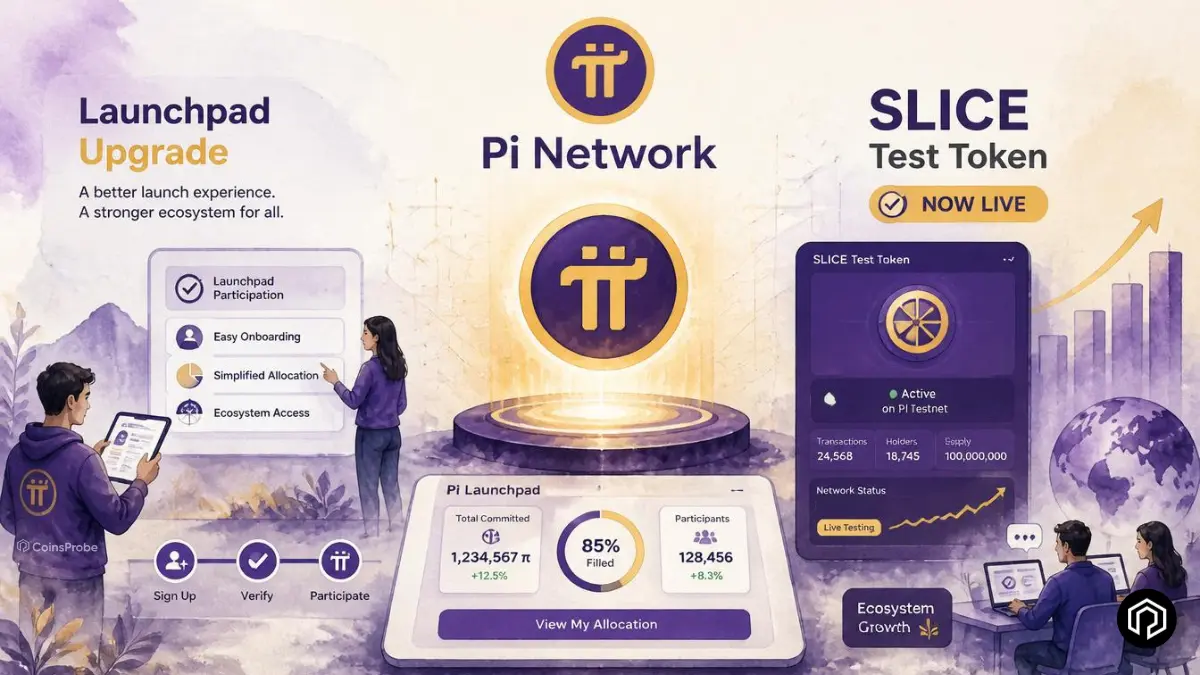

- Pi Network has rolled out major Pi Launchpad improvements based on real user feedback from the first test token (IRRA) — simplifying the participation flow, introducing a commitment-first approach, and fixing the high drop-off rates identified during the first launch.
- The second Testnet token SLICE is now live — connected to a real working app called Slice of Pi — open for participation until Pi2Day, June 28, 2026.
- A new Fair-Access Hold mechanism scales the required hold proportionally with commitment size — preventing whale dominance and giving smaller Pioneers a fairer allocation opportunity.
- SLICE is a Testnet token only — it will never migrate to Mainnet — and exists purely to test the new flow and gather real engagement data before the eventual Mainnet Launchpad launch.
Pi Network has done something that separates genuinely iterative projects from those that simply launch and move on: it listened to what went wrong with the first test, documented it publicly, and shipped meaningful fixes before the next one.
The first Pi Launchpad test token — IRRA, launched on Pi Day 2026 — revealed a set of real friction points that were causing Pioneers to drop off before completing participation. The team has now addressed those specific pain points with a redesigned flow — and is testing it with the second Testnet token SLICE, connected to a real Pi-integrated app called Slice of Pi.
As we covered in our Pi Launchpad testnet explosive growth article — the Launchpad attracted over 300,000 Pioneers before Mainnet even started. The improvements announced today are building on that foundation — making the experience significantly more accessible ahead of the eventual Mainnet launch.
What Went Wrong With the First Test — And What Pi Did About It
The IRRA test was not just a product launch — it was a data collection exercise. Pi Network documented three specific problems that the real user data revealed:
Problem 1 — Confusion between staking and committing
Pioneers were unclear about the distinction between two separate actions — staking Test-Pi and committing Test-Pi — leading to misunderstandings about what they were doing and why.
Problem 2 — High drop-off rates from separate screens
When users had to navigate between different screens to complete separate actions, significant numbers were dropping off mid-process — never completing their participation despite having started.
Problem 3 — Too many complex steps for new Pioneers
The multi-step flow created friction that was manageable for experienced Pioneers but a significant barrier for newer users who were encountering the Launchpad for the first time.
This is the kind of honest product feedback that most projects never surface publicly — and the fact that Pi Network documented these specific pain points and addressed them directly reflects genuine iterative development rather than a polished launch narrative.
The Four Key Improvements
1. Commitment-First Approach
The most fundamental change: instead of separate staking and committing screens — Pioneers now start by choosing their commitment amount (how much Test-Pi they want to use for token acquisition). The system then automatically calculates everything else and presents it on a single screen.
This eliminates the confusion between staking and committing entirely — because there is only one primary action for the Pioneer to take. The system handles the calculation. The Pioneer makes one decision.
2. Fair-Access Hold Mechanism
Rather than a flat hold requirement — the new system scales the required hold proportionally with the commitment amount:
- Larger commitments require proportionally larger holds
- Smaller commitments require proportionally smaller holds
- The held Pi is temporary — it is returned after the hold period ends
This mechanism serves a specific equity purpose: preventing large holders (whales) from dominating token allocations by simply committing maximum amounts. By requiring a proportional hold alongside the commitment — the system creates a natural barrier to whale concentration while keeping the process accessible for smaller Pioneers.
3. Deterministic Hold-to-Commit Ratio
The previous dynamic model — which changed based on real-time conditions — has been replaced with a fixed curve. The ratio between the hold required and the commitment amount is now predictable and consistent.
This matters for user trust: Pioneers can calculate exactly what will be required before they start the process, rather than encountering a dynamic requirement that may have changed since they last checked. Predictability reduces friction and builds confidence.
4. Single-Screen UX with Sequential Transactions
All details — commitment amount, fair-access hold, engagement bonuses, and total — are now presented on one scrollable screen. The two transactions (commit + hold) that were previously handled on separate pages are now processed sequentially from a single confirmation page.
Engagement bonuses are now displayed as a percentage bonus on received tokens rather than an abstract figure — making the incentive immediately understandable without requiring any calculation from the user.
The Second Testnet Token — SLICE
While the UX improvements address the process — SLICE introduces something the IRRA test did not have: connection to a real working application.
SLICE is the native token of Slice of Pi — a Pi-integrated game built directly within the Pi Browser ecosystem. This distinction matters for what the test is actually measuring:
IRRA tested whether Pioneers could navigate the participation flow.
SLICE tests whether Pioneers who acquire a token will engage with the product behind it — measuring the correlation between token participation and real app usage.
This engagement data will be one of the most valuable inputs the Pi Core Team has collected to date — because it directly informs whether the Launchpad model produces genuine user acquisition for projects or simply token speculation.
Key SLICE details:
| Detail | Data |
|---|---|
| Token name | SLICE |
| Connected app | Slice of Pi (Pi-integrated game) |
| Participation deadline | Pi2Day — June 28, 2026 |
| Testnet only | Will never migrate to Mainnet |
| Purpose | Test new flow + measure product engagement |
How to Participate in SLICE
The new simplified flow in practice:
Step 1 — Open the Pi Browser and navigate to the Pi Launchpad app
Step 2 — Review the SLICE token and Slice of Pi project details
Step 3 — Choose your commitment amount in Test-Pi
Step 4 — Review the auto-calculated fair-access hold and total — everything shown on one screen
Step 5 — Confirm both transactions sequentially from the single confirmation page
Step 6 — Engage with the Slice of Pi app to potentially earn engagement bonuses on received tokens
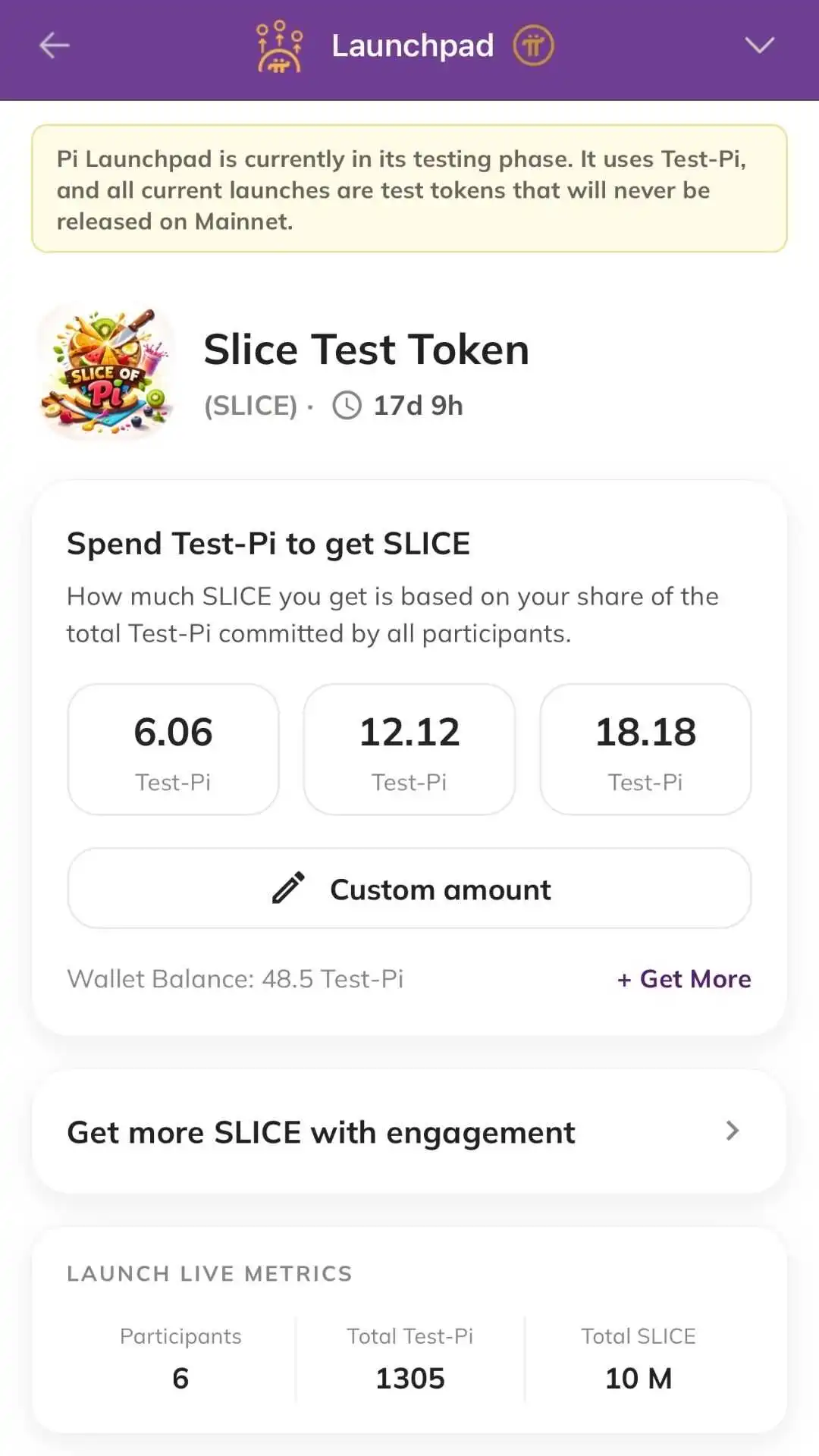
The entire process should now complete in a single session without the navigational drop-off points that affected the IRRA participation rate.
The Pi Launchpad Philosophy — Why This Matters
The SLICE launch reinforces a principle that distinguishes Pi’s Launchpad from most token launch platforms: proceeds from token sales go into liquidity pools rather than directly to the project team.
This structure means:
- Projects cannot simply fundraise and disappear
- Liquidity is bootstrapped from day one — creating healthy trading conditions rather than thin post-launch markets
- Token prices are supported by real liquidity rather than pure speculative demand
As we covered in our Pi Launchpad growth article — the Launchpad’s approach to token economics is designed for real utility and user acquisition — not fundraising extraction. This utility-first philosophy is directly relevant to the question many Pioneers are asking: as we analysed in our Claude AI $PI price recovery article, genuine demand-driving utility is one of the key catalysts that could support $PI’s price recovery above $1 — and Launchpad projects generating real app engagement are exactly the kind of utility that moves the demand needle.
What Comes Next
The June 28 deadline for SLICE participation is also the timeline for collecting the engagement data that will inform the next iteration of the Launchpad flow before Mainnet launch.
Pioneers who participate in SLICE are directly contributing to the dataset that shapes how the final Mainnet Launchpad will work — making participation valuable beyond any token economics.
The Pi Core Team has consistently framed these Testnet exercises as genuine feedback collection rather than theatre — and the changes between IRRA and SLICE demonstrate that the feedback is actually influencing the product. The Launchpad expansion also connects directly to Pi’s broader developer acquisition push — as we covered in our Pi Network Vibe Coder Campaign article, Pi is actively recruiting AI app builders to bring their creations to the Pi Browser ecosystem — and the improved Launchpad flow gives those builders a cleaner, more accessible token launch mechanism when their apps are ready to onboard users.
As we covered in our Protocol v25.2 upgrade article — Pi’s infrastructure is progressing simultaneously toward v26 — the fully upgraded production environment that will host the eventual Mainnet Launchpad. The UX work happening in these Testnet iterations will land on infrastructure that is significantly more capable than what existed when IRRA launched.
Bottom Line
The Pi Launchpad SLICE launch is a textbook example of iterative product development done properly. Identify the specific problems. Document them honestly. Ship targeted fixes. Test with real users. Repeat.
The commitment-first flow, fair-access hold mechanism, deterministic ratio, and single-screen UX all directly address the specific friction points IRRA revealed. SLICE adds the dimension of real app engagement data that will make the next iteration more valuable still.
Pioneers have until June 28 to participate — test the new flow, engage with Slice of Pi, and submit feedback. Every data point collected before Mainnet makes the final launch better for the entire ecosystem.
Frequently Asked Questions (FAQ)
What is the new Pi Launchpad update?
Pi Network released a major UX improvement to the Launchpad with a simpler “Commitment-First” flow and automatic fair-access hold calculation.
What is SLICE token?
SLICE is the second test token on Pi Launchpad, connected to the “Slice of Pi” game. It is purely for testing and will not migrate to Mainnet.
How does the new participation flow work?
You now choose your commitment amount first. The system automatically calculates the required fair-access hold. Everything is shown on one screen for easier participation.
When does the SLICE test end?
The SLICE participation window is open until Pi2Day – June 28, 2026.
How can I participate in the new Launchpad?
Open Pi Browser → Go to Pi Launchpad → Select SLICE → Choose commitment amount → Confirm the transactions.
The opinions and market insights shared on CoinsProbe represent the views of individual authors based on prevailing market conditions at the time of publication. Cryptocurrency investments carry significant risk and volatility. Readers are encouraged to conduct their own research and seek professional financial advice before making investment decisions. CoinsProbe and its contributors do not accept responsibility for financial losses or decisions made based on published content.
CoinsProbe may publish sponsored articles, affiliate links, or promotional collaborations. All sponsored material is clearly labeled to maintain transparency with our audience. Our editorial decisions remain fully independent, and advertising partnerships do not influence reviews, rankings, or published opinions.
Since 2023, CoinsProbe has delivered reliable insights on cryptocurrency, blockchain, and digital assets. Our content is created by experienced researchers and analysts who follow strict editorial standards focused on accuracy, transparency, and credibility. Every article is carefully reviewed and verified using trusted sources and current market data. We provide unbiased analysis and timely updates covering everything from emerging crypto projects to major industry developments.