


- Arbitrum froze 30,766 ETH linked to the KelpDAO exploit.
- Funds moved to a secure wallet, pending DAO decision.
- Critics warn of centralization risks and “backdoor” concerns.
- Debate intensifies over security vs decentralization trade-off.
A major controversy has erupted across the crypto space after Arbitrum’s Security Council stepped in to freeze over 30,000 ETH (worth $71M) linked to the recent KelpDAO exploit.
The move, announced today om April 21, 2026, was intended as a rapid response to protect funds. But instead of universal praise, it has sparked a heated debate:
Is this a necessary defense against hackers — or proof that decentralization still has limits?
What Happened?
Following the KelpDAO exploit, Arbitrum’s Security Council used a special mechanism to transfer 30,766 ETH from the attacker’s wallet into a frozen address.
- The funds are now locked
- They cannot be moved without future DAO governance approval
- No other user balances or chain operations were affected
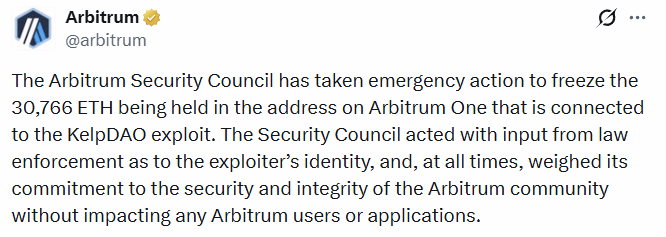
According to the council, the decision was made in coordination with law enforcement and aimed at preventing further damage while giving the DAO time to decide the next steps.
Why It Sparked Backlash
Despite the intention, the move immediately raised serious concerns within the crypto community.
Critics argue that this action demonstrates a centralized “override capability” — something many believe should not exist in decentralized systems.
The core concern is simple:
If funds can be moved without private keys, even in extreme cases, what prevents misuse in the future?
Some community voices warned that such mechanisms could:
- Be exploited by attackers if discovered
- Be influenced by political or external pressure
- Undermine the principle of “code is law”
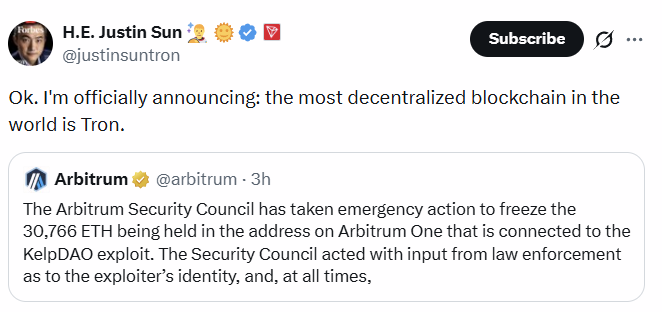
Adding fuel to the debate, Justin Sun took a jab at the situation, claiming that Tron is now the “most decentralized blockchain” — highlighting the growing tension around Layer 2 governance models.
The Defense: Security Over Ideology
Supporters of the decision argue that the move was not only justified — but necessary.
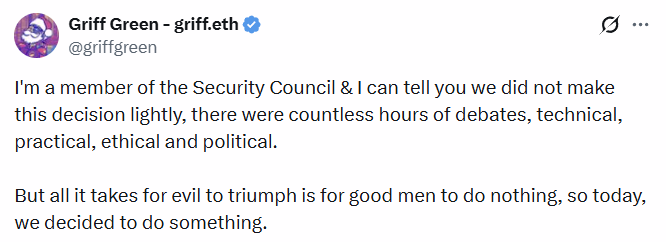
Griff Green, a member of the Security Council, explained that the decision came after extensive technical, ethical, and governance discussions.
From this perspective:
- The action prevented stolen funds from being fully laundered
- It gives the community time to recover or redistribute assets
- It reflects the reality that current Layer 2 systems are not fully decentralized yet
The Bigger Debate: Is Decentralization Absolute?
This incident highlights a deeper issue within crypto:
Decentralization is not binary — it’s a spectrum.
Many Layer 2 networks, including Arbitrum, still operate with:
- Security councils
- Emergency controls
- Governance-based intervention mechanisms
These exist to protect users during extreme events — but they also introduce trust assumptions.
Critics see this as:
- A crack in the promise of immutability
- Proof that decentralization is still evolving
Supporters see it as:
- A necessary trade-off for safety
- A temporary phase before full decentralization
What Happens Next?
The frozen funds are now effectively in limbo.
The Arbitrum DAO will decide what happens next, with possible outcomes including:
- Returning funds to victims
- Redistributing assets
- Holding or burning the funds
Until then, the frozen wallet stands as a symbol of both:
- Hope for recovery
- Concerns over control
Bottom Line
The Arbitrum intervention may go down as either:
- A decisive move that protected users, or
- A turning point in the decentralization debate
What’s clear is that the conversation around security vs decentralization is far from settled.
As DeFi grows more complex, moments like this will continue to test the foundations of the ecosystem — and define what decentralization truly means in practice.
Frequently Asked Questions (FAQ)
Why did Arbitrum freeze ETH?
To prevent stolen funds from being moved after the KelpDAO exploit and allow time for governance decisions.
Are user funds affected?
No, only the attacker’s wallet was targeted — regular users were not impacted.
Is Arbitrum centralized?
Not fully. Like many Layer 2s, it uses a Security Council for emergency actions.
What happens to the frozen ETH?
The Arbitrum DAO will decide whether to return, redistribute, or hold the funds.
Why is this controversial?
Because it shows funds can be moved without private keys, raising concerns about decentralization.
The opinions and market insights shared on CoinsProbe represent the views of individual authors based on prevailing market conditions at the time of publication. Cryptocurrency investments carry significant risk and volatility. Readers are encouraged to conduct their own research and seek professional financial advice before making investment decisions. CoinsProbe and its contributors do not accept responsibility for financial losses or decisions made based on published content.
CoinsProbe may publish sponsored articles, affiliate links, or promotional collaborations. All sponsored material is clearly labeled to maintain transparency with our audience. Our editorial decisions remain fully independent, and advertising partnerships do not influence reviews, rankings, or published opinions.
Since 2023, CoinsProbe has delivered reliable insights on cryptocurrency, blockchain, and digital assets. Our content is created by experienced researchers and analysts who follow strict editorial standards focused on accuracy, transparency, and credibility. Every article is carefully reviewed and verified using trusted sources and current market data. We provide unbiased analysis and timely updates covering everything from emerging crypto projects to major industry developments.