
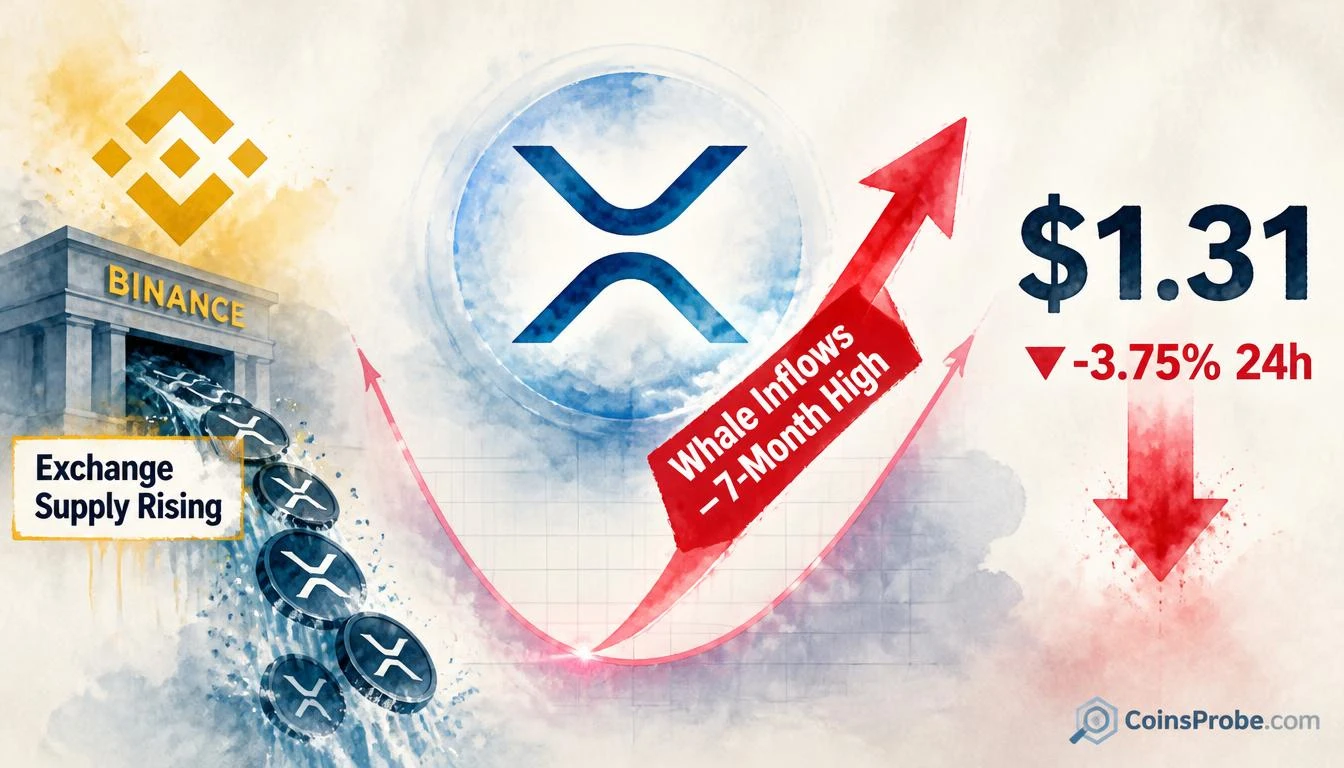
- XRP trades at $1.31 — down 3.75% in 24 hours — as whale inflows to Binance hit a seven-month high per CryptoQuant
- @ArabxChain: "Increased whale inflows to centralized exchanges can increase the amount of XRP available for trading, potentially raising the risk of selling pressure"
- 30-day rolling whale inflow has reversed a months-long decline, now at its highest reading since approximately March 2026
- $1.25 is the nearest technical reference level identified by prior analysts if exchange supply pressure intensifies
XRP is trading at $1.31 — down 3.75% in the past 24 hours — with a market cap of approximately $82.9 billion and $2.59 billion in 24-hour volume. Behind that price decline sits a specific, measurable on-chain signal: whale inflows to Binance have reached their highest level in seven months, a structural shift that analyst @ArabxChain flags as a direct risk to XRP’s near-term price stability.
The alert was published by @cryptoquant_com on October 15, 2026, citing a full Quicktake analysis authored by @ArabxChain. The analyst’s own words: “Increased whale inflows to centralized exchanges can increase the amount of XRP available for trading, potentially raising the risk of selling pressure.” This is not a speculative read — it is a direct causal mechanism grounded in exchange supply dynamics.
What Whale Inflows to Binance Actually Measure
The metric tracked here is XRP whale inflows to Binance — specifically, the 30-day rolling sum of large-holder deposits onto the exchange. This is a flow metric, not a stock. It does not describe the total XRP sitting on Binance; it quantifies how much XRP large holders have moved onto the exchange over the trailing 30-day window. The distinction matters: a rising 30-day inflow does not mean existing holders are selling — it means the pipeline of potential sell-side supply is expanding.
When whales move XRP to a centralized exchange like Binance, they are not obligated to sell. But exchanges are where selling happens. A seven-month high in inflows means more XRP has entered the Binance order book environment than at any point since approximately March 2026 — increasing the probability that supply-side pressure materializes.
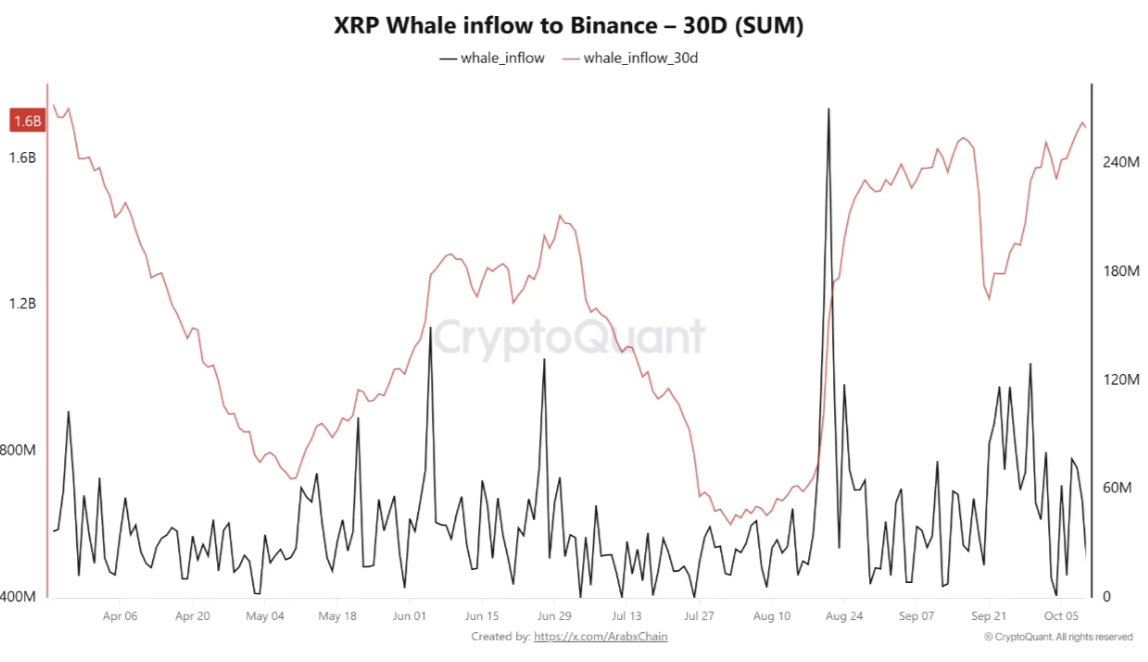
What the Chart Shows
The CryptoQuant chart covers daily XRP whale inflows to Binance from approximately April through early October 2026. The 30-day rolling sum (pink line, right Y-axis scaling to 240M) traces a broad U-shape across the period: declining steadily from April through mid-July, then recovering sharply around late August — with a visible daily spike in the black line — before climbing again toward the right edge of the chart. The highlighted label on the chart reads 1.6B on the left Y-axis, marking the scale of the daily inflow series, while the rolling 30-day sum approaches its highest reading since April. The visual message is unambiguous: after months of declining whale exchange deposits, the flow has reversed and is now accelerating upward into October.
Why Seven-Month Highs in Exchange Inflows Matter
Exchange inflows from large holders are one of the most direct observable precursors to sell-side pressure in any liquid crypto asset. The mechanism is straightforward:
- Whales hold XRP in self-custody or cold wallets — where it cannot be sold on a spot exchange
- A decision to move XRP to Binance converts potential supply into active supply
- Active supply competes in the order book — widening the gap between buyers and sellers
- Sustained elevated inflows mean the sell queue is being continuously replenished
A seven-month high is notable because it breaks a trend. From April through July 2026, the 30-day rolling inflow was declining — meaning large holders were not moving XRP onto exchanges at an increasing rate. That period of declining inflows coincided with reduced selling pressure. The reversal now underway is the structural opposite.
This dynamic also intersects with broader patterns in crypto markets. As noted in Bitcoin Whales Are Accumulating Into the Recovery, whale behavior on centralized exchanges is one of CryptoQuant’s most-tracked leading indicators — and the directional signal it provides typically precedes price action rather than confirming it after the fact.
Context: What This Signal Does and Doesn’t Say
The @ArabxChain analysis identifies a risk condition, not a confirmed breakdown. Elevated inflows create the conditions for selling pressure — they do not guarantee it executes. Whales may deposit XRP onto Binance for reasons that include collateral for derivatives positions, preparation for staking via exchange products, or OTC facilitation. The signal raises the probability of supply-side pressure; it does not confirm that a sustained sell-off is in progress.
What the data does confirm with certainty: more XRP is available for trading on Binance right now than at any point in the last seven months. That is a supply-side fact. How demand responds to it is the open variable.
It is also worth noting that XRP’s price context adds urgency to the signal. At $1.31 — already down 3.75% on the day — the asset is not entering this elevated supply environment from a position of strength. A macro shock amplifying exchange outflows could compound the pressure quickly, as illustrated by the broader market dynamic covered in Hot CPI Wipes $106M in ETH Longs in One Hour as Rate-Hike Odds Double.
The Level Analysts Are Watching
With no price targets or support levels stated in the @ArabxChain analysis, the relevant technical context comes from existing chart structure. As previously identified by analysts tracking XRP’s parallel channel formation, the $1.25 zone has been cited as an immediate downside reference — detailed in XRP Parallel Channel — Analyst Watches $1.25 Before Rebound to $1.42–$1.60. The current seven-month high in whale inflows does not invalidate that structure — but it does increase the probability that $1.25 gets tested if exchange supply continues expanding.
Bullish Scenario
If 30-day rolling whale inflows to Binance begin declining from the current seven-month high — signaling that large holders are no longer accelerating exchange deposits — the immediate supply-side pressure diminishes. A stabilization above $1.31 with declining inflow momentum would suggest the sell pipeline is not being replenished, reducing the near-term risk flagged by @ArabxChain.
Bearish Scenario
If inflows continue rising beyond the current seven-month high while XRP trades below $1.31, the supply overhang on Binance deepens. In that scenario, the $1.25 support level identified in prior technical analysis becomes the immediate downside reference — a break below which would extend the sell-side narrative further.
The on-chain signal from @ArabxChain is direct: XRP whale inflows to Binance have hit a seven-month high, meaning more XRP is actively available for trading on the exchange than at any point since March 2026. The mechanism is supply expansion — not a confirmed sell-off, but the structural precondition for one. At $1.31, with a 3.75% daily loss already registered and the 30-day rolling inflow accelerating upward into October, the risk asymmetry favors caution. Watch whether the 30-day whale inflow metric peaks and reverses — or continues climbing — as the decisive real-time indicator of whether this supply overhang translates into sustained price pressure.
Frequently Asked Questions
What does a seven-month high in XRP whale inflows to Binance actually mean?
How is the 30-day rolling inflow different from total XRP on Binance?
Does this mean XRP is guaranteed to fall further from $1.31?
What on-chain metric should traders watch to know if this risk is fading?
Source: CryptoQuant · Published by CoinsProbe Markets Desk
The opinions and market insights shared on CoinsProbe represent the views of individual authors based on prevailing market conditions at the time of publication. Cryptocurrency investments carry significant risk and volatility. Readers are encouraged to conduct their own research and seek professional financial advice before making investment decisions. CoinsProbe and its contributors do not accept responsibility for financial losses or decisions made based on published content.
CoinsProbe may publish sponsored articles, affiliate links, or promotional collaborations. All sponsored material is clearly labeled to maintain transparency with our audience. Our editorial decisions remain fully independent, and advertising partnerships do not influence reviews, rankings, or published opinions.
Since 2023, CoinsProbe has delivered reliable insights on cryptocurrency, blockchain, and digital assets. Our content is created by experienced researchers and analysts who follow strict editorial standards focused on accuracy, transparency, and credibility. Every article is carefully reviewed and verified using trusted sources and current market data. We provide unbiased analysis and timely updates covering everything from emerging crypto projects to major industry developments.