
- XRP trades at $1.36 (+4.72% 24h), market cap $85.53B, as Binance leverage ratio hits multi-month lows
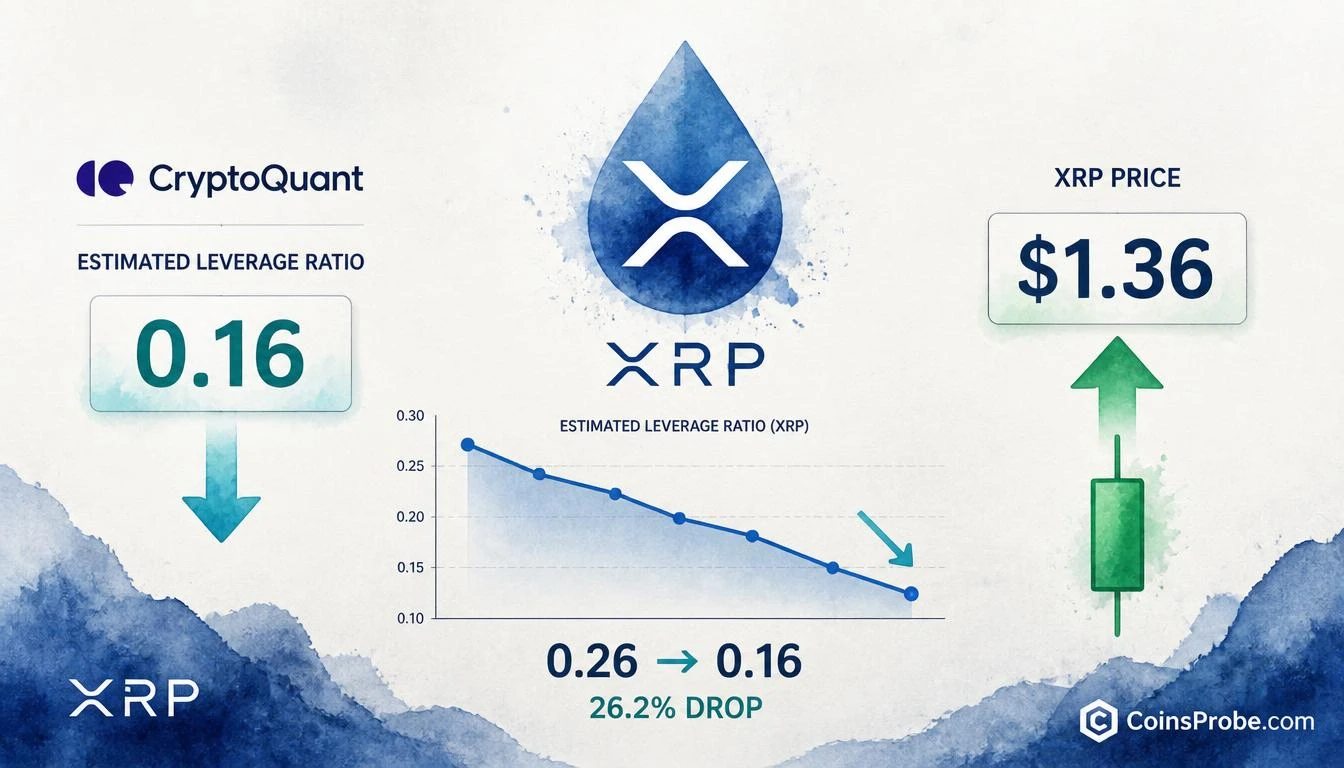
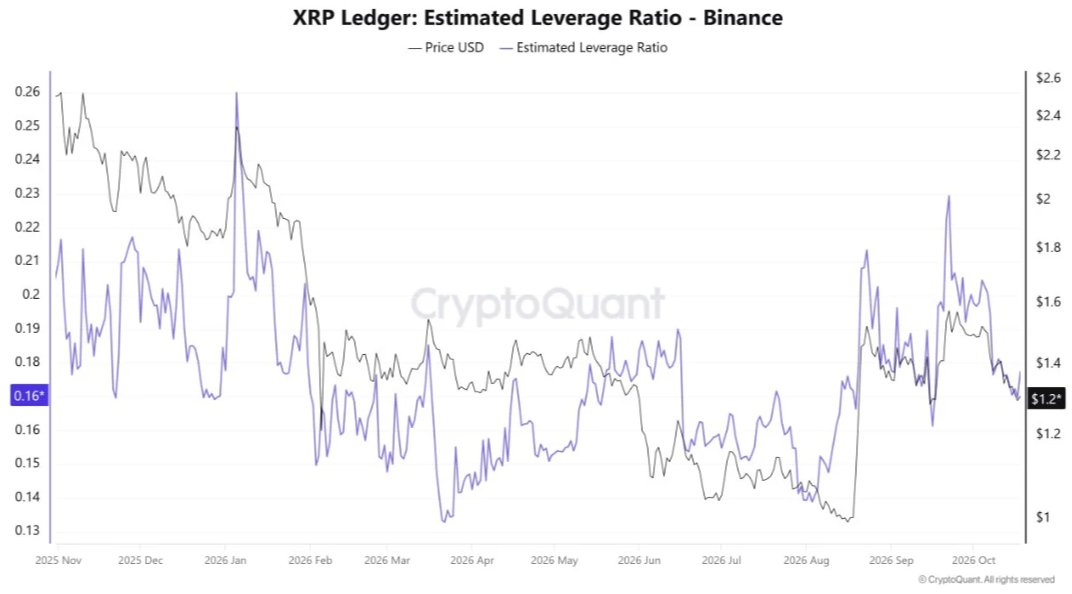
- Binance XRP Estimated Leverage Ratio drops 26.2% in under one month — from ~0.26 peak (Jan 2026) to ~0.16 now, per CryptoQuant/@ArabxChain
- Lower ELR reduces cascading liquidation risk; analyst notes: "potentially mitigating the risks associated with liquidations"
- Watch 0.16 ELR level — a reversal higher alongside rising open interest would signal returning derivatives fragility
XRP is trading at $1.36 — up 4.72% in the past 24 hours, with a market capitalization of $85.53 billion — as a structural shift in derivatives positioning quietly unfolds beneath the surface. The Binance XRP Estimated Leverage Ratio has fallen 26.2% in less than a month, according to CryptoQuant data published on October 21, 2026. That drop is not a neutral datapoint. It signals that traders have materially reduced their leveraged exposure to XRP on Binance, the largest derivatives venue for the asset.
CryptoQuant analyst @ArabxChain flagged the move in a published quicktake, concluding: “The decline may reflect a reduction in leveraged positioning, potentially mitigating the risks associated with liquidations.” The analyst’s language is measured — this is an observation about structural risk, not a directional price call. But the mechanism it describes has direct implications for how XRP trades from here.
What the Estimated Leverage Ratio Actually Measures
The Estimated Leverage Ratio (ELR) on CryptoQuant measures open interest relative to the exchange’s token reserves — specifically, it divides futures open interest by the exchange’s holdings of that token. A rising ELR means traders are taking on more leveraged positions relative to the available collateral base. A falling ELR means the opposite: leverage is being unwound, either through position closures, liquidations, or a shift toward spot exposure.
The current Binance XRP ELR reads approximately 0.16, per the chart annotations. This compares to a peak near 0.26 in late January 2026, marking the high-water mark for leveraged XRP positioning on Binance. From that January peak to the current reading, the ratio has compressed by a substantial margin — with the most recent leg lower (-26.2%) occurring in under 30 days.
Why a Falling Leverage Ratio Matters — The Mechanism
High leverage ratios create fragility. When a large share of open interest is concentrated in leveraged positions, a price move in either direction can trigger cascading liquidations — forced closures that amplify the initial move. XRP experienced this dynamic in early 2026, when the leverage ratio was near its peak of 0.26 and the asset saw sharp intraday dislocations.
A declining leverage ratio reverses that structure. With the ELR now at approximately 0.16 — near the lower boundary of its November 2025-to-October 2026 range — the derivatives stack on Binance is materially lighter. Fewer leveraged positions means fewer automatic liquidation triggers if price moves against those positions. This does not predict the direction of the next move, but it does reduce the probability of a disorderly, liquidation-driven cascade in either direction.
Put plainly: at 0.16, XRP’s derivatives market on Binance is structurally cleaner than it has been for most of 2026. That is a precondition — not a guarantee — for more orderly price discovery. For context on how whale-level positioning interacts with these dynamics, XRP whale outflows recently hit a 5-year low, a parallel signal worth tracking alongside leverage data.
What the Chart Shows — January Peak to October 2026 Low
The CryptoQuant chart covers November 2025 through October 2026 and overlays the leverage ratio (left axis, 0.13–0.26 range) against XRP’s spot price on the right axis ($1.0–$2.6). Both lines traced an almost identical trajectory: a sharp peak in late January 2026 — when XRP was trading near the upper end of its range and leverage was at its most elevated — followed by a sustained decline through mid-2026. A partial recovery in August and September 2026 was followed by a fresh rollover, with the leverage ratio now descending steeply back toward multi-month lows.
The current callout values printed on the chart are 0.16 for the leverage ratio and $1.2 for price — though at time of writing, XRP spot has since moved to $1.36 on the live market. The price label on the chart reflects a slightly earlier snapshot, while the leverage ratio reading of 0.16 represents the current structural state of derivatives positioning.
What This Is — And What It Is Not
@ArabxChain’s analysis does not attach a price target to this observation. The ELR drop is not framed as a buy signal, nor does it imply that a rally is imminent. What it establishes is a change in the risk architecture of XRP’s derivatives market. The asset had $1.58 billion in 24-hour trading volume at time of writing — a liquid market where the difference between an orderly decline and a liquidation cascade is precisely the kind of positioning data CryptoQuant tracks.
For broader context on liquidity conditions across the market, the recent development where USDT supply contracted by $1 billion is a relevant macro backdrop worth monitoring alongside any XRP derivatives read.
Scenarios From Here
Bullish Scenario
If spot demand continues to absorb sell pressure at current levels while the leverage ratio remains compressed near 0.16, any upside move encounters a cleaner derivatives stack — meaning fewer overhanging longs to liquidate on a dip and fewer shorts to squeeze on a rally. Price could trend more smoothly toward the $1.6–$1.8 resistance band visible on the chart without the amplification effect that high-leverage environments create.
Bearish Scenario
A declining leverage ratio does not eliminate downside risk. If spot selling pressure intensifies, a lower ELR simply means the cascade would be smaller — not absent. A sustained close below $1.20 (the chart’s lower right-axis reference level) would put XRP back into the congestion zone where it spent much of mid-2026, and the reduced leverage would offer limited structural support in a spot-driven decline.
The single most important development in XRP’s derivatives market over the past month is the 26.2% compression in Binance’s Estimated Leverage Ratio, as identified by @ArabxChain via CryptoQuant. The ratio now sits at approximately 0.16 — down from a January 2026 peak near 0.26 — and according to the analyst, this decline “may reflect a reduction in leveraged positioning, potentially mitigating the risks associated with liquidations.” At $1.36 spot with $1.58 billion in daily volume, XRP is trading into a structurally lighter derivatives environment than it has seen for most of this cycle. Watch the 0.16 ELR level — if it holds or continues declining, liquidation cascade risk remains suppressed. If it begins climbing again alongside rising open interest, the fragility that characterized January 2026 would be returning.
Frequently Asked Questions
What is the XRP Estimated Leverage Ratio on Binance and why does it matter?
Does a falling leverage ratio mean XRP will go up?
How significant is a 26.2% drop in the leverage ratio within one month?
What level should traders watch to know if XRP leverage is rising again?
Source: CryptoQuant · Published by CoinsProbe Markets Desk
The opinions and market insights shared on CoinsProbe represent the views of individual authors based on prevailing market conditions at the time of publication. Cryptocurrency investments carry significant risk and volatility. Readers are encouraged to conduct their own research and seek professional financial advice before making investment decisions. CoinsProbe and its contributors do not accept responsibility for financial losses or decisions made based on published content.
CoinsProbe may publish sponsored articles, affiliate links, or promotional collaborations. All sponsored material is clearly labeled to maintain transparency with our audience. Our editorial decisions remain fully independent, and advertising partnerships do not influence reviews, rankings, or published opinions.
Since 2023, CoinsProbe has delivered reliable insights on cryptocurrency, blockchain, and digital assets. Our content is created by experienced researchers and analysts who follow strict editorial standards focused on accuracy, transparency, and credibility. Every article is carefully reviewed and verified using trusted sources and current market data. We provide unbiased analysis and timely updates covering everything from emerging crypto projects to major industry developments.