
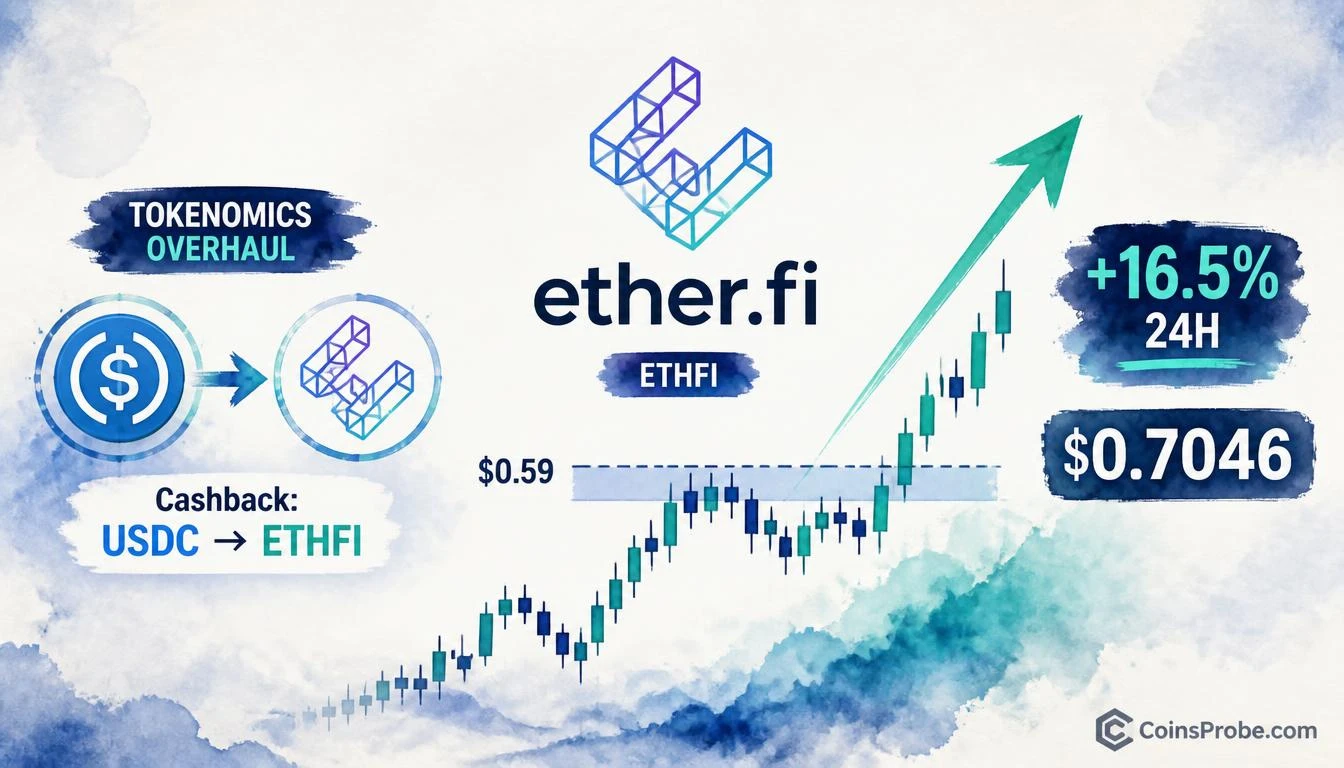

- ETHFI is up 16.48% in 24 hours to $0.7046 — 7-day gain reaches 18.9% — $679.7M market cap
- Primary catalyst: Ether.fi switches card cashback from USDC to ETHFI, tightens staking tiers, launches account-protection pool
- Whale accumulation identified at $0.59–$0.60 breakout zone accelerated the move over the past 48 hours
- 24-hour volume hits $141.6M — on-chain staking participation rate is the key sustainability metric to watch
Ether.fi’s 16.5% single-day surge is not a reaction to a new exchange listing or a macro catalyst. The move is traceable to a set of structural tokenomics changes that directly increased demand for ETHFI as a functional token — not merely a speculative one.
At the time of writing, ETHFI is trading at approximately $0.7046, up 16.48% in the past 24 hours and 18.9% over the past seven days. Market cap stands at $679.7 million, with 24-hour trading volume reaching $141.6 million — a figure that indicates meaningful participation, not thin-order-book volatility.
The Core Catalyst — Ether.fi’s Tokenomics Overhaul
Three interconnected product changes appear to be the primary engine behind today’s ETHFI move, each of which restructures how the token is used within the protocol itself.
| Change | Previous Structure | New Structure |
|---|---|---|
| Card Cashback Currency | USDC | ETHFI |
| Staking Tier Requirements | Standard | Tightened (higher ETHFI stake needed) |
| Account Protection Pool | Not present | Newly introduced |
Source: Ether.fi product coverage, September 2026
Why Cashback in ETHFI Flows Directly to Demand
When a protocol switches card cashback rewards from a stablecoin (USDC) to its native token (ETHFI), the mechanism is direct: users who previously received liquid USDC now receive ETHFI. Those who want to spend those rewards in fiat or stablecoins must either hold or sell ETHFI — but the token first has to be acquired and distributed. More critically, users who want to maximize cashback rates now have an incentive to hold ETHFI, not sell it. This converts a reward mechanism from a sell-pressure event into a hold-incentive event.
The tightened staking tier requirements compound this. If higher ETHFI balances are required to qualify for premium protocol tiers, users already active on the platform face a structural incentive to accumulate — not reduce — their ETHFI positions. Combined with the launch of an account-protection pool (which likely requires ETHFI collateral or participation), the net effect is three simultaneous demand-side changes in a single upgrade cycle.
Whale Accumulation and Technical Breakout — The Accelerant
Separate from the tokenomics catalyst, market coverage identified whale accumulation beginning around the $0.59–$0.60 zone as a contributing factor to the rally’s acceleration over the past 48 hours. A breakout above that level — which had previously acted as resistance — appears to have triggered momentum-driven buying that amplified the structural catalyst into a double-digit single-day move.
This pattern — structural catalyst providing the fundamental justification, technical breakout providing the price trigger — is consistent with how protocol-level changes translate into market moves. The tokenomics shift gave sophisticated buyers a reason to accumulate; the $0.59–$0.60 breakout gave technically-oriented traders the signal to enter. This is also not the first time ETHFI has demonstrated breakout behavior following a structural development, as noted in prior coverage of Ether.fi breaking out after its Upbit listing and earlier double-digit moves linked to key technical setups.
No new exchange listing, regulatory announcement, or major institutional partnership was identified as a specific trigger for today’s move. The rally is protocol-native in origin.
Is the Rally Sustainable?
The sustainability question for a tokenomics-driven rally depends on whether the structural changes produce lasting behavioral shifts or short-term sentiment pop. If Ether.fi’s active user base increases cashback utilization and maintains higher ETHFI staking balances in response to the new tier requirements, the demand-side pressure is durable. If users rotate out of ETHFI rewards quickly or the tier incentives prove insufficient to sustain holding behavior, the move could fade as volume normalizes from the current $141.6 million 24-hour spike.
The metric to track is Ether.fi’s active staking participation rate and on-chain ETHFI wallet concentration data via Glassnode or Arkham — both of which update in real time and will show whether the accumulation observed during the $0.59–$0.60 breakout zone is being sustained or distributed into the rally.
Ether.fi’s three simultaneous tokenomics changes — cashback switching from USDC to ETHFI, tightened staking tiers, and a new account-protection pool — created structural demand-side pressure that was then amplified by whale accumulation at the $0.59–$0.60 breakout zone, producing today’s 16.48% single-day move to $0.7046. The question of whether this sustains will be answered by on-chain staking participation data and whether the $141.6 million volume figure consolidates at elevated levels or reverts to pre-move baselines in sessions ahead.
Frequently Asked Questions
Why is Ether.fi (ETHFI) up today?
What is the current ETHFI price and market cap?
What does switching cashback from USDC to ETHFI mean for the token?
Is the ETHFI rally sustainable?
Source: Coingecko Scanner · Published by CoinsProbe Markets Desk
The opinions and market insights shared on CoinsProbe represent the views of individual authors based on prevailing market conditions at the time of publication. Cryptocurrency investments carry significant risk and volatility. Readers are encouraged to conduct their own research and seek professional financial advice before making investment decisions. CoinsProbe and its contributors do not accept responsibility for financial losses or decisions made based on published content.
CoinsProbe may publish sponsored articles, affiliate links, or promotional collaborations. All sponsored material is clearly labeled to maintain transparency with our audience. Our editorial decisions remain fully independent, and advertising partnerships do not influence reviews, rankings, or published opinions.
Since 2023, CoinsProbe has delivered reliable insights on cryptocurrency, blockchain, and digital assets. Our content is created by experienced researchers and analysts who follow strict editorial standards focused on accuracy, transparency, and credibility. Every article is carefully reviewed and verified using trusted sources and current market data. We provide unbiased analysis and timely updates covering everything from emerging crypto projects to major industry developments.