
The AI and Big Data cryptocurrency narrative just experienced one of crypto’s most brutal corrections. In mid-2024, tokens focused on artificial intelligence and data infrastructure commanded nearly $70 billion in combined market capitalization. Today, that figure sits at just $15.22B—a staggering 78% decline.
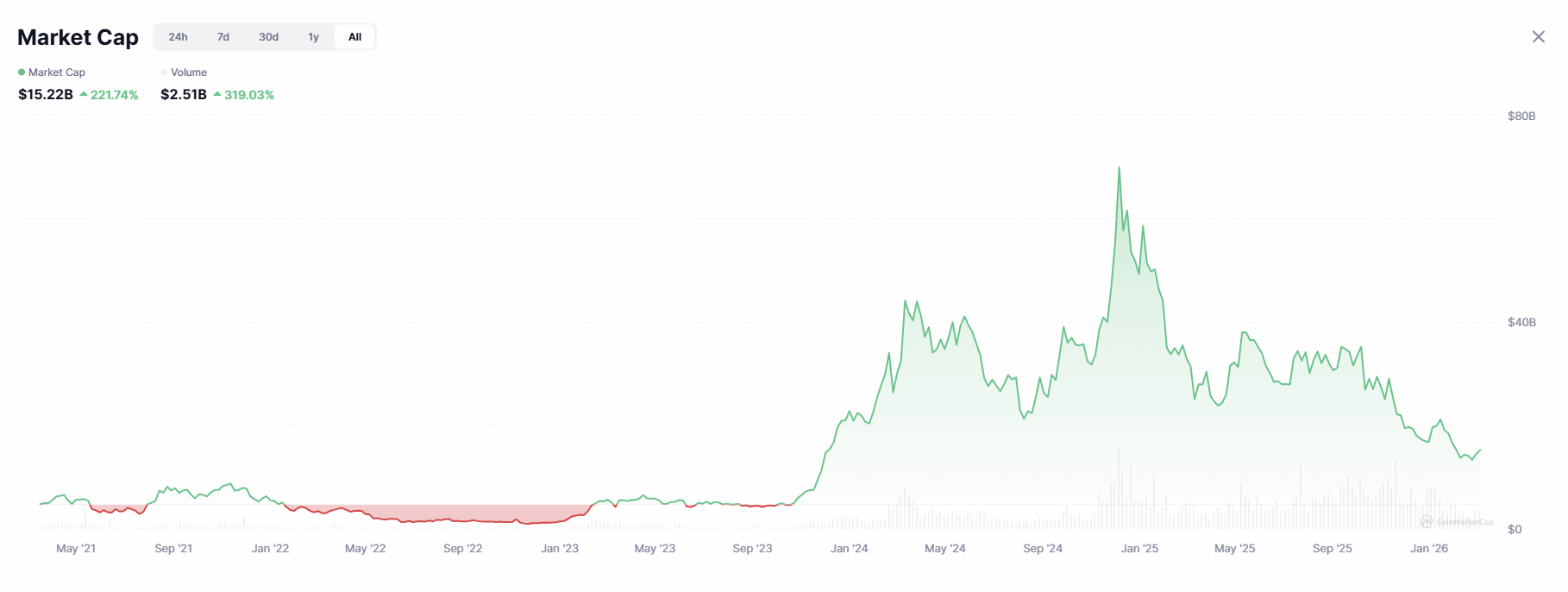
This wasn’t a gradual fade. It was a narrative collapse.
When Bitcoin rallied in late 2023 and early 2024, AI tokens became crypto’s hottest trade. Retail investors believed the AI boom would translate directly into altcoin gains. Tokens like RENDER, FET, and others surged on the promise that decentralized GPU networks would become essential infrastructure.
But a hard reality emerged: Enterprise AI spending flowed to NVIDIA, Microsoft, and Amazon—not to decentralized crypto networks. Centralized cloud providers captured the infrastructure spend that tokens promised.
RENDER’s Brutal Decline
RENDER token exemplifies the sector’s pain. The token reached an all-time high of $12.18 in mid-2024. Today it trades at $1.40—a devastating -90% decline from peak.
Market cap collapsed from multi-billion valuations to $730.8 million. The token that promised to democratize GPU rendering instead became a cautionary tale about following narratives rather than fundamentals.

Yet despite the destruction, a compelling technical pattern is forming that could hint at a potential recovery scenario.
A Fractal Pattern Similar to NVIDIA
Market analysts are now comparing RENDER’s price structure to a historical pattern seen in NVIDIA’s stock between late 2021 and early 2023.
During that period, NVIDIA experienced a deep correction after losing key technical support levels. The stock then moved into a wedge-like consolidation pattern, where price volatility gradually tightened near the lows. Eventually, NVIDIA broke out of that structure and began a powerful rally during the AI boom of 2023.
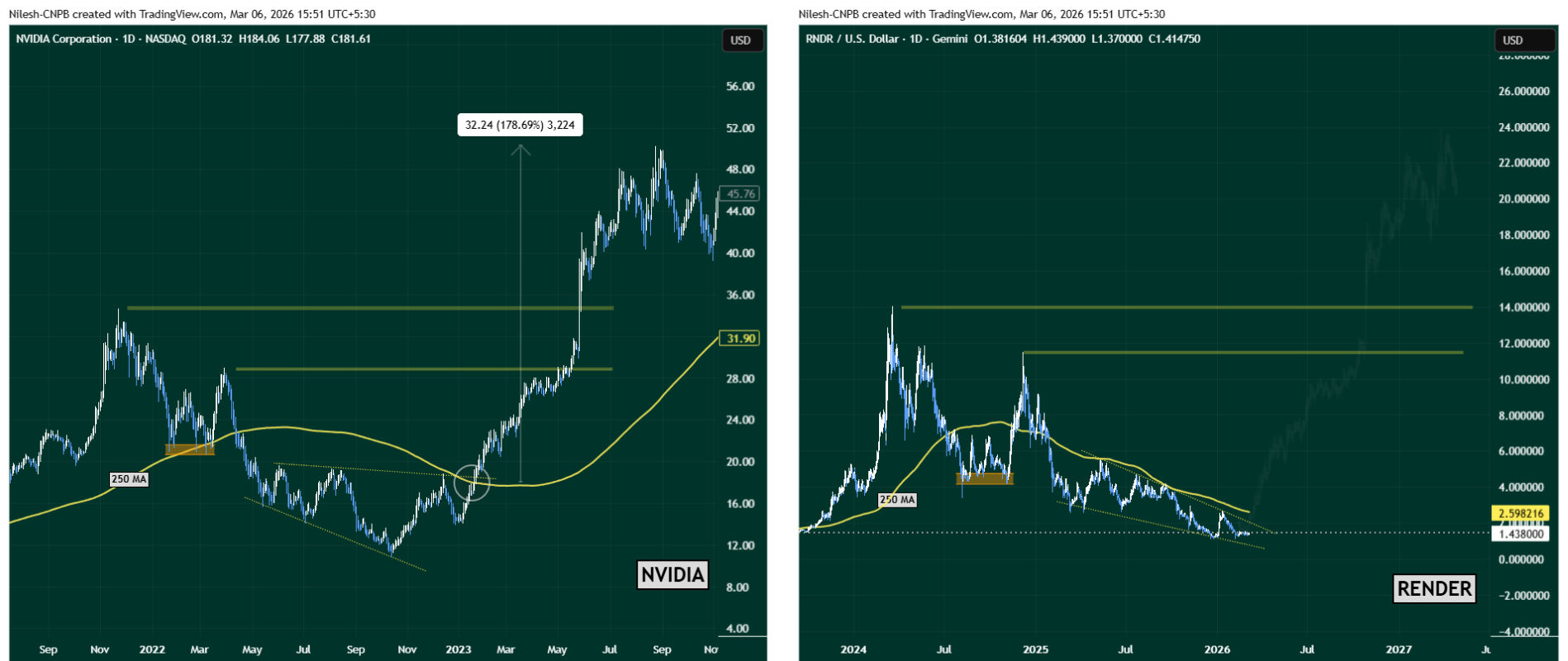
Interestingly, RENDER appears to be forming a similar structure.
After losing its long-term trend support, the token entered a prolonged decline before settling into a falling wedge pattern. Over the past several months, price action has compressed near the $1.30–$1.50 range, suggesting that selling pressure may be gradually weakening.
Why the Patterns Look Similar
Both NVIDIA and RENDER:
- Lost key moving average support (the 250-day MA)
- Formed geometric wedge patterns during extended corrections
- Are now testing critical support zones
- Face a potential breakout moment
However, the chart pattern alone doesn’t guarantee recovery.
What Could Happen Next
If the falling wedge pattern continues to develop and eventually breaks to the upside, analysts believe RENDER could attempt a recovery toward higher resistance levels.
One of the key levels traders are watching is the long-term moving average near $2.59. A strong move above this area could indicate that buyers are regaining control and that momentum is shifting.
If bullish momentum strengthens further, the next potential resistance zones could appear between $3.50 and $5, with additional upside to above $20 possible if the broader crypto market turns positive.
However, technical patterns alone rarely determine long-term price direction.
The Fundamental Challenge
While chart patterns can signal potential reversals, sustainable price recovery typically requires fundamental growth.
RENDER’s actual use case: Decentralized GPU rendering for visual effects and 3D graphics—a specialized niche with significant headwinds.
Competition from entrenched players: AWS, Google Cloud, and Microsoft Azure dominate cloud rendering with scale advantages, established enterprise relationships, and lower costs.
Adoption metrics tell the story: Network utilization data shows that RENDER’s daily GPU rendering capacity remains limited. Adoption has been gradual despite years of operation, with monthly active users in the 10,000-15,000 range and limited enterprise traction.
Tokenomics pressure: RENDER has ongoing supply inflation from network emissions. Without genuine adoption growth exceeding that inflation, token price faces dilution pressure.
For RENDER to replicate NVIDIA’s recovery, it would need real adoption acceleration in its rendering niche. This requires major studios and enterprises switching from established centralized solutions to RENDER—something that hasn’t shown clear signs of happening.
The Critical Difference
While the comparison to NVIDIA’s recovery is drawing attention, there’s a crucial distinction:
NVIDIA’s recovery worked because the business transformed. Revenue surged as enterprise AI demand exploded. The technical breakout aligned with genuine business momentum and fundamental acceleration.
RENDER’s situation is different. The technical setup may be sound, but the adoption narrative remains unproven. Network usage metrics remain flat, and enterprise adoption is limited.
This means RENDER could experience a relief rally (20-50% bounce) from the technical breakout, but sustaining higher prices requires the fundamental story to change.
What Traders Are Watching
For now, the chart structure suggests RENDER may be approaching a critical technical moment. A breakout from the current wedge formation could trigger renewed interest, while failure to hold support could extend the downtrend.
Many traders are closely watching:
- $1.70-$1.95: Wedge breakout zone (if broken with volume, signals potential recovery)
- $2.59: The critical 250-day moving average—reclaiming this would validate the fractal
- $4.70-$5.50: Intermediate resistance if momentum continues
As a result, market participants are cautious. While the technical similarities can offer clues—future performance ultimately depends on liquidity, adoption growth, and broader market sentiment.
Conclusion
The chart structure suggests RENDER may be approaching a critical technical moment. If price breaks above the wedge with volume, a relief rally toward $2.59 becomes probable.
However, the fractal is an interesting technical setup—but not a guarantee of recovery without fundamental support.
For traders, the risk/reward may be attractive as a short-term technical trade. For long-term investors, the question is whether RENDER’s network will achieve the adoption growth needed to justify higher valuations.
Until that narrative changes, watch for volume confirmation at key resistance levels. The patterns repeat in markets, but capital flows to fundamentals, not geometry alone.

The opinions and market insights shared on CoinsProbe represent the views of individual authors based on prevailing market conditions at the time of publication. Cryptocurrency investments carry significant risk and volatility. Readers are encouraged to conduct their own research and seek professional financial advice before making investment decisions. CoinsProbe and its contributors do not accept responsibility for financial losses or decisions made based on published content.
CoinsProbe may publish sponsored articles, affiliate links, or promotional collaborations. All sponsored material is clearly labeled to maintain transparency with our audience. Our editorial decisions remain fully independent, and advertising partnerships do not influence reviews, rankings, or published opinions.
Since 2023, CoinsProbe has delivered reliable insights on cryptocurrency, blockchain, and digital assets. Our content is created by experienced researchers and analysts who follow strict editorial standards focused on accuracy, transparency, and credibility. Every article is carefully reviewed and verified using trusted sources and current market data. We provide unbiased analysis and timely updates covering everything from emerging crypto projects to major industry developments.