
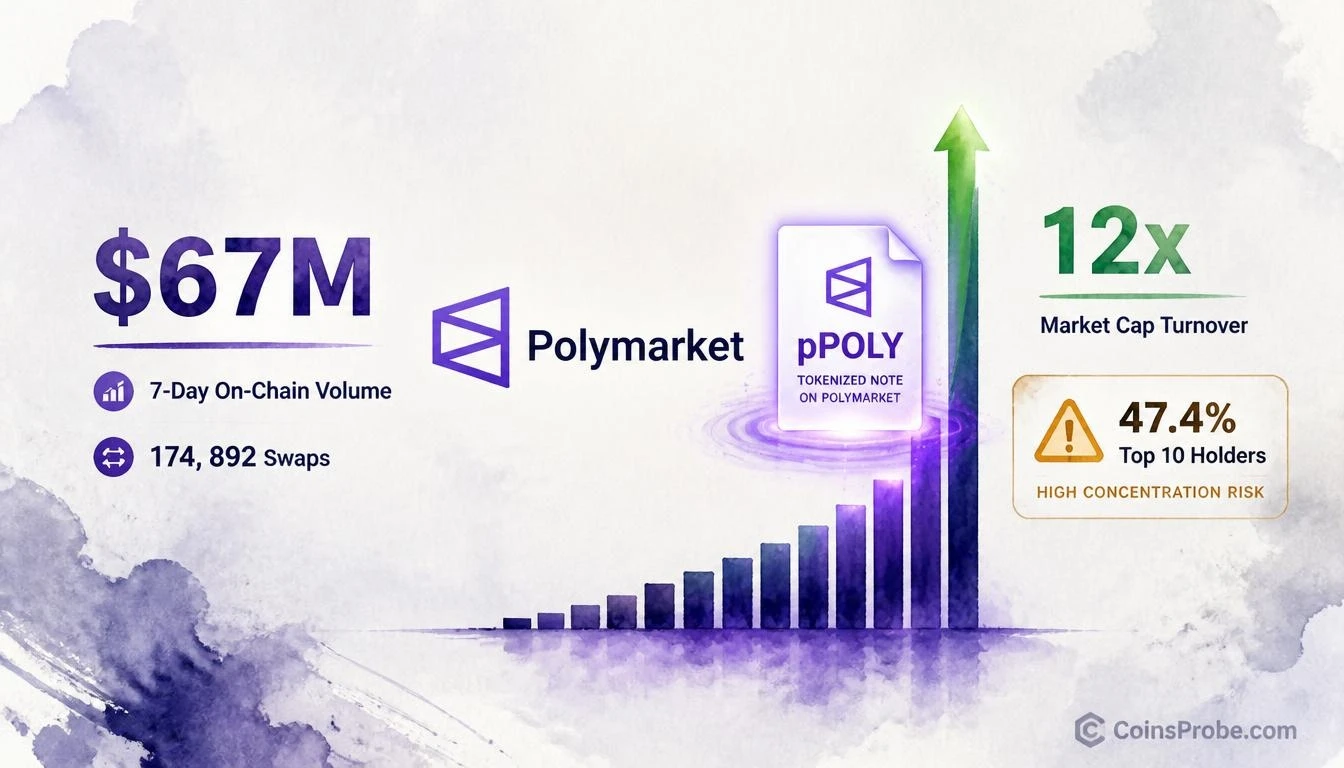

- pPOLY generated $67M in on-chain volume and 174,892 swaps in its first 7 days of trading per CryptoQuant
- The tokenized Polymarket Series B note traded at ~12x its total market cap in week one — an extreme turnover ratio
- Top 10 pPOLY holders control 47.4% of supply — concentration risk embedded in a high-volume instrument
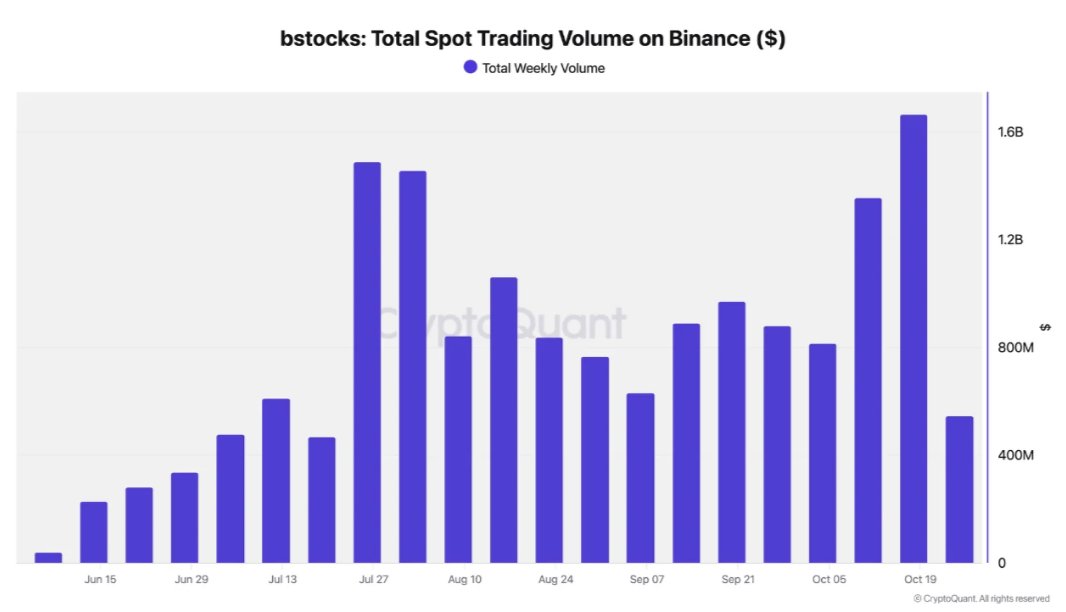
- Binance bstocks weekly volume surged to a new high around Oct 19 before sharply declining on the final bar
Polymarket has not held an IPO. Yet in the span of seven days, traders poured $67 million into a tokenized note designed to track it — generating 174,892 swaps and trading at roughly 12 times its own market value in the process. The numbers, published by CryptoQuant (@cryptoquant_com) on October 29, 2026, make one thing structurally clear: demand for pre-IPO crypto exposure is outpacing the supply of the instruments designed to carry it.
The instrument at the center of this activity is pPOLY — a tokenized note that tracks Polymarket’s Series B valuation. It is not equity. It is not a direct stake in the prediction market platform. It is a structured product giving on-chain traders synthetic exposure to a private company’s pre-IPO price trajectory. Despite those qualifications, the market treated it with a velocity typically reserved for liquid, battle-tested assets. CryptoQuant flagged the data as evidence of a broader structural shift in how crypto-native capital is engaging with traditional private market milestones.
$67M in 7 Days — The pPOLY Volume Breakdown
The raw numbers from CryptoQuant’s dataset are not ambiguous. In its first week of trading, pPOLY recorded:
- $67,000,000 in total on-chain volume
- 174,892 individual swap transactions
- A turnover ratio of approximately 12x its total market capitalization
A 12x turnover ratio in a single week is structurally extreme. For context, a ratio above 1x means the entire float changed hands at least once. At 12x, every unit of outstanding supply theoretically changed hands more than twelve times over — a figure that reflects either deep speculative appetite, arbitrage activity between venues, or both simultaneously. CryptoQuant’s data does not distinguish the driver, but the magnitude itself is the signal.
Holder Concentration — The Structural Risk Hidden in the Data
Volume tells one side of the story. Holder distribution tells the other. According to CryptoQuant, the top 10 holders of pPOLY control 47.4% of total supply. That is not a trivial concentration figure for an instrument trading at $67M weekly volume. It means that fewer than ten wallets command nearly half of all outstanding pPOLY — creating a structural asymmetry where a small number of participants can materially influence liquidity, pricing, and exit availability for the remaining holders.
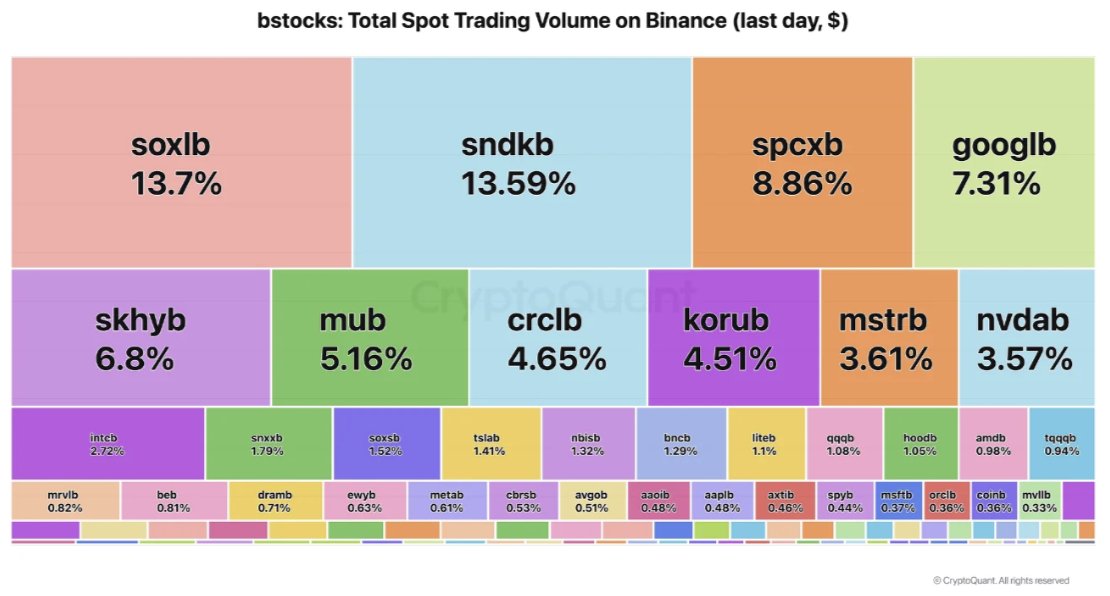
Binance’s bstocks data provides the broader ecosystem context. The tokenized stock segment — which includes assets like soxlb, sndkb, and googlb — shows a diverse but top-heavy distribution of daily volume. On the single-day snapshot captured by CryptoQuant, soxlb led with 13.7% of total bstocks volume, followed by sndkb at 13.59% and spcxb at 8.86%. pPOLY’s explosive weekly volume suggests it temporarily dominated the conversation within this segment before the sharp post-peak drop visible on the weekly chart.
Why Pre-IPO Tokenization Is Drawing This Volume Now
Polymarket’s profile makes it a logical candidate for concentrated pre-IPO interest. The platform has become one of the most-referenced prediction markets globally — its odds on U.S. elections, Fed decisions, and crypto events are cited by institutions and media alike. CoinsProbe has previously covered Polymarket’s expansion into 15-minute Bitcoin price markets on its U.S. app and the platform’s record prediction market odds during the 2026 midterm cycle. That public-facing visibility translates directly into private-market speculation: traders who use the platform want exposure to its growth trajectory before any traditional IPO mechanism opens that window.
The Series B valuation tracked by pPOLY gives on-chain participants a synthetic proxy for that exposure. The product essentially tokenizes the private-market bet — letting crypto wallets take positions on Polymarket’s private valuation without requiring accredited investor status, broker access, or a traditional allocation. At $67M in seven days, the demand signal is unambiguous: there is significant on-chain capital waiting for pre-IPO crypto exposure that traditional financial rails cannot currently service.
What the Volume Surge Does and Does Not Confirm
What it confirms: There is genuine, quantifiable demand for tokenized pre-IPO instruments in the crypto-native capital base. 174,892 swaps at 12x market cap turnover is not noise — it is a structural demand signal.
What it does not confirm: The volume is not a price signal for pPOLY’s underlying valuation, nor does it imply Polymarket’s IPO is imminent or that pPOLY holders will realize gains. High turnover in a concentrated-supply instrument can reflect speculation, arbitrage, or wash-like activity as easily as it reflects genuine conviction buying.
The concentration risk: With 47.4% of supply in ten wallets, any coordinated exit by top holders would disproportionately impact liquidity for the remaining 52.6% of the float. This is the primary structural risk in the current setup — and it is not addressed by volume alone.
Bullish and Bearish Readings on the Pre-IPO Tokenization Thesis
Bullish Scenario
If Polymarket moves toward a public listing — or announces further Series funding — pPOLY’s tracking mechanism becomes a direct beneficiary. Weekly volume sustaining above $50M would indicate that the first-week spike was demand, not novelty. Continued growth in the broader bstocks segment on Binance, where over 35 tokenized instruments already trade daily, would validate the infrastructure supporting instruments like pPOLY.
Bearish Scenario
The sharp volume drop visible on the weekly Binance bstocks chart in the final bar suggests the initial surge may be normalizing. If volume reverts to pre-spike levels and top-10 holders begin distributing their 47.4% concentration, the instrument’s liquidity profile could deteriorate rapidly. The absence of a live IPO catalyst means there is no fundamental floor guaranteed by an event timeline.
The pPOLY data point is not merely about one tokenized note. It is CryptoQuant’s clearest evidence yet that on-chain capital has developed both the appetite and the infrastructure to front-run traditional private market events — at scale, without institutional intermediaries, and faster than any IPO process can move. Whether that velocity sustains depends on what Polymarket does next. Watch weekly on-chain volume for pPOLY as the primary confirmation metric: a hold above $50M would indicate structural demand; a collapse toward $5M–$10M would indicate the first-week figure was pure novelty.
Source: x.comFrequently Asked Questions
What is pPOLY and how does it track Polymarket?
Why did pPOLY trade 12x its market cap in one week?
Is the 47.4% top-10 holder concentration a red flag for pPOLY?
What metric should traders watch to determine if pPOLY demand is structural or a one-week novelty?
Source: CryptoQuant · Published by CoinsProbe Markets Desk
The opinions and market insights shared on CoinsProbe represent the views of individual authors based on prevailing market conditions at the time of publication. Cryptocurrency investments carry significant risk and volatility. Readers are encouraged to conduct their own research and seek professional financial advice before making investment decisions. CoinsProbe and its contributors do not accept responsibility for financial losses or decisions made based on published content.
CoinsProbe may publish sponsored articles, affiliate links, or promotional collaborations. All sponsored material is clearly labeled to maintain transparency with our audience. Our editorial decisions remain fully independent, and advertising partnerships do not influence reviews, rankings, or published opinions.
Since 2023, CoinsProbe has delivered reliable insights on cryptocurrency, blockchain, and digital assets. Our content is created by experienced researchers and analysts who follow strict editorial standards focused on accuracy, transparency, and credibility. Every article is carefully reviewed and verified using trusted sources and current market data. We provide unbiased analysis and timely updates covering everything from emerging crypto projects to major industry developments.