
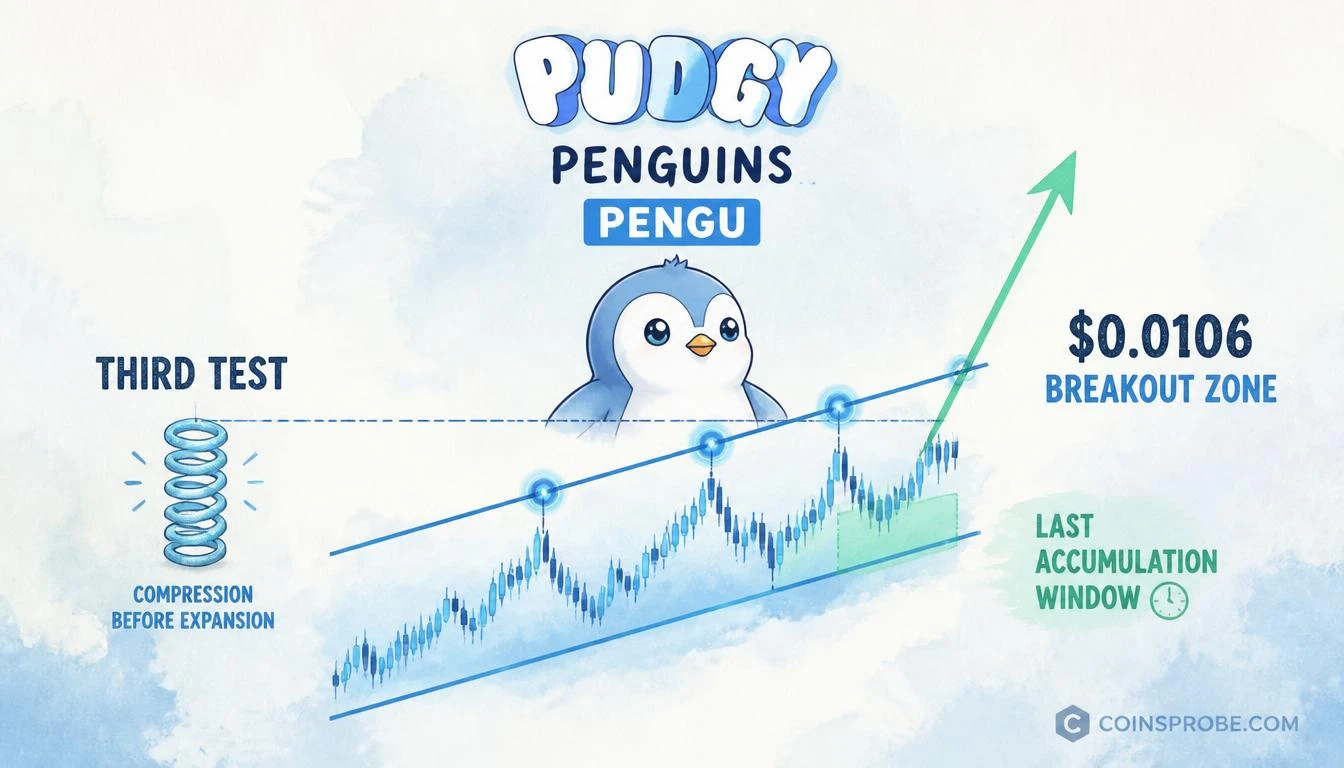

- PENGU has tested channel resistance at $0.0106 three consecutive times without a confirmed breakout
- Analyst Ali Martinez (@alicharts) flags this as potentially the last discount accumulation window before a breakout
- Three resistance tests progressively absorb seller supply — each test leaves fewer sellers at the $0.0106 zone
- A confirmed daily close above $0.0106 opens the next measured move; a channel break below invalidates the thesis
Pudgy Penguins’ native token PENGU is approaching a decisive inflection point. Three consecutive rejections at the upper boundary of its ascending price channel — fixed at $0.0106 — have positioned the asset at what analyst Ali Martinez is calling a last-chance accumulation window before a potential structural breakout.
Crypto analyst Ali Martinez (@alicharts) posted the signal on September 29, 2026, stating: “PENGU has now made three attempts to break above the top of its channel at $0.0106. And the more often resistance gets tested, the weaker it can become. I believe this could be one of the last opportunities to accumulate $PENGU at a discount.”
The observation carries a specific technical logic: repeated testing of a resistance level progressively exhausts the selling pressure concentrated at that zone.
The Three-Test Principle — Why Repeated Resistance Weakens
When a price level is tested once, sellers at that zone absorb demand cleanly. By the second test, a portion of those sellers have already exited their positions. By the third test — which PENGU has now completed — the pool of willing sellers at $0.0106 is materially thinner than it was at first contact. This is not an opinion. It is a supply-and-demand mechanic documented across decades of technical literature and observable in real-time order book structure.
The pattern is particularly meaningful when it occurs at the upper boundary of a defined price channel. A channel top is not a random line — it is a zone where price has historically encountered coordinated selling. Three rejections from the same level, while price continues to form higher lows within the channel, creates a compression setup: the asset is building energy below a ceiling that is losing structural support with each touch.
This dynamic is broadly consistent with patterns seen across major altcoin breakouts. When assets like Ethereum formed bull flag structures with repeated resistance touches before breaking out, the breakout candle carried outsized volume precisely because supply had been systematically absorbed.

$0.0106 — The Line That Defines PENGU’s Next Move
The $0.0106 level is not arbitrary. It represents the top of PENGU’s price channel — a zone that has now functioned as hard resistance across three distinct approaches. Martinez’s framing is deliberate: the very persistence of the tests is what makes the current entry compelling.
The mechanics are straightforward. Each failed breakout attempt invites new buyers who set stop-losses just below the channel top. Each subsequent rally back toward $0.0106 demonstrates that bulls are not retreating — they are reloading. The third test arriving with the channel structure still intact is what distinguishes this from a topping pattern.
The invalidation is equally clear: a decisive close below the channel’s lower boundary would break the ascending structure entirely, negating the accumulation thesis and opening downside toward the next structural support.
Why the Timing of This Signal Matters
Martinez uses the phrase “last buying opportunity” with specific intent. It does not forecast an imminent explosive rally — it identifies the shrinking window between current price and a potential breakout above $0.0106. Once resistance converts to support following a confirmed close above that level, the discount entry window closes. Buyers who enter post-breakout pay a premium relative to accumulation range pricing.
This framing matters for position sizing. Accumulating below $0.0106 with a defined stop below channel support creates a risk structure that post-breakout entries cannot replicate. The asymmetry is a function of where price currently sits relative to the critical level — not a guarantee of outcome.
Assets navigating this kind of technical compression often behave similarly to setups flagged in divergence signals on smaller-cap altcoins — the resolution, whether bullish or bearish, tends to arrive with velocity once the structure breaks.
Bullish Scenario — Breakout Above $0.0106
A confirmed daily close above $0.0106 converts the channel top to support and opens the next leg higher. In channel breakout structures, the measured move target is typically equal to the channel’s internal height projected upward from the breakout point. Continuation above $0.0106 on volume would confirm that the three-test absorption sequence has completed its function.
Bearish Scenario — Channel Breakdown
A failure to hold the channel’s lower boundary on a closing basis breaks the ascending structure that supports Martinez’s thesis. Channel breakdowns after multiple resistance tests can accelerate quickly as stop-losses beneath the structure trigger in sequence. The discount accumulation narrative is nullified entirely on a confirmed lower boundary breach.
PENGU’s current setup is defined by a single number: $0.0106. Three tests have not broken it. Each test has, however, thinned the supply sitting at that level. Martinez’s signal is essentially a time-sensitive observation — the entry risk/reward that exists below channel resistance today will not exist once price either breaks above it or collapses the structure below. Watch $0.0106 as the level that decides whether this three-test compression resolves as a breakout or a failed pattern.
Frequently Asked Questions
What does the three-test resistance rule mean for PENGU at $0.0106?
What price level invalidates Ali Martinez’s PENGU accumulation thesis?
Why does Martinez call this the ‘last’ buying opportunity for PENGU?
What would a confirmed PENGU breakout above $0.0106 target next?
Source: Ali Charts · Published by CoinsProbe Markets Desk
The opinions and market insights shared on CoinsProbe represent the views of individual authors based on prevailing market conditions at the time of publication. Cryptocurrency investments carry significant risk and volatility. Readers are encouraged to conduct their own research and seek professional financial advice before making investment decisions. CoinsProbe and its contributors do not accept responsibility for financial losses or decisions made based on published content.
CoinsProbe may publish sponsored articles, affiliate links, or promotional collaborations. All sponsored material is clearly labeled to maintain transparency with our audience. Our editorial decisions remain fully independent, and advertising partnerships do not influence reviews, rankings, or published opinions.
Since 2023, CoinsProbe has delivered reliable insights on cryptocurrency, blockchain, and digital assets. Our content is created by experienced researchers and analysts who follow strict editorial standards focused on accuracy, transparency, and credibility. Every article is carefully reviewed and verified using trusted sources and current market data. We provide unbiased analysis and timely updates covering everything from emerging crypto projects to major industry developments.