
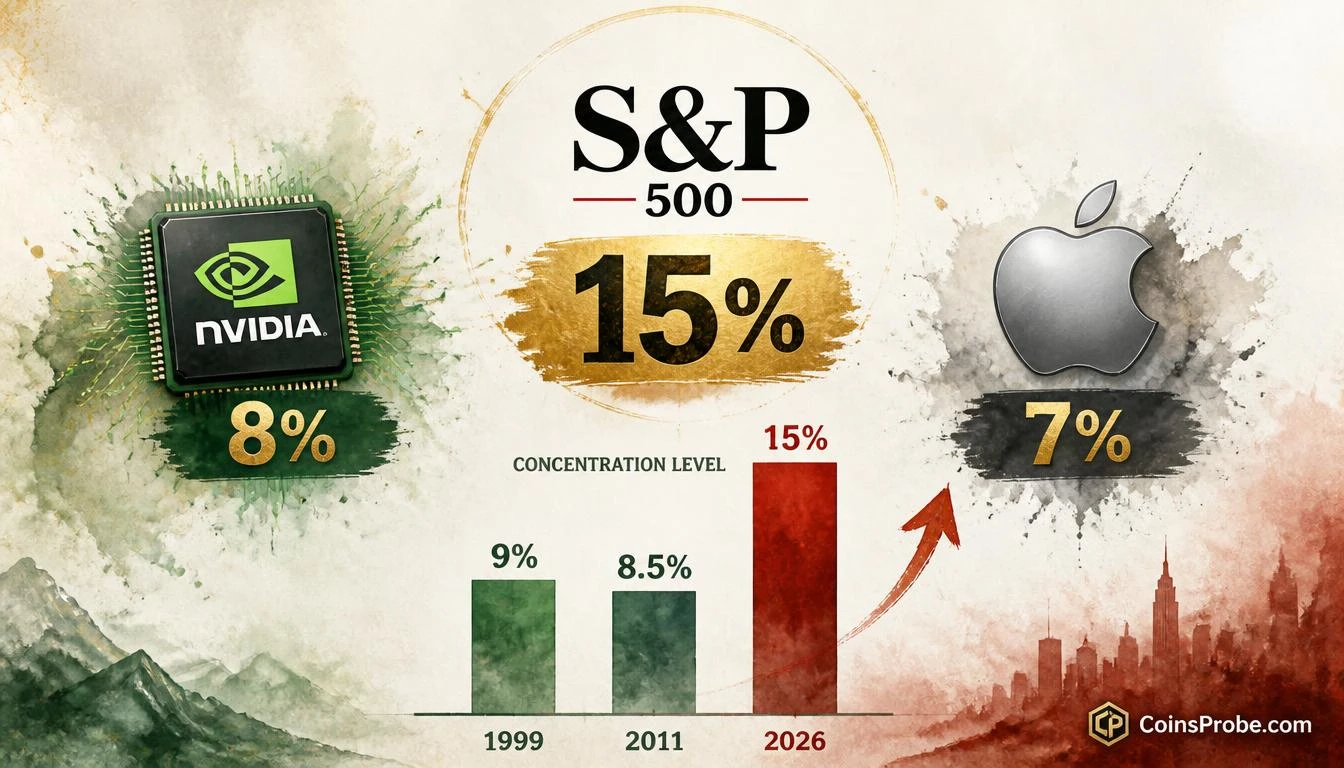
- Nvidia (8%) + Apple (7%) = 15% of S&P 500 market cap — an all-time high per The Kobeissi Letter
- Current 15% concentration is 67% above the 1999 dot-com bubble peak of 9% (Microsoft + GE)
- S&P 500 passive investors carry direct single-stock risk: a 10% NVDA/AAPL drop hits ~0.8–1.0% of the full index
The S&P 500 has never been this concentrated in two names. Nvidia ($NVDA) and Apple ($AAPL) now collectively represent 15% of the index’s total market capitalization — an all-time high, according to The Kobeissi Letter.
Nvidia alone carries a record 8% weighting, driven by its AI-infrastructure dominance. Apple holds 7%. Together, they surpass every prior concentration milestone in the index’s history.
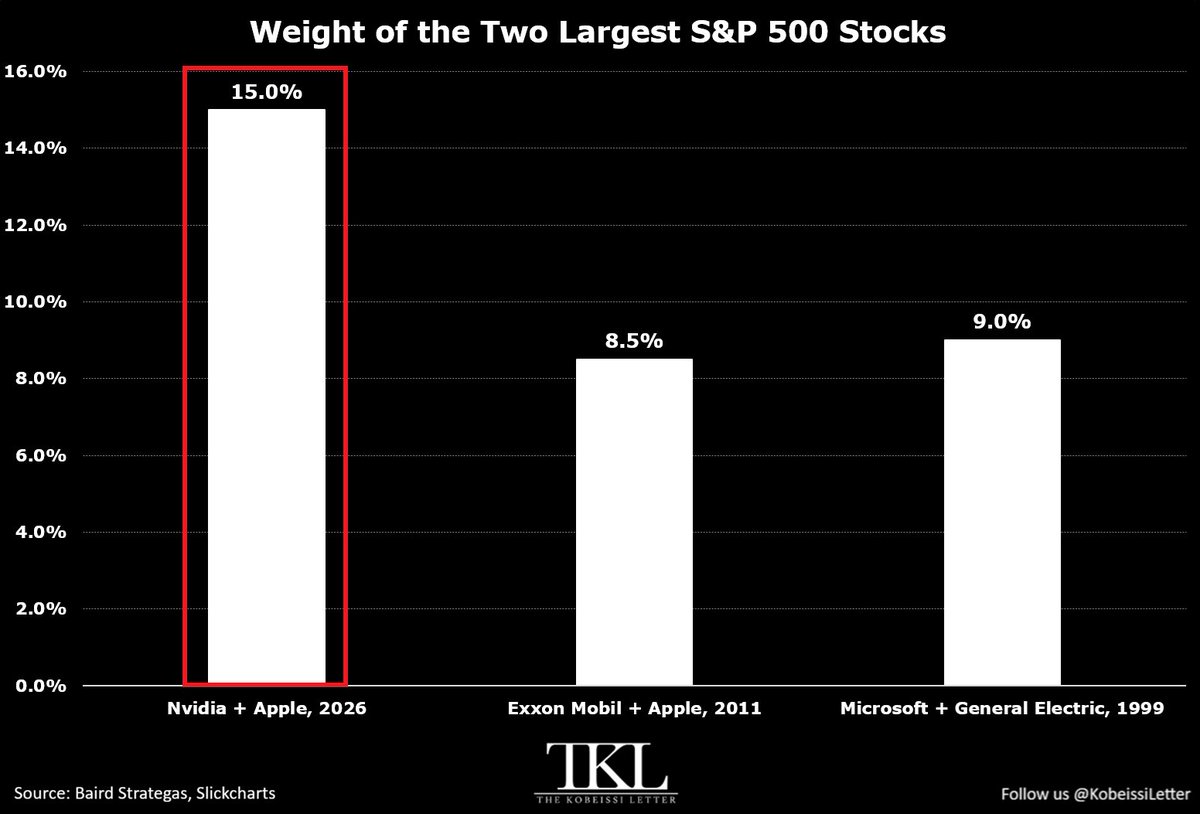
The historical context makes the number stark. At the peak of the 1999 dot-com bubble, the two largest S&P 500 companies — Microsoft and General Electric — combined for just 9% of the index. The current reading is 67% higher than that widely-cited warning era. In 2011, Exxon Mobil and Apple together held approximately 8.5%.
What This Means for Passive Investors
The implication is direct: investors holding standard S&P 500 index funds are not as diversified as the 500-company label suggests. A 10% drawdown in either Nvidia or Apple translates to roughly a 0.8%–1.0% drag on the entire index — before any other stock moves. Passive exposure to the S&P 500 is, structurally, a concentrated bet on two AI-era megacaps.
Concentration at this level historically precedes mean-reversion events. Equal-weight S&P alternatives such as $RSP eliminate this single-stock dependency by treating all 500 constituents equally regardless of market cap.
This data point arrives as broader macro leverage continues to build. Global debt hit a record $365 trillion after a $10 trillion surge in H1 2026 — a backdrop that historically amplifies the impact of any large-cap correction on risk assets broadly, including crypto. Meanwhile, Hyperliquid stablecoin TVL reached $7.67B, reflecting parallel concentration dynamics in DeFi liquidity.
No single equity event guarantees a correction. But when two stocks control more of a 500-name index than any prior point in recorded history — including the peak of the dot-com era — the concentration risk is no longer theoretical. It is structural, and it is at an all-time high.
Frequently Asked Questions
How does Nvidia’s 8% S&P 500 weighting compare to historical megacap dominance?
What happens to the S&P 500 if Nvidia or Apple drops sharply?
Is an equal-weight S&P 500 ETF a way to reduce this concentration risk?
Source: Kobeissiletter · Published by CoinsProbe Markets Desk
The opinions and market insights shared on CoinsProbe represent the views of individual authors based on prevailing market conditions at the time of publication. Cryptocurrency investments carry significant risk and volatility. Readers are encouraged to conduct their own research and seek professional financial advice before making investment decisions. CoinsProbe and its contributors do not accept responsibility for financial losses or decisions made based on published content.
CoinsProbe may publish sponsored articles, affiliate links, or promotional collaborations. All sponsored material is clearly labeled to maintain transparency with our audience. Our editorial decisions remain fully independent, and advertising partnerships do not influence reviews, rankings, or published opinions.
Since 2023, CoinsProbe has delivered reliable insights on cryptocurrency, blockchain, and digital assets. Our content is created by experienced researchers and analysts who follow strict editorial standards focused on accuracy, transparency, and credibility. Every article is carefully reviewed and verified using trusted sources and current market data. We provide unbiased analysis and timely updates covering everything from emerging crypto projects to major industry developments.