
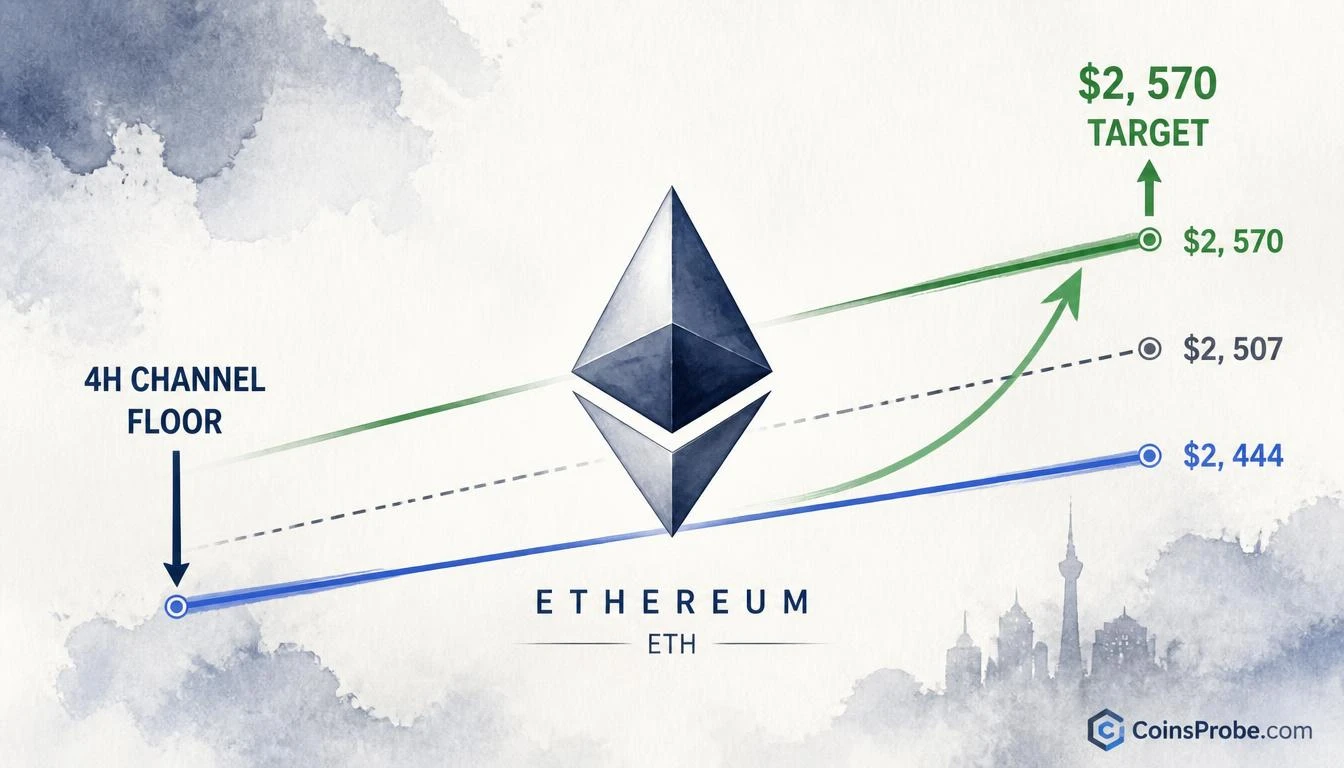

- ETH is trading at $2,444.81 — up 1.87% in 24 hours — at the lower boundary of its 4-hour channel
- Analyst Ali Martinez (@alicharts) targets $2,570 upper channel boundary as the primary recovery level
- Channel mid-range near $2,507 is the first structural checkpoint — a close above confirms rebound thesis
- Loss of the lower boundary (~$2,410) fully invalidates the channel structure and Martinez's trade setup
Ethereum is trading at $2,444.81 — up 1.87% in the last 24 hours — with a market cap of approximately $298.4 billion and $15.3 billion in daily volume. Despite a turbulent stretch of sessions, one structural fact stands out: ETH has not broken its 4-hour channel. It has only reached its floor.
That floor is precisely where analyst Ali Martinez (@alicharts) is now focused. In a post published on September 17, 2026, Martinez stated: “Despite the volatility over the past few days, Ethereum remains contained within its 4-hour channel. Now that price has reached the lower boundary, I’m watching for $ETH to rebound toward the mid-range and eventually the upper boundary near $2,570.”
That single observation contains a complete trade thesis — one built not on sentiment, but on channel geometry and boundary positioning.
The 4-Hour Channel — Structure Before Direction
A price channel on the 4-hour timeframe is a parallel structure connecting a series of lower highs and lower lows — or in this case, a defined corridor within which ETH has oscillated across multiple sessions. The lower boundary functions as dynamic support; the upper boundary as dynamic resistance. The mid-range is the equilibrium zone where price frequently rotates.
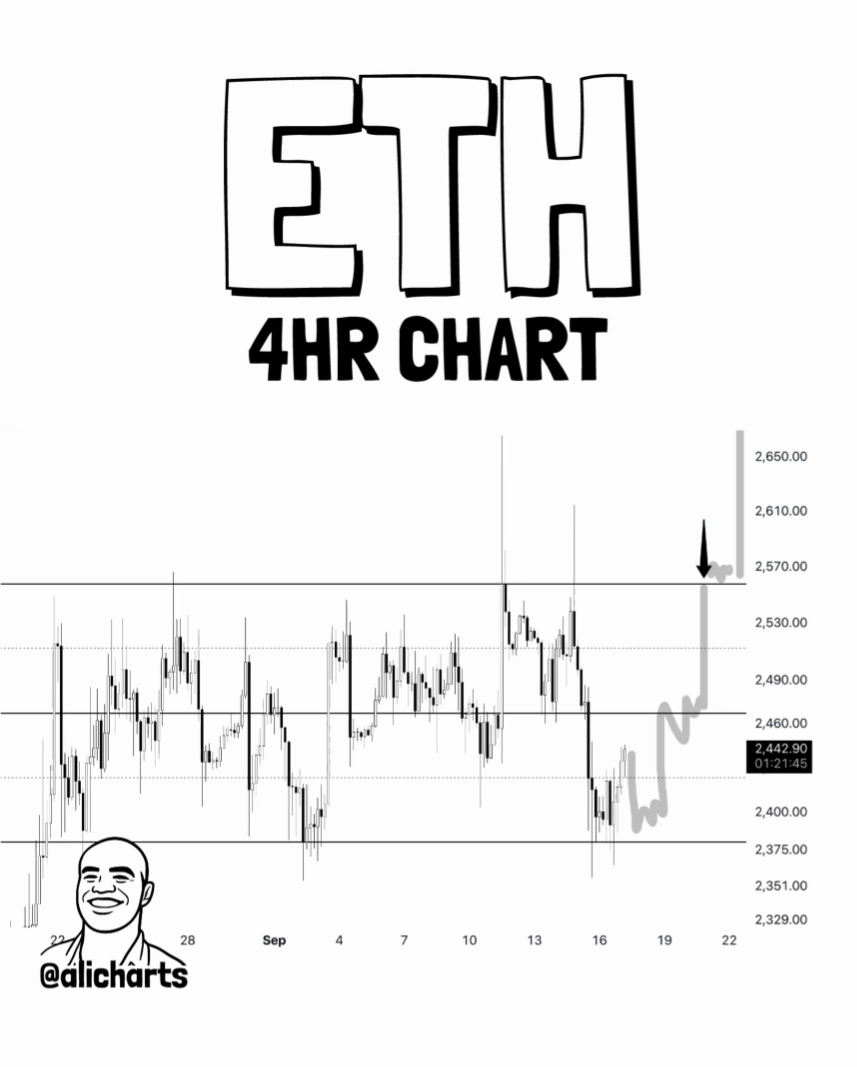
The analytical significance here is not that ETH touched support. It is that after days of volatility — including sharp intraday swings in both directions — the channel structure has held. Price did not close below the lower boundary. It did not invalidate the structure. It tagged the floor and, as of writing, is showing early recovery signs with the 1.87% 24-hour gain.
Channel boundary touches are not guarantees of reversal. But they are high-probability inflection zones — the market equivalent of a spring reaching maximum compression before releasing stored energy. When a structured channel holds through volatility, the lower boundary becomes a defined reference point: either it holds and price retraces toward equilibrium, or it breaks and the structure is invalidated entirely.
The Three Levels Martinez Is Tracking
Martinez’s framework breaks into three sequential targets, each with distinct analytical meaning:
| Level | Zone | Significance |
|---|---|---|
| ~$2,444 | Lower Boundary (Current) | Channel floor — active support, current price |
| ~$2,507 | Mid-Range | Channel equilibrium — first recovery target |
| $2,570 | Upper Boundary | Channel ceiling — primary price target per Martinez |
Channel levels based on @alicharts 4-hour ETH analysis, September 17, 2026
The distance from current price ($2,444.81) to the upper boundary ($2,570) represents a ~5.1% potential move within the existing channel structure alone. This is not a macro thesis — it is a contained, channel-geometry trade with a defined invalidation level at the lower boundary.
The mid-range near $2,507 functions as an intermediate checkpoint. A clean reclaim and hold above that level would confirm the rebound thesis is progressing. Failure to hold the mid-range on any bounce would signal the channel is compressing rather than recovering.
What the Channel Geometry Actually Means
The critical detail in Martinez’s analysis is the word “contained.” Volatility did not break the channel. This matters more than the price swings themselves. In technical structure analysis, the retention of a channel through high-volatility sessions is evidence of structural integrity — the market is still respecting the same reference geometry it established at the start of the channel formation.
Channel boundary touches on the 4-hour timeframe are particularly significant because the timeframe is liquid enough to eliminate noise but structured enough to reflect institutional positioning. A 4-hour channel that survives intraday volatility is not a coincidence — it reflects a market that is actively pricing within those boundaries.
For context on ETH’s broader market dynamics, Bitcoin UTXO Age Bands flagging a mid-cycle floor — not the cycle low — suggests the macro crypto structure may be entering a recovery phase, which would provide tailwind for any ETH channel rebound.
Volume and 24-Hour Context
ETH’s $15.33 billion in 24-hour volume at time of writing is a notable supporting data point. Elevated volume at a channel boundary — particularly when accompanied by a positive 24-hour return — is consistent with accumulation behavior at support rather than breakdown behavior. A breakdown from a channel boundary on heavy volume would look structurally different: price closing below the lower boundary with volume expanding to the downside.
The current setup — price at channel floor, positive 24-hour return, contained structure — aligns with the rebound scenario Martinez is mapping. It does not confirm it. But it does not contradict it either.
Bullish Scenario — Reclaim of Mid-Range ($2,507)
A sustained 4-hour close above $2,507 (channel mid-range) opens the path toward $2,570, the upper boundary identified by Martinez. That move represents a ~5.1% gain from current price ($2,444.81) and would confirm the lower boundary held as genuine support. A close above $2,570 would shift the structure from range-bound to breakout territory.
Bearish Scenario — Loss of Lower Boundary (~$2,400–$2,420)
A 4-hour close below the channel’s lower boundary — estimated in the $2,400–$2,420 zone based on the current channel geometry — would invalidate the entire rebound thesis. That outcome would signal the channel has broken down, opening unstructured downside toward the next major support levels. Martinez’s trade thesis has no validity below that boundary.
What This Analysis Does and Doesn’t Say
What it says: Ethereum has reached the lower boundary of a defined 4-hour channel and has not broken it. The channel structure remains intact despite multi-day volatility. The primary target for a channel-rebound move is $2,570.
What it doesn’t say: This is not a macro bullish call on Ethereum. It is a channel-geometry trade with a defined scope. The analysis is valid within the 4-hour channel structure only — broader market conditions, ETH fundamentals, or macro macro events could override the setup entirely.
What to watch for continuation: A 4-hour close above $2,507 (mid-range) with volume confirming — not declining — on the move higher. That is the structural condition that separates a genuine channel rebound from a dead-cat bounce within the lower range.
For those tracking ETH alongside other mid-cap chart structures, NEAR’s developing Inverse Head & Shoulders pattern below $3 is another example of channel and pattern geometry flagging potential 2027 breakout setups across the altcoin market.
Bottom Line
Ethereum is sitting at the lower boundary of its 4-hour channel at $2,444.81 — a level that has held through days of volatility without producing a structural breakdown. Analyst Ali Martinez (@alicharts) identifies this as a channel-floor inflection point with a two-stage recovery path: first to the mid-range (~$2,507), then to the upper boundary at $2,570. The 5.1% distance from current price to the upper target is contained and geometry-defined, not speculative. The trade thesis stands as long as the lower boundary holds.
A 4-hour close below ~$2,410 invalidates the structure entirely. Watch $2,507 — a sustained close above that level is the first confirmation that the channel rebound is underway. Watch $2,570 as the level that determines whether this remains a range-bound structure or becomes something larger.
Frequently Asked Questions
What is the $2,570 Ethereum target based on?
What level must Ethereum reclaim to confirm a channel rebound?
At what price does the Ethereum 4-hour channel analysis get invalidated?
Why is Ethereum’s channel holding significant despite recent volatility?
Source: Ali Charts · Published by CoinsProbe Markets Desk
The opinions and market insights shared on CoinsProbe represent the views of individual authors based on prevailing market conditions at the time of publication. Cryptocurrency investments carry significant risk and volatility. Readers are encouraged to conduct their own research and seek professional financial advice before making investment decisions. CoinsProbe and its contributors do not accept responsibility for financial losses or decisions made based on published content.
CoinsProbe may publish sponsored articles, affiliate links, or promotional collaborations. All sponsored material is clearly labeled to maintain transparency with our audience. Our editorial decisions remain fully independent, and advertising partnerships do not influence reviews, rankings, or published opinions.
Since 2023, CoinsProbe has delivered reliable insights on cryptocurrency, blockchain, and digital assets. Our content is created by experienced researchers and analysts who follow strict editorial standards focused on accuracy, transparency, and credibility. Every article is carefully reviewed and verified using trusted sources and current market data. We provide unbiased analysis and timely updates covering everything from emerging crypto projects to major industry developments.