

- Bitget cumulative BTC outflows hit $668.6M post-reopening — but decelerated sharply after October 1, per CryptoQuant
- CryptoQuant analyst @JA_Maartun: withdrawal rush "stabilized rather than developed into a sustained run"
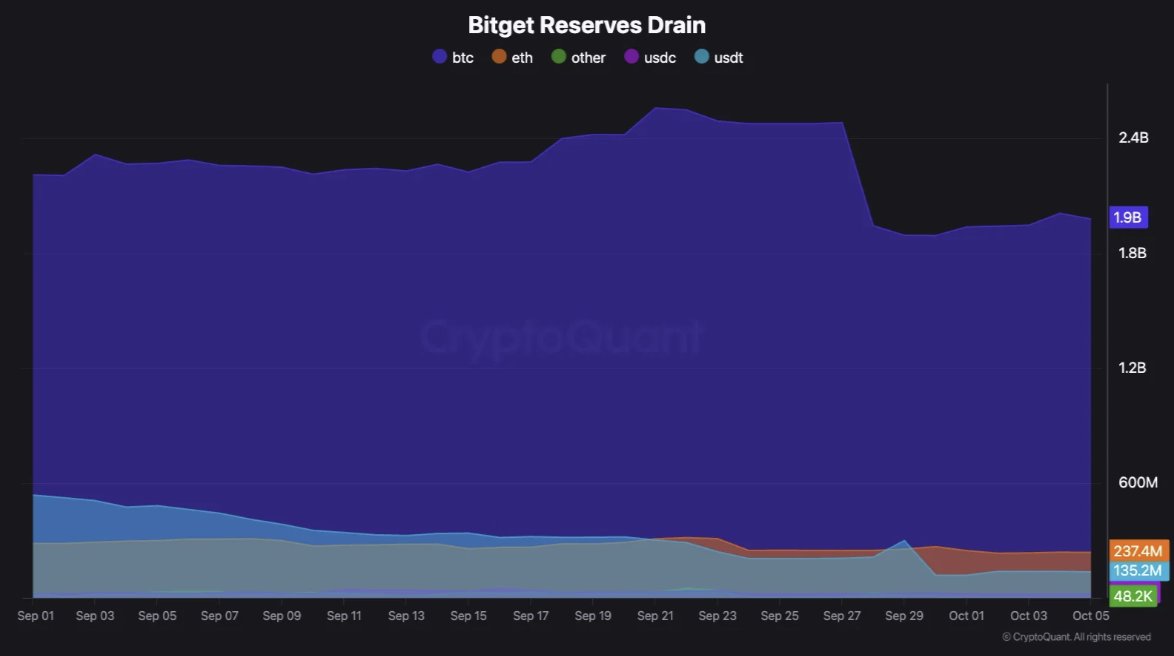
- Bitget BTC reserves stood at $1.9B as of October 5 — drawdown contained, no continued decline
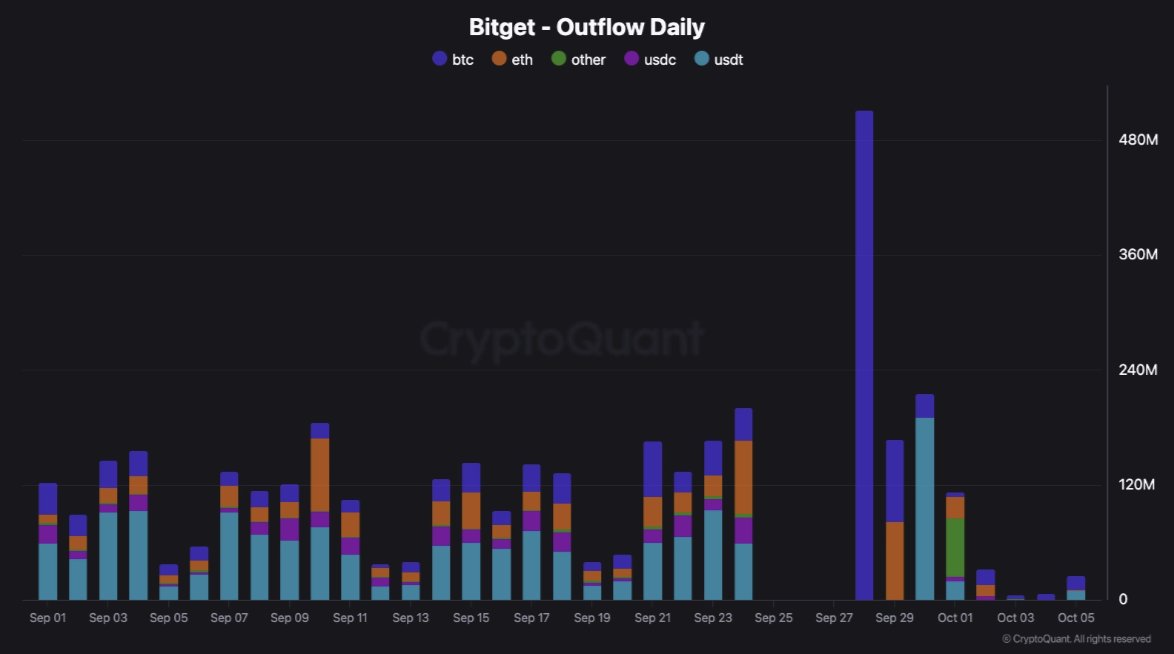
- Daily outflow bars returned to near-baseline levels by early October after single-spike peak on Sep 27–28
One week after Bitget reopened withdrawals following a temporary suspension, on-chain data is delivering a clear verdict: the initial user rush was a spike, not a bank run. CryptoQuant analyst @JA_Maartun published the findings on October 8, 2026, drawing on exchange outflow and reserve data spanning September 1 through October 5.
The conclusion, published via @cryptoquant_com, was direct: “Data suggests the initial withdrawal rush has stabilized rather than developed into a sustained run on the exchange. Bitget’s fast communication and phased reopening appear to have helped contain the situation.” This is not a hedged observation — it is a declarative, data-backed conclusion from a named CryptoQuant analyst examining five asset classes simultaneously.
The Withdrawal Spike — What the Daily Outflow Data Shows
The daily outflow chart covering September 1 through October 5 tells the most important part of this story in a single visual. Across BTC, ETH, USDT, USDC, and other assets, outflow bars remained moderate and consistent through the first three weeks of September. Then, around September 27–28 — coinciding with the moment withdrawals formally reopened — a single bar dwarfed every surrounding period. The spike was dominated by BTC outflows. By early October, bars had rapidly compressed back toward baseline levels, forming a sharp peak-and-reversion shape that is the structural opposite of a sustained capital flight event.
Cumulative Flows — The Numbers Behind the Narrative
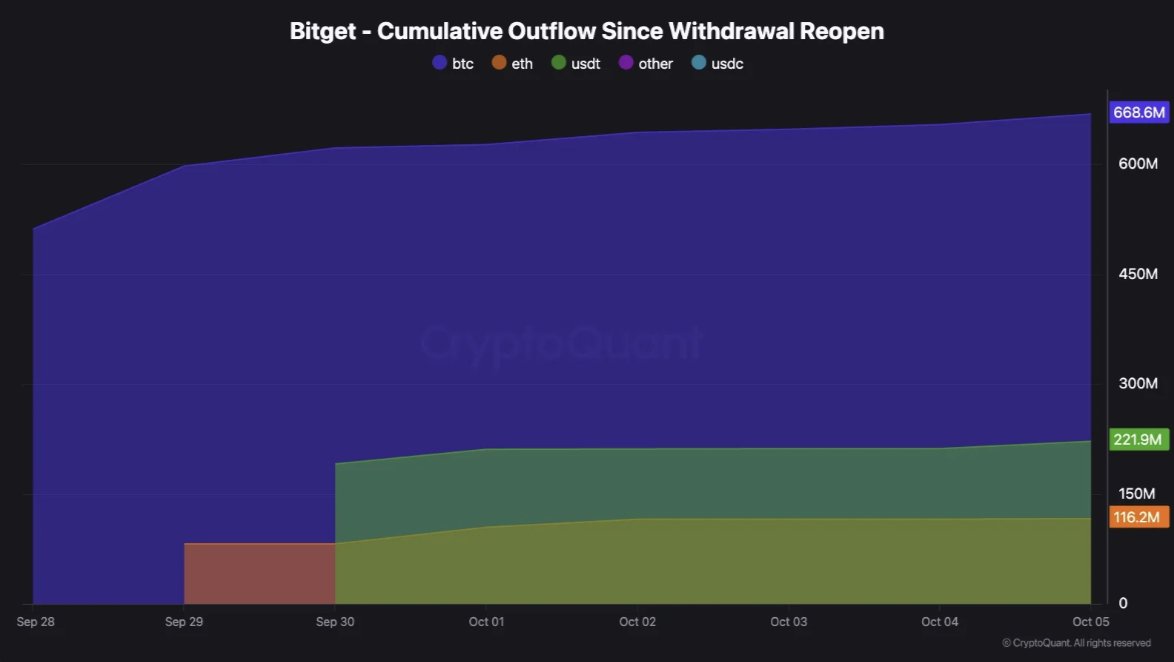
The cumulative outflow chart for the September 28 through October 5 window puts precise figures on the rush. BTC led all asset outflows at $668.6 million cumulative. USDT followed at $221.9 million, with ETH contributing $116.2 million. Taken together, these are not trivial figures — they represent real capital leaving the platform in the immediate post-reopening period. But the shape of the cumulative curve is what matters analytically: a steep initial rise from September 28–29, a secondary step-up around September 30, and then a visible flattening from October 1 through October 5. Decelerating outflow velocity is the mathematical signature of panic subsiding, not deepening.
Reserves — Drawdown Contained, Stabilization Confirmed
The reserve chart completes the picture. Bitget’s total multi-asset reserves — measured across BTC, ETH, USDC, USDT, and other assets — rose gradually through mid-September, peaked around September 19–23, then dropped sharply in the September 27–29 window as withdrawals reopened and users moved funds off the platform. As of early October, the chart shows stabilization rather than continued decline. Right-side reserve labels as of October 5 read: BTC at $1.9 billion, ETH/other at $237.4 million, USDC at $135.2 million, and USDT at $48.2 thousand. The drawdown was significant but contained. The subsequent plateau, not a continued descent, is what @JA_Maartun’s conclusion rests on.
Why This Matters — The Difference Between a Rush and a Run
A withdrawal rush and a bank run produce entirely different on-chain signatures. A rush is front-loaded: users who were locked out exit quickly once access is restored, outflows peak in the first 48–72 hours, and the curve flattens as the backlog clears. A sustained run produces the opposite pattern — outflows that either maintain velocity or accelerate as confidence erodes and new users join the exit. Bitget’s data maps cleanly to the first pattern. The daily outflow spike around September 27–28 was the backlog clearing. The cumulative curve flattening after October 1 is the confirmation that no second wave of exits followed. @JA_Maartun specifically credits Bitget’s communication response and phased withdrawal reopening as structural factors that prevented the former from becoming the latter.
For context on how exchange-level confidence metrics interact with broader sentiment signals, see our earlier analysis on TAO Long/Short Ratio and ETH sentiment divergence on Binance — a reminder that exchange-specific dynamics and market-wide sentiment can move independently.
What the Data Does and Doesn’t Establish
The CryptoQuant data establishes three things with precision: the outflow spike was temporally concentrated around the reopening date, cumulative outflow velocity decelerated meaningfully after October 1, and reserve levels stabilized rather than continuing to fall into early October. What the data does not establish is any forward projection about user retention, trading volume recovery, or competitive positioning relative to peer exchanges. @JA_Maartun’s conclusion is specifically about the withdrawal crisis dynamic — whether it became a run — not about Bitget’s broader commercial recovery trajectory. Bitcoin itself is trading at approximately $82,922 at the time of writing, down 1.52% in the past 24 hours, and the macro environment remains its own variable entirely separate from Bitget’s exchange-specific situation.
Bullish Scenario
If reserve levels hold at current October 5 readings — BTC reserves at $1.9 billion — and daily outflow bars continue to normalize toward pre-crisis September baselines, Bitget’s on-chain profile would indicate a full operational recovery from the withdrawal crisis without further capital erosion.
Bearish Scenario
A renewed acceleration in daily outflows — returning toward or beyond the September 27–28 spike magnitude — would contradict @JA_Maartun’s stabilization conclusion and signal that a second wave of user exits is underway, a pattern the current data does not yet show.
The on-chain verdict for Bitget’s first post-crisis week is stabilization. The $668.6 million in cumulative BTC outflows, the $221.9 million in USDT outflows, and the $116.2 million in ETH outflows were real and significant — but they decelerated sharply after October 1 rather than sustaining or accelerating. The reserve chart corroborates the daily flow data. Watch Bitget’s daily outflow figures on CryptoQuant in the sessions ahead — any re-acceleration toward late-September volumes would be the first meaningful signal that the stabilization thesis requires revision.
Source: x.comFrequently Asked Questions
How much did users withdraw from Bitget after withdrawals reopened?
What is the difference between a withdrawal rush and a bank run on an exchange?
What are Bitget’s current reserve levels after the withdrawal crisis?
What would signal that Bitget’s withdrawal crisis is not truly over?
Source: CryptoQuant · Published by CoinsProbe Markets Desk
The opinions and market insights shared on CoinsProbe represent the views of individual authors based on prevailing market conditions at the time of publication. Cryptocurrency investments carry significant risk and volatility. Readers are encouraged to conduct their own research and seek professional financial advice before making investment decisions. CoinsProbe and its contributors do not accept responsibility for financial losses or decisions made based on published content.
CoinsProbe may publish sponsored articles, affiliate links, or promotional collaborations. All sponsored material is clearly labeled to maintain transparency with our audience. Our editorial decisions remain fully independent, and advertising partnerships do not influence reviews, rankings, or published opinions.
Since 2023, CoinsProbe has delivered reliable insights on cryptocurrency, blockchain, and digital assets. Our content is created by experienced researchers and analysts who follow strict editorial standards focused on accuracy, transparency, and credibility. Every article is carefully reviewed and verified using trusted sources and current market data. We provide unbiased analysis and timely updates covering everything from emerging crypto projects to major industry developments.