
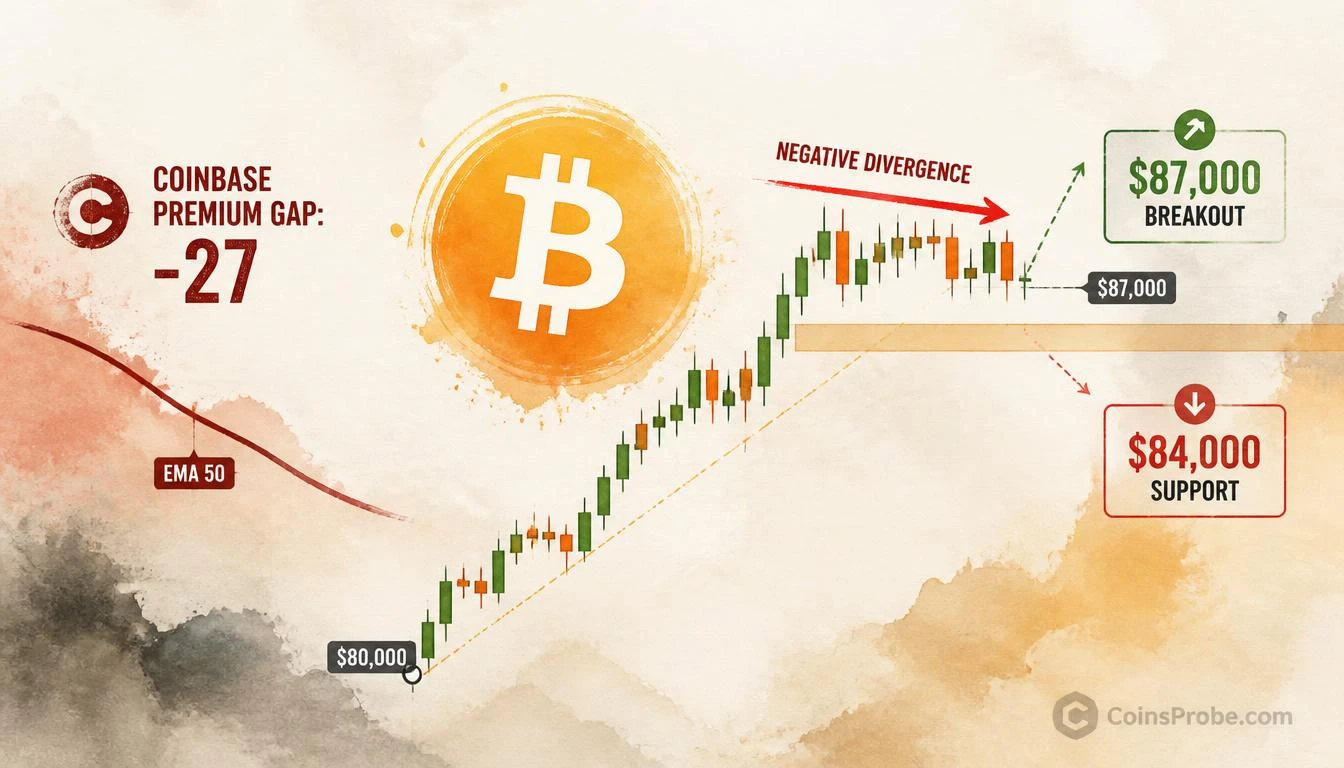

- Bitcoin trades at $85,970 (+1.18% 24h) — pressing the $86K–$87K resistance zone after an 8.75% rally from $80K on Sep 20
- Coinbase Premium Gap collapsed to -27 on Sep 22 from +9 peak — CryptoQuant flags bearish divergence as U.S. institutional demand cools at the highs
- ETF inflow follow-through is the single binary test: a positive Premium Gap recovery confirms breakout; sustained negative reading opens pullback risk to $84K–$85K
- Key levels: $87,000 is the breakout target; $84,000 is the primary downside support if ETF flows disappoint
Bitcoin is trading at $85,970 — up 1.18% in the past 24 hours — with a market cap of $1.73 trillion, pressing against a critical resistance band between $86,000 and $87,000. The rally that carried BTC from $80,000 to current levels is intact. But one institutional demand metric has just issued a sharp warning: the Coinbase Premium Gap has turned negative, signaling that U.S. spot buyers are no longer supporting prices at the highs.
That is the assessment from CryptoQuant (@cryptoquant_com), which flagged the development in real time on September 22: “The Coinbase Premium Gap has turned negative, suggesting U.S. spot demand has cooled. All eyes are on the U.S. session to see whether ETFs can deliver another strong day.” The platform’s read is direct — a breakout above $87,000 is not a technical question. It is an ETF flow question. And right now, that flow has paused.
What the Coinbase Premium Gap Actually Measures
The Coinbase Premium Gap is not a sentiment indicator. It is a structural demand signal. It measures the price differential between BTC/USD on Coinbase Pro — the primary venue for U.S. institutional and ETF-related spot activity — versus BTC/USDT on Binance, which represents global retail-weighted demand. When the gap is positive, U.S. buyers are paying a premium over the global price — demand is absorbing supply domestically. When the gap turns negative, U.S. buyers are bidding below the global rate, meaning domestic institutional demand is not keeping pace with global price action.
This metric has historically been one of the most reliable leading indicators of ETF inflow direction. A sustained positive reading in early 2025 preceded multiple multi-week rallies. A negative reading at a resistance ceiling — as is occurring now — has preceded consolidation or rejection in prior instances.
Current Reading — Negative 27 at the Resistance Zone
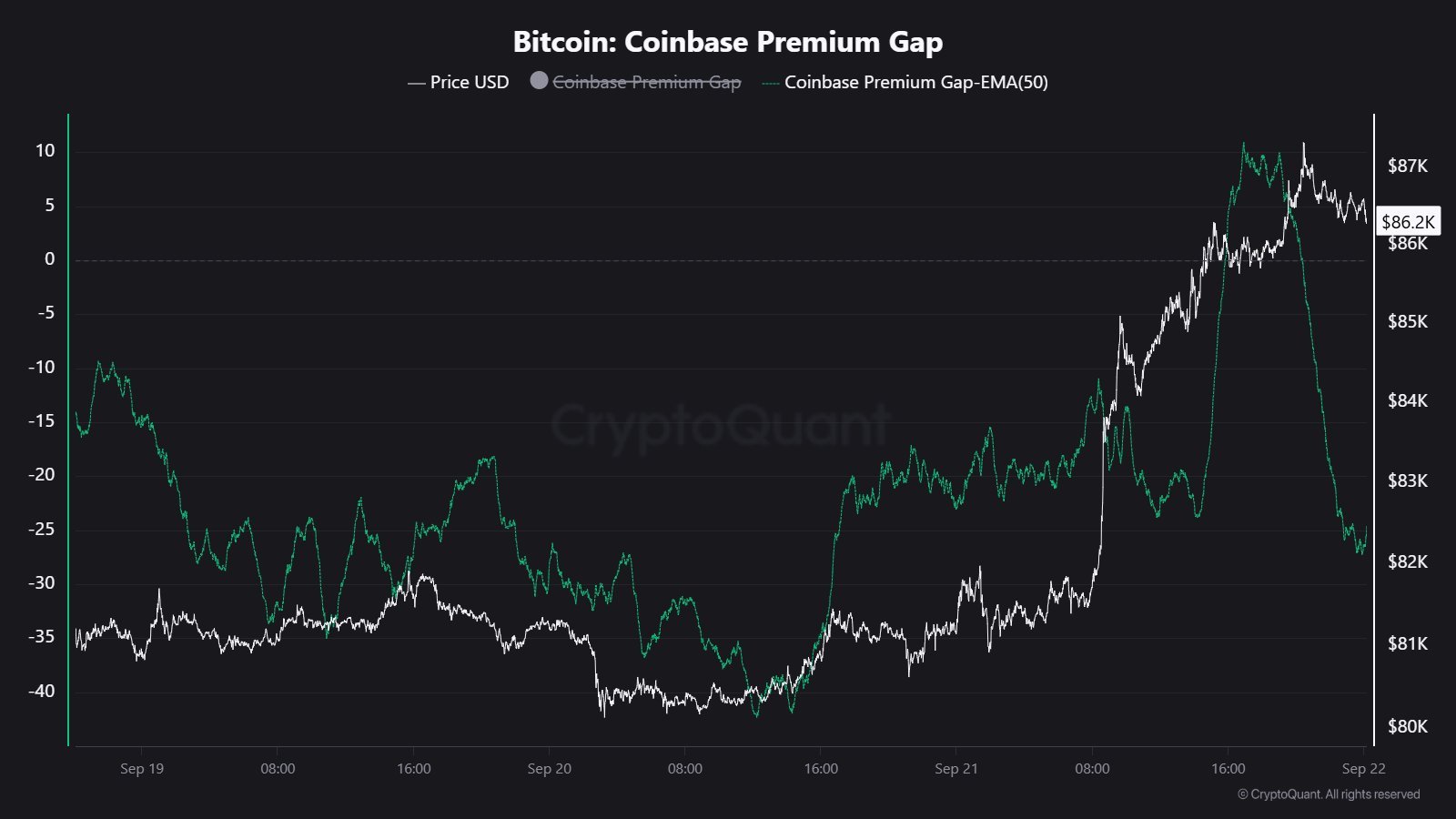
The CryptoQuant chart covering September 19–22 reveals a sharp and sudden deterioration in the Premium Gap reading. The chart shows Bitcoin rallied from a $80,000 trough on September 20 to a peak above $87,000 on September 21–22. During that rally, the Premium Gap climbed to a reading of approximately +9, confirming that U.S. institutional buyers were actively participating in the move higher.
Then, on September 22, the reading collapsed to approximately -27 — a swing of roughly 36 points — while Bitcoin’s price held near the highs. The EMA(50) of the Premium Gap has turned steeply downward, confirming this is not a single-session noise reading. It is a directional shift. CryptoQuant identifies this as a classic bearish divergence: price holding elevated while the institutional demand metric deteriorates rapidly.
Why Bearish Divergence at $86K–$87K Is the Key Concern
The $86,000–$87,000 zone is not an arbitrary level. It is the ceiling that Bitcoin has now reached on the back of a $7,000 rally from the September 20 low. Breaking through that ceiling requires sustained institutional buying — specifically, ETF inflows large enough to absorb the supply being offered at current prices.
The mechanism is direct: U.S. spot ETFs — primarily BlackRock’s IBIT and Fidelity’s FBTC — purchase Bitcoin through Coinbase Custody as their primary execution venue. When ETF inflows are strong, Coinbase buyers pay a premium. When inflows stall or reverse, the premium collapses. A negative Premium Gap reading at a resistance level therefore carries a specific implication: the primary buying force behind the recent rally has cooled precisely at the level where additional supply pressure is highest.
This dynamic was also highlighted recently in our coverage of institutional Bitcoin flow signals — Bitcoin Exchange Flows Flash Pre-Fed Warning — What the Data Shows — where exchange inflow data showed similar institutional caution at elevated price levels.
The ETF Flow Threshold — What Confirms or Invalidates
CryptoQuant’s framing is precise: “BTC needs ETF flows to follow through to push through this area.” This creates a specific, testable condition. The outcome is not determined by technicals alone. It is determined by whether the U.S. trading session produces another strong day of ETF net inflows.
| Metric | Reading (Sep 22) | Implication |
|---|---|---|
| Coinbase Premium Gap | ~-27 | U.S. spot demand below global rate |
| EMA(50) of Premium Gap | Steeply downward | Trend deterioration confirmed |
| BTC Price (Sep 22) | ~$86,200 | Holding at resistance ceiling |
| Rally range (Sep 20–22) | $80K → $87K (+8.75%) | Institutional-led move now stalling |
Source: CryptoQuant, September 22, 2026
Bull and Bear Scenarios From Here
Bullish Scenario — ETF Flows Resume, Premium Gap Recovers
If the U.S. session delivers strong ETF net inflows and the Coinbase Premium Gap returns to positive territory — ideally above +5 — the structural signal flips back to supportive. In that case, $87,000 becomes the immediate target, with a sustained close above that level opening a run toward $90,000–$92,000 based on the measured move from the September 20 base. The rally structure remains intact as long as ETF demand re-engages at this level.
Bearish Scenario — Premium Gap Stays Negative, ETF Flows Disappoint
If the U.S. session produces flat or negative ETF flows, the Coinbase Premium Gap remaining negative at current price levels creates real pullback risk. CryptoQuant’s chart analysis identifies $84,000–$85,000 as the primary support zone — approximately 1.1%–2.3% below current price. A break below $84,000 on weak institutional demand would suggest the $80,000–$87,000 rally was a relief move, not a breakout.
What This Does and Doesn’t Say
What it says: U.S. institutional buyers — the primary driver of the September 20–22 rally — are not currently bidding above global prices at the $86K–$87K resistance zone. The structural tailwind has paused.
What it doesn’t say: It does not confirm a top. A single-session divergence in the Premium Gap has not historically been sufficient to reverse a trend. The EMA trend matters more than the spot reading.
What to watch for continuation: Coinbase Premium Gap recovering above zero during the U.S. trading session, confirmed by ETF net inflow data showing a positive day. CryptoQuant’s Premium Gap dashboard updates in real time.
Bottom Line
Bitcoin at $85,970 is 1.2% below the $87,000 level that CryptoQuant identifies as the breakout threshold — and the Coinbase Premium Gap at -27 is the single most important data point traders need to monitor heading into the U.S. session. The rally from $80,000 was institutionally driven: positive premium readings confirmed that ETF-related buying was absorbing supply. The sudden reversal to -27 on September 22, while price held near highs, is a textbook bearish divergence in the institutional demand signal. A breakout above $87,000 without that signal recovering is historically fragile. Watch for the Coinbase Premium Gap to return to positive territory during the U.S. session — that is the confirmation that separates a genuine breakout from a failed attempt at resistance. The level that determines the near-term direction is $84,000 to the downside and $87,000 to the upside.
Frequently Asked Questions
What does a negative Coinbase Premium Gap mean for Bitcoin?
Why does Bitcoin need ETF flows to break above $87,000?
What is the key support level if Bitcoin fails to break $87,000?
How do traders know if ETF flows have resumed?
Source: CryptoQuant · Published by CoinsProbe Markets Desk
The opinions and market insights shared on CoinsProbe represent the views of individual authors based on prevailing market conditions at the time of publication. Cryptocurrency investments carry significant risk and volatility. Readers are encouraged to conduct their own research and seek professional financial advice before making investment decisions. CoinsProbe and its contributors do not accept responsibility for financial losses or decisions made based on published content.
CoinsProbe may publish sponsored articles, affiliate links, or promotional collaborations. All sponsored material is clearly labeled to maintain transparency with our audience. Our editorial decisions remain fully independent, and advertising partnerships do not influence reviews, rankings, or published opinions.
Since 2023, CoinsProbe has delivered reliable insights on cryptocurrency, blockchain, and digital assets. Our content is created by experienced researchers and analysts who follow strict editorial standards focused on accuracy, transparency, and credibility. Every article is carefully reviewed and verified using trusted sources and current market data. We provide unbiased analysis and timely updates covering everything from emerging crypto projects to major industry developments.