
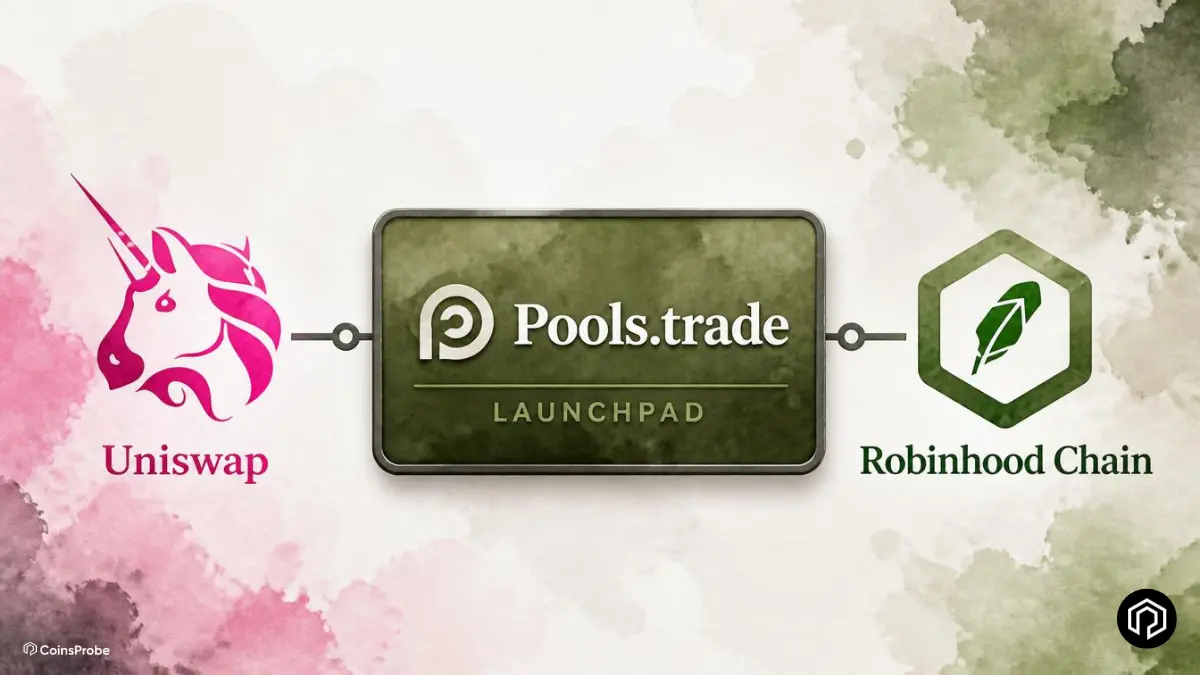

- Uniswap Labs has launched Pools.trade, a token launchpad built for Robinhood Chain.
- The platform offers permanently locked liquidity, MEV/sniping protection, autocompounding LP fees, and no extra launchpad fees.
- Traders generated over $150 million in volume before the official interface went live.
- Tokens launched on Pools.trade gain instant exposure across the Uniswap ecosystem and partner platforms, including Bitget, GMGN, FOMO, and OKX Wallet.
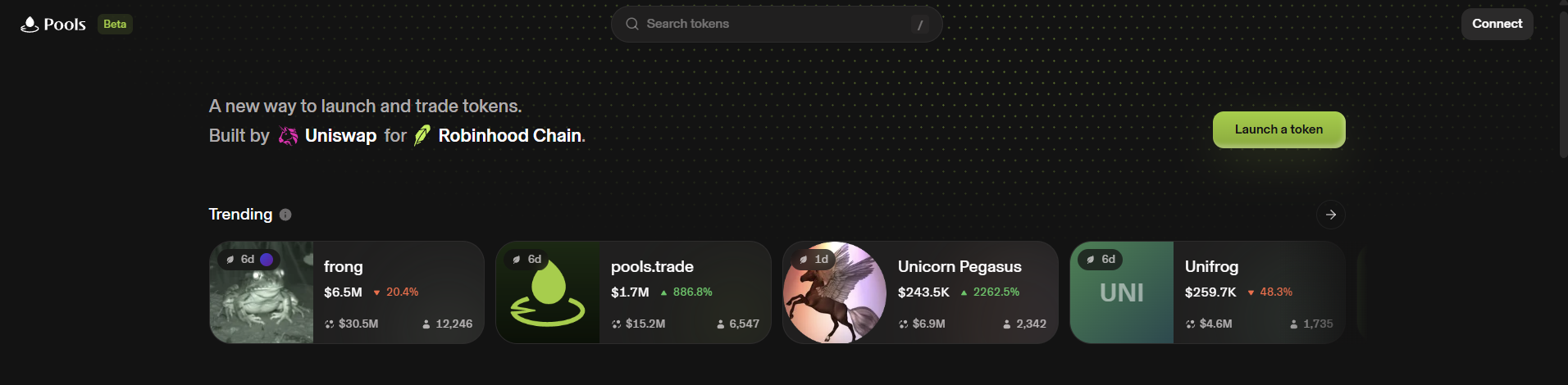
Uniswap Labs has officially rolled out Pools.trade, a dedicated token launchpad built specifically for Robinhood Chain. The platform went live on August 5, 2026, allowing users to create, discover, and trade new tokens end-to-end at pools.trade.T
his marks Uniswap’s direct entry into the competitive launchpad space on the emerging Layer 2 network, where it already serves as the primary public AMM.
What Is Pools.trade and Why Does It Matter
Pools.trade is a token launchpad built by Uniswap Labs specifically for Robinhood Chain — the Layer-2 network that launched on July 1, 2026 and surpassed Binance Smart Chain in DEX volume within its first week.
Uniswap already serves as Robinhood Chain’s primary public AMM — meaning most DEX trading on the chain flows through its pools. Pools.trade extends that infrastructure upstream: instead of capturing value only when tokens are traded, Uniswap now captures value from the moment tokens are created. It is a full-stack play on Robinhood Chain’s token economy.
Uniswap founder Hayden Adams’ context:
Adams noted that Uniswap has been used as both a launchpad and launchpad infrastructure for more than eight years — with various projects using Uniswap’s v2, v3, and now v4 pools as the liquidity destination for newly launched tokens. Pools.trade formalises and optimises that relationship — building Uniswap’s own native launchpad experience rather than leaving that value to third parties.
What Makes Pools.trade Different — Five Key Differentiators
1. Permanently Locked Liquidity
All liquidity on Pools.trade is held by the protocol and cannot be removed by the token creator — ever. Every token launched on the platform ends in a standard Uniswap v4 pool with liquidity locked permanently. This eliminates the rug-pull mechanic that has made token creator liquidity withdrawal one of the most common ways retail traders lose money on launchpads — a structural protection that most competing platforms do not enforce at the protocol level.
2. Autocompounding LP Fees
The 0.25% LP fee automatically compounds back into the permanently locked liquidity position — growing the pool’s depth over time rather than being distributed and withdrawn. As trading volume generates fees, those fees immediately increase the available liquidity, creating a self-reinforcing cycle where active tokens become progressively more liquid without any action required from creators or the protocol.
3. Sniping Mitigation
Token creators purchase tokens in the same block as the launch — a specific mechanism designed to reduce the advantage of bots that typically front-run new launches to capture early price appreciation at the expense of genuine buyers. By aligning the creator’s initial purchase with the launch block, the window for bot exploitation is compressed. This directly addresses one of the most complained-about dynamics on existing launchpads.
4. Zero Additional Launchpad Fees
Users pay only the standard Uniswap v4 protocol fee — with no additional launchpad fee on top. Most competing platforms charge approximately 1% in combined fees — Pools.trade keeps total spreads significantly below that level. Hayden Adams specifically highlighted this as making the experience “far better for traders” — and the math is straightforward: lower fees mean more value captured by traders on every transaction rather than by the platform.

5. Optional Creator Fees
Creators can elect to receive 0.05% of the 0.25% LP fee — with the remaining portion continuing to autocompound into the locked liquidity pool. This is optional rather than mandatory — preserving the zero-additional-fee experience for traders while giving token creators a mechanism to earn from ongoing trading activity if they choose to enable it.
Two Key Features to Launch Tokens on Pools.Trade
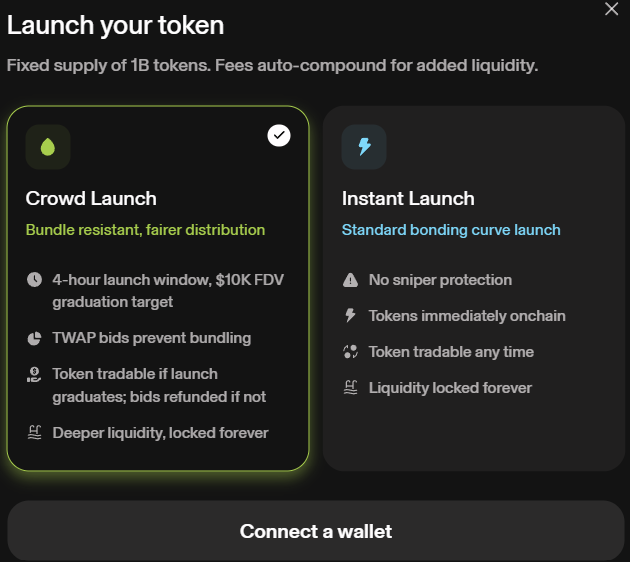
Every token on Pools.trade starts with a fixed supply of 1 billion tokens and ends in a standard Uniswap v4 pool with permanently locked liquidity. The path to that endpoint offers two options:
Option 1 — Crowd Launch:
The Crowd Launch mechanism is designed for deeper, fairer liquidity distribution:
- 4-hour launch window during which participants can bid
- TWAP (time-weighted average price) bidding — reduces bundling and bot activity by averaging prices across the window rather than allowing instant first-mover advantage
- Minimum $10,000 fully diluted valuation required to graduate — tokens that do not reach this threshold have all bids refunded, preventing the accumulation of valueless tokens in the ecosystem
- Result: deeper initial liquidity distribution with more participants at fair prices
Option 2 — Instant Launch:
The Instant Launch mechanism prioritises speed and simplicity:
- Token goes live immediately — no waiting window
- Classic bonding-curve mechanism — the same model that Pump.fun made famous, where price increases along a mathematical curve as buyers accumulate
- No minimum FDV requirement — any token can launch regardless of initial demand
- Users can buy and sell at any time after launch
Both mechanisms ensure the final liquidity ends in a permanently locked Uniswap v4 pool — the structural protection applies regardless of which launch method is used.
The $150M Volume Before the UI Even Launched
One of the more remarkable details of Pools.trade’s launch story is what happened before the official interface went live.
The Uniswap team deployed smart contracts ahead of the UI launch — and the community discovered them before the official rollout. Traders began interacting with the contracts directly and generated over $150 million in volume on earlier contract versions before the Pools.trade interface was publicly available.
This level of pre-launch organic activity — $150M in volume from users finding and using raw smart contracts without a user interface — reflects the acute demand for new token launch infrastructure on Robinhood Chain. The community did not wait for Uniswap to announce the product. They found the contracts and started trading.
The unexpected scale of this activity required the Uniswap team to update indexing and site support for both test and final contract versions simultaneously — a non-trivial engineering task that slightly delayed the public rollout but ultimately resulted in a launch that could handle the existing user activity from day one.
Adams acknowledged the complexity this created while expressing strong enthusiasm — noting the team’s commitment to continuous upgrades based on user feedback as the product moves through its beta phase.
Distribution — Immediate Access to the Uniswap Ecosystem
Tokens launched on Pools.trade do not exist in isolation — they gain immediate distribution across the full Uniswap ecosystem from the moment of launch:
| Platform | Integration Type |
|---|---|
| Uniswap Web App | Native listing and trading |
| Uniswap Wallet | Mobile trading access |
| Uniswap Trading API | Programmatic access for integrators |
| Bitget | Third-party exchange integration |
| FOMO | Trading platform integration |
| GMGN | On-chain trading tool |
| OKX Wallet | Wallet integration |
This distribution network means a token launched on Pools.trade is immediately discoverable and tradeable across multiple venues simultaneously — a significant advantage over launchpads where tokens remain isolated on a single platform until they manually list on other venues.
The Competitive Context — Pools.trade vs Pump.fun
The token launchpad comparison that the crypto community will immediately draw is with Pump.fun — the dominant Solana-based memecoin launchpad that generates $30–40M in monthly revenue and has been one of the most profitable protocols in DeFi throughout 2026.
As we covered in our $PUMP Power of 3 expansion and revenue article — Pump.fun’s success model is built on its bonding-curve mechanism, graduation fees, and the Solana ecosystem’s active memecoin trading culture. Pools.trade is targeting the equivalent position on Robinhood Chain — with structural advantages including lower fees, permanent liquidity locks, and native Uniswap ecosystem distribution.
Whether Pools.trade can replicate the cultural and volume success that Pump.fun achieved on Solana — on a chain that already surpassed BSC in DEX volume within its first week — will be one of the more closely watched competitive dynamics in the launchpad sector over the coming months.
The Disclaimer — What Uniswap Is Explicit About
Uniswap Labs has been direct about what Pools.trade is and is not:
What it is: A memecoin launchpad for speculative, highly volatile assets that can go to zero.
What it is not: A curated or reviewed listing process. Tokens are not reviewed or endorsed by the Uniswap team — any token can launch (particularly via Instant Launch), and some may include optional creator fees.
The permanent liquidity lock and anti-rug structural protections reduce some categories of risk — but they do not protect against the fundamental reality that most new token launches on any platform will decline in value. This is a tool for sophisticated participants who understand speculative asset risk.
Bottom Line
Uniswap’s launch of Pools.trade on Robinhood Chain is a strategic extension of its infrastructure playbook — moving from the trading layer into the creation layer on a chain where it already dominates DEX activity. Permanently locked liquidity, autocompounding fees, sniping mitigation, and zero additional launchpad fees address the most common complaints about existing launchpads while immediate Uniswap ecosystem distribution gives launched tokens instant reach.
The $150M in pre-launch volume confirms demand was there before the product was officially available. The question now is whether Pools.trade’s structural advantages convert that early demand into the sustained launchpad activity that could make it the dominant token creation venue on Robinhood Chain.
Frequently Asked Questions (FAQ)
What is Pools.trade?
A dedicated token launchpad built by Uniswap Labs specifically for Robinhood Chain — launched August 5, 2026 at pools.trade — allowing users to create, discover, and trade new tokens with permanently locked liquidity and zero additional launchpad fees.
What makes Pools.trade different from Pump.fun and other launchpads?
Five key differentiators: permanently locked liquidity (no rug pulls), autocompounding LP fees, sniping mitigation (creator buys in same block as launch), zero additional launchpad fees (only standard v4 fee), and immediate Uniswap ecosystem distribution across web app, wallet, API, and third-party integrations.
What are the two ways to launch tokens on Pools.trade?
Crowd Launch — a 4-hour TWAP bidding window with a $10,000 minimum FDV to graduate, designed for fairer distribution. Instant Launch — immediate launch using a classic bonding curve with no minimum FDV requirement.
What distribution does a Pools.trade token get?
Immediate listing across the Uniswap web app, wallet, and trading API — plus third-party integrations including Bitget, FOMO, GMGN, and OKX Wallet — making launched tokens discoverable and tradeable across multiple venues from day one.
Is Pools.trade safe to use?
Uniswap explicitly states Pools.trade is for speculative memecoins that can go to zero. Tokens are not reviewed or endorsed. The permanent liquidity lock prevents rug pulls but does not protect against tokens declining in value. It is currently in beta.
The opinions and market insights shared on CoinsProbe represent the views of individual authors based on prevailing market conditions at the time of publication. Cryptocurrency investments carry significant risk and volatility. Readers are encouraged to conduct their own research and seek professional financial advice before making investment decisions. CoinsProbe and its contributors do not accept responsibility for financial losses or decisions made based on published content.
CoinsProbe may publish sponsored articles, affiliate links, or promotional collaborations. All sponsored material is clearly labeled to maintain transparency with our audience. Our editorial decisions remain fully independent, and advertising partnerships do not influence reviews, rankings, or published opinions.
Since 2023, CoinsProbe has delivered reliable insights on cryptocurrency, blockchain, and digital assets. Our content is created by experienced researchers and analysts who follow strict editorial standards focused on accuracy, transparency, and credibility. Every article is carefully reviewed and verified using trusted sources and current market data. We provide unbiased analysis and timely updates covering everything from emerging crypto projects to major industry developments.