
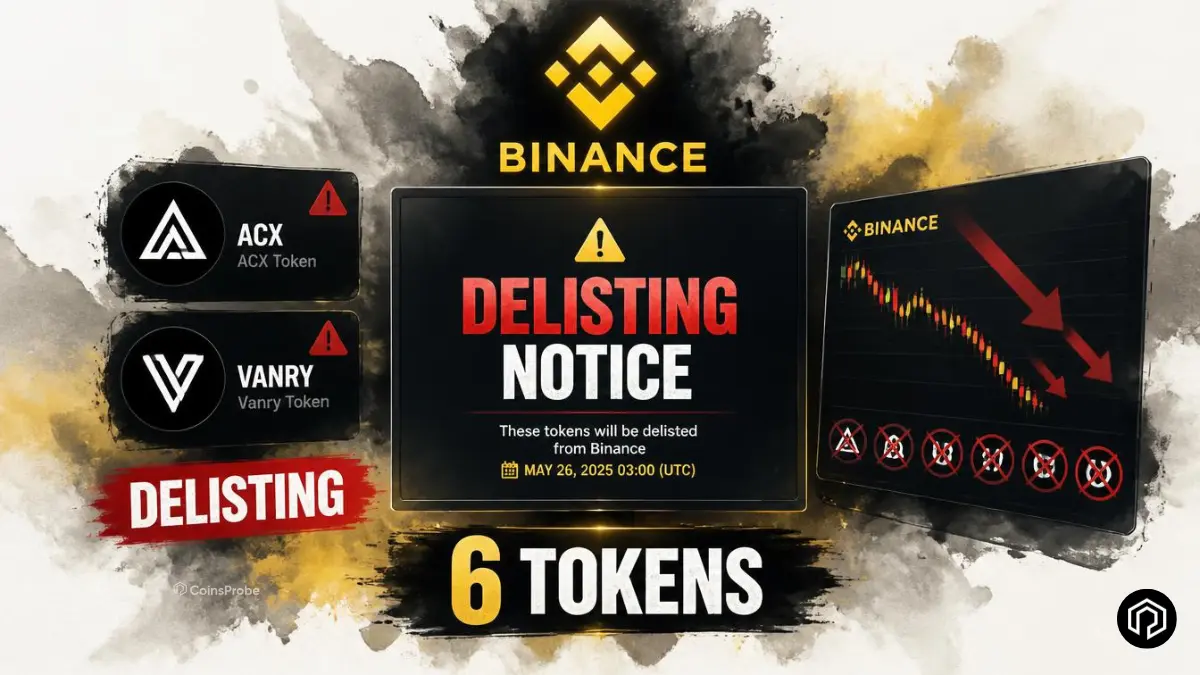

- Binance will delist six tokens—ACX, HFT, PIVX, PYR, VANRY, and VIC—on August 17, 2026.
- The announcement triggered sharp sell-offs, with losses of up to 23% across the affected tokens.
- Binance said the removals followed its regular listing review process.
- Users should withdraw or convert affected tokens before the delisting deadline.
Binance has announced the delisting of six cryptocurrencies from its platform. All spot trading pairs for the following tokens will be removed at 03:00 UTC on August 17, 2026:
| Token | Symbol |
|---|---|
| Across Protocol | ACX |
| Hashflow | HFT |
| PIVX | PIVX |
| Vulcan Forged | PYR |
| Vanar Chain | VANRY |
| Viction | VIC |
Full official announcement: binance.com/en/support/announcement/detail/64cf7544b98e4f2ca7f54ba11fd72d9d
Why Binance Is Delisting These Tokens
In its official notice, Binance stated that it regularly reviews all listed digital assets to ensure they continue meeting the exchange’s listing standards — covering factors including trading volume, liquidity, development activity, team transparency, and regulatory compliance.
When a project no longer satisfies these criteria — or when market conditions shift in ways that reduce the token’s suitability for the platform — Binance may decide to delist. The stated goal is to protect users and maintain a healthier trading environment by focusing the platform’s liquidity and attention on projects with stronger ongoing fundamentals.
Binance did not cite specific reasons for each individual token’s removal — which is standard practice for the exchange’s periodic delisting announcements. The affected projects span a range of categories: cross-chain bridging infrastructure (ACX), DEX aggregation (HFT), privacy (PIVX), gaming (PYR), Layer-1 infrastructure (VANRY and VIC) — suggesting this is a broad liquidity and activity review rather than a targeted action against a specific category.
Market Reaction — All Six Tokens Decline Sharply
The delisting announcement triggered immediate selling pressure across all six affected tokens — as holders rushed to exit positions before liquidity conditions deteriorate further:
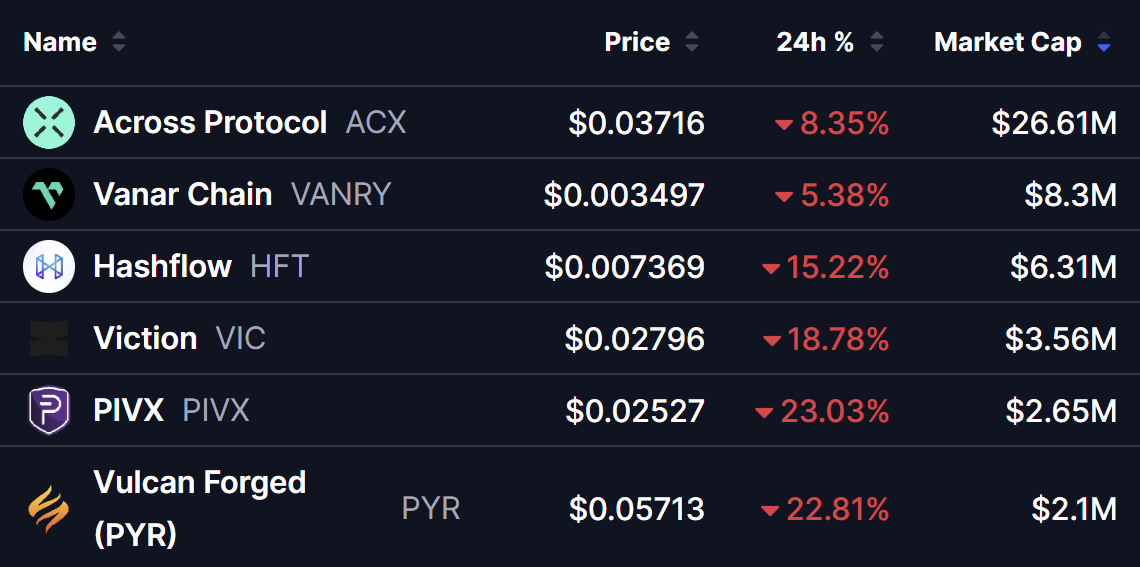
PIVX and PYR have seen the sharpest declines — both down more than -22% — reflecting either the highest concentration of Binance-dependent liquidity for these specific tokens or the greatest seller urgency among their respective holder bases.
ACX and VANRY have held up relatively better in the immediate 24-hour window — though both remain significantly lower and the selling pressure is likely to continue as the August 17 deadline approaches and holders continue exiting.
The pattern here is consistent with prior Binance delisting events — the immediate 24-hour decline is rarely the full extent of the move. As the deadline approaches and liquidity dries up on the platform, further downward pressure typically follows as remaining holders exit into an increasingly thin order book.
What Binance Delisting Means in Practice
For holders unfamiliar with the mechanics of an exchange delisting — here is what happens and when:
Trading pairs removed: All spot trading pairs for the six tokens are removed at 03:00 UTC on August 17, 2026. After this point, you cannot buy or sell these tokens on Binance.
Open orders cancelled automatically: Any open limit orders, stop-loss orders, or other pending orders will be cancelled automatically at the delisting time. You will not need to cancel them manually — but you also will not receive execution on them.
Deposits and withdrawals phased out: Binance will phase out deposit and withdrawal support for these tokens on a separate schedule — typically announced after the trading delisting. Once withdrawal support ends, you will no longer be able to move tokens from Binance to an external wallet through the standard interface.
The critical window: The period between now and August 17 is when you have the most options and the best liquidity. Acting early gives you better prices, more time to troubleshoot technical issues, and more choices about where to move funds.
What Holders Must Do — Action Guide
If you hold any of these six tokens on Binance, take one of the following actions before August 17:
Option 1 — Withdraw to a personal wallet:
Transfer your tokens to a self-custody wallet (hardware wallet or software wallet) where you retain full control. This preserves your position if you believe the token has long-term value outside of Binance’s platform.
Option 2 — Convert to other assets:
Sell the delisted tokens on Binance while liquidity and trading remain available — converting into stablecoins (USDT, USDC), Bitcoin, Ethereum, or other assets you wish to hold. This is the simplest approach for holders who do not have strong conviction in the individual token’s long-term prospects.
Option 3 — Transfer to another exchange:
If the token is listed on other centralised exchanges (Bybit, OKX, KuCoin, Gate.io, etc.) — you may be able to withdraw from Binance and continue trading on another platform. Check availability before initiating the transfer.
The recommendation: Act well before August 17 — not on August 17 itself. The days immediately before a delisting deadline typically see increased withdrawal volumes and potential network congestion, making early action significantly more reliable than last-minute exits.
The Broader Context — Binance’s Periodic Delisting Process
Binance conducts periodic reviews of its token listings and has delisted dozens of tokens over the years as part of its ongoing effort to maintain listing quality. This is not an unusual or emergency event — it is part of the exchange’s standard governance process.
For the affected tokens, the Binance delisting represents a significant liquidity reduction — Binance is typically the highest-volume venue for many smaller and mid-cap tokens, and losing access to its user base materially reduces the token’s accessible market. Whether the individual projects can sustain sufficient liquidity and community engagement through other venues will determine their longer-term trajectories after August 17.
For holders, the delisting is a reminder of the custodial risk embedded in keeping assets on centralised exchanges — a theme we have covered extensively in the context of the BitMart shutdown and BitMEX closure in last month. Self-custody remains the only approach that fully eliminates the risk of an exchange decision affecting your access to your assets.
Bottom Line
Binance’s delisting of ACX, HFT, PIVX, PYR, VANRY, and VIC on August 17, 2026 has triggered immediate double-digit declines across all six tokens — with PIVX and PYR down more than -22% in the first 24 hours. Holders have approximately two weeks to withdraw to self-custody, convert to other assets, or transfer to alternative exchanges before trading pairs are removed and open orders are automatically cancelled.
The most important action is the most simple one: do not wait until August 17.
Frequently Asked Questions (FAQ)
Which tokens is Binance delisting on 17 August 2026?
Across Protocol (ACX), Hashflow (HFT), PIVX, Vulcan Forged (PYR), Vanar Chain (VANRY), and Viction (VIC) — all spot trading pairs removed at 03:00 UTC on August 17, 2026.
Why is Binance delisting these tokens?
Binance cited its standard periodic review process — tokens are delisted when they no longer meet the exchange’s listing criteria covering trading volume, liquidity, development activity, and team transparency.
What should I do if I hold any of these tokens on Binance?
Act before August 17 — either withdraw to a personal wallet, convert to other assets (stablecoins, BTC, ETH), or transfer to another exchange that still lists the token. Do not wait until the deadline.
The opinions and market insights shared on CoinsProbe represent the views of individual authors based on prevailing market conditions at the time of publication. Cryptocurrency investments carry significant risk and volatility. Readers are encouraged to conduct their own research and seek professional financial advice before making investment decisions. CoinsProbe and its contributors do not accept responsibility for financial losses or decisions made based on published content.
CoinsProbe may publish sponsored articles, affiliate links, or promotional collaborations. All sponsored material is clearly labeled to maintain transparency with our audience. Our editorial decisions remain fully independent, and advertising partnerships do not influence reviews, rankings, or published opinions.
Since 2023, CoinsProbe has delivered reliable insights on cryptocurrency, blockchain, and digital assets. Our content is created by experienced researchers and analysts who follow strict editorial standards focused on accuracy, transparency, and credibility. Every article is carefully reviewed and verified using trusted sources and current market data. We provide unbiased analysis and timely updates covering everything from emerging crypto projects to major industry developments.