


- Stablecoin activity is showing early signs of recovery across major exchanges, according to CryptoQuant.
- Binance ERC-20 stablecoin deposits remain elevated at around 12,000 transactions.
- USDC exchange flows have turned positive, ending a two-month outflow streak.
- The signals are constructive but still cautious, with no clear sign of aggressive buying yet.
Two independent on-chain signals from CryptoQuant are pointing in the same direction in late July 2026: stablecoin liquidity is returning to exchanges after a prolonged period of subdued flows. The signals are early and measured — not the kind of explosive surge that precedes sharp price moves — but their simultaneous appearance from two different data sources adds credibility to the interpretation that something is shifting in how investors are positioning their dry powder.
Signal 1 — Binance ERC-20 Stablecoin Deposits Hold Elevated After July Spikes
CryptoQuant researcher Rei (@Satoureireal) has flagged that ERC-20 stablecoin deposit transactions into Binance are currently running at approximately 12,000 — maintaining elevated activity following a series of sharp spikes throughout July 2026 that pushed readings to 35,000–50,000 at their peaks.
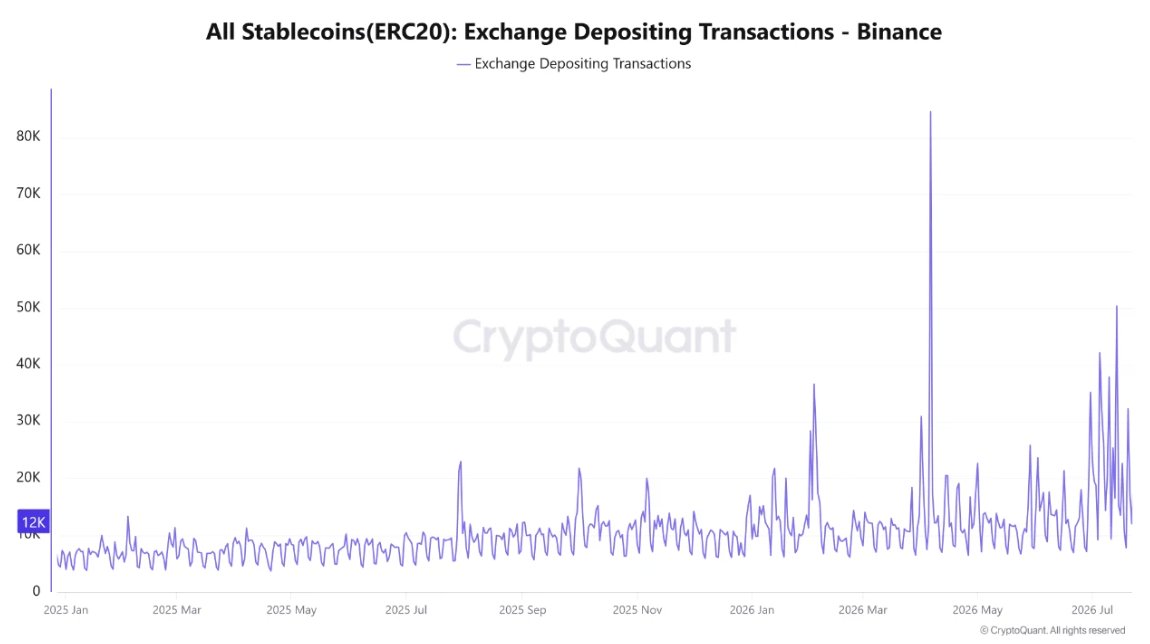
What the Binance chart shows:
Looking at the full chart — which spans from January 2025 through late July 2026 — the baseline for Binance ERC-20 stablecoin deposit transactions ran consistently in the 5,000–10,000 range for most of 2025. From mid-2025 onward, the readings began to spike more frequently and to higher levels — with the most notable single spike reaching approximately 80,000+ in early 2026.
The July 2026 pattern shows a series of elevated spikes — several reaching 35,000–50,000 — before the current reading has settled back to approximately 12,000. This cooldown from the July peaks is why Rei characterises the signal as maintained rather than explosive — activity is above the 2025 baseline but has come off the month’s highs.
What rising Binance stablecoin deposits mean:
Stablecoins deposited onto Binance represent capital being actively repositioned onto the exchange — moving from private wallets or other venues onto a platform where it can be deployed into trading positions quickly. This pattern typically reflects traders and investors preparing for potential buying opportunities rather than simply holding stablecoins in self-custody.
When this deposit transaction count rises — and particularly when it sustains above historical baselines — it signals that participants are moving dry powder into a position where it can be deployed rapidly if and when they identify entry opportunities in Bitcoin, Ethereum, or other assets.
Signal 2 — USDC Netflows Return to Positive — US Capital Back on Exchanges
The second signal — and potentially the more significant one for US-linked institutional capital — comes from CryptoQuant analyst CW8900, who identified that USDC exchange netflows have returned to a net inflow state after more than two months of sustained outflows.
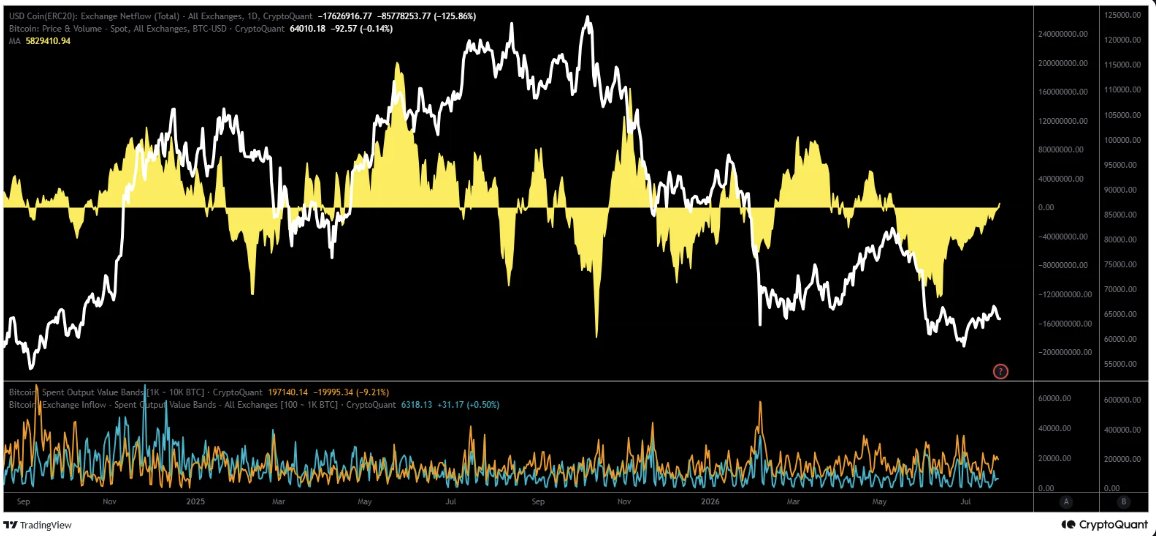
The timeline:
USDC exchange netflows flipped to net outflow on May 11, 2026 — and remained in outflow territory for more than two months continuously. This extended outflow period coincided with the period of broader crypto market weakness and price pressure that has characterised much of 2026’s corrective phase. US-linked capital was leaving exchanges — a signal of reduced near-term trading intent — and moving to self-custody or off-exchange storage.
The recent reversal back to net inflow marks the end of that two-month streak and signals that US-linked participants are once again moving USDC onto exchanges — a directional shift in intent from holding to potential deployment.
The chart context:
The second chart — showing USDC (ERC-20) Exchange Netflow (yellow areas above and below the zero line) alongside Bitcoin’s price (white line) — tells the story visually. The large positive yellow areas (above zero) visible in mid-2025 coincided with Bitcoin’s rally toward and through its all-time high. The sustained negative yellow areas (below zero) in 2026 coincided with the corrective phase. The current signal shows the netflow transitioning back toward positive territory — the same directional shift that historically has preceded or accompanied improving price action.
Why USDC specifically matters:
USDC is the primary stablecoin preferred by US institutional investors and many regulated financial participants. When USDC flows move — as opposed to Tether (USDT), which has a more globally distributed holder base — it provides a cleaner signal specifically about US-linked capital behaviour. A return to USDC net inflows is therefore interpreted as evidence that American institutional and professional capital is repositioning back onto exchanges rather than continuing to reduce exchange exposure.
What These Two Signals Mean Together
Taken individually, each signal provides a single data point about stablecoin behaviour. Taken together — and arriving from two independent analysts using two separate datasets in the same week — they paint a more coherent picture of what is happening to liquidity in late July 2026:
Stablecoins that were sitting off exchanges are moving back on. The Binance deposit transaction data shows this from the exchange-specific perspective. The USDC netflow data shows it from the US-capital-specific perspective. Both point toward the same underlying behaviour: investors who had been holding stablecoins in self-custody or off-exchange are now repositioning that capital in preparation for potential deployment.
The scale is measured, not explosive. Neither analyst is characterising this as the beginning of a liquidity flood. Binance deposit transactions at 12,000 are above the 2025 baseline but well below the July peaks. USDC netflows have returned to positive but have not yet reached the high positive territory visible during the 2025 bull market. This is early-stage repositioning — constructive, but not yet the kind of scale that historically drives immediate sharp price moves.
Dry powder is accumulating on exchanges. Stablecoins parked on exchanges are not earning yield and are not sitting in self-custody for security — they are positioned for rapid deployment into trading positions. Rising stablecoin exchange balances have historically been one of the more reliable leading indicators of improving crypto demand, because the capital has to arrive on the exchange before it can be used to buy.
This connects directly to the broader on-chain picture we have been tracking throughout July 2026 — including the Bitcoin 7-day ETF inflow streak totalling $981M and the $ETH Rebounds from $1,500 Long-Term Support — each measuring a different dimension of the same underlying recovery in market participation.
What to Watch Going Forward
Binance deposit transaction count: Watch whether the current ~12,000 reading expands back toward or above the July peak levels of 35,000–50,000. A sustained move above 20,000 would strengthen the case that the elevated deposit activity is building rather than fading.
USDC netflow direction: Watch whether the return to positive USDC netflows continues or accelerates. A sustained positive reading over multiple weeks — particularly if the magnitude increases — would suggest the two-month outflow reversal has genuine momentum behind it.
Bitcoin price response: The historical relationship between rising stablecoin exchange inflows and Bitcoin price action makes BTC’s response over the coming weeks the most direct test of whether the liquidity returning to exchanges translates into actual buying pressure or simply sits idle.
Bottom Line
Two independent CryptoQuant signals in late July 2026 are both pointing toward the same constructive conclusion: stablecoin liquidity is returning to exchanges after a prolonged period of subdued flows. Binance ERC-20 stablecoin deposit transactions are maintaining elevated levels after July spikes. USDC exchange netflows have ended a two-month outflow streak and returned to positive territory — a specific signal about US institutional capital repositioning.
The picture is one of measured, cautious recovery rather than aggressive accumulation — but the direction is clear, and the convergence of two independent data sources pointing the same way in the same week gives this signal more weight than either would carry alone.
Frequently Asked Questions
What do rising stablecoin deposits on Binance indicate?
Capital being actively repositioned onto the exchange — moving from private wallets or other venues to a platform where it can be rapidly deployed into trading positions. Rising deposit transaction counts signal participants preparing for potential buying opportunities.
What happened to USDC exchange netflows?
USDC netflows flipped to net outflow on May 11, 2026 and remained negative for more than two months. They have recently returned to a net inflow state — signalling that US-linked capital is moving back onto exchanges.
The opinions and market insights shared on CoinsProbe represent the views of individual authors based on prevailing market conditions at the time of publication. Cryptocurrency investments carry significant risk and volatility. Readers are encouraged to conduct their own research and seek professional financial advice before making investment decisions. CoinsProbe and its contributors do not accept responsibility for financial losses or decisions made based on published content.
CoinsProbe may publish sponsored articles, affiliate links, or promotional collaborations. All sponsored material is clearly labeled to maintain transparency with our audience. Our editorial decisions remain fully independent, and advertising partnerships do not influence reviews, rankings, or published opinions.
Since 2023, CoinsProbe has delivered reliable insights on cryptocurrency, blockchain, and digital assets. Our content is created by experienced researchers and analysts who follow strict editorial standards focused on accuracy, transparency, and credibility. Every article is carefully reviewed and verified using trusted sources and current market data. We provide unbiased analysis and timely updates covering everything from emerging crypto projects to major industry developments.