
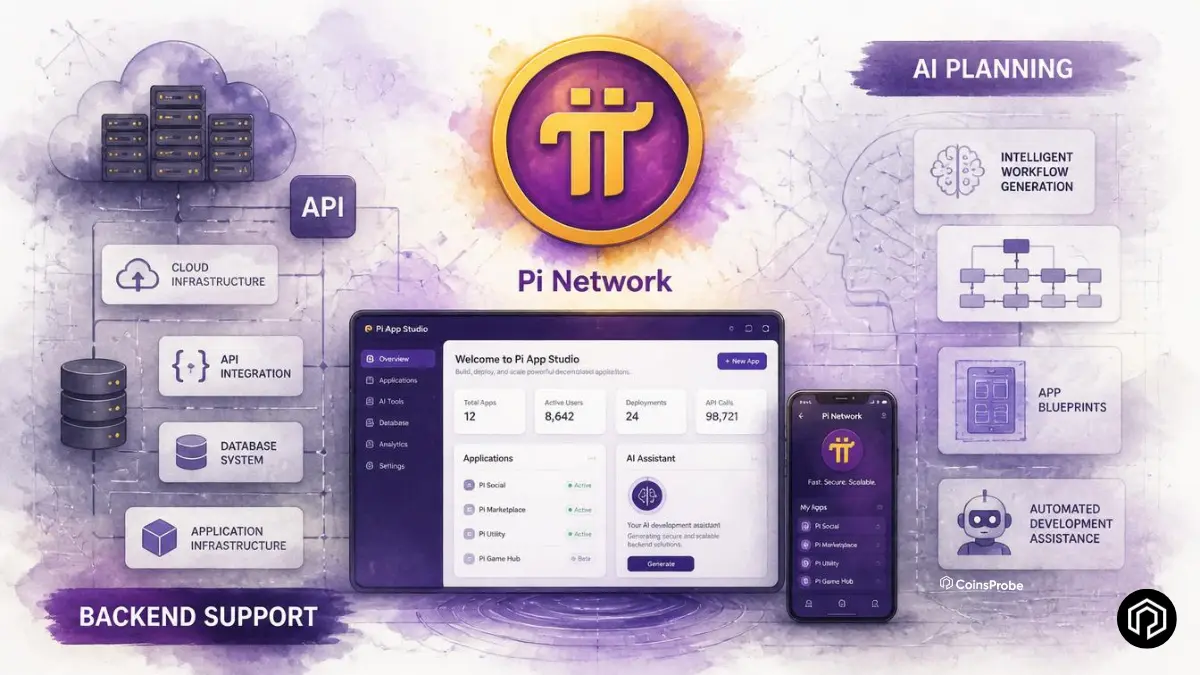

- Pi Network has launched two major Pi App Studio upgrades: persistent storage and an AI-assisted app planning phase.
- Apps can now save user data across sessions, enabling more practical use cases.
- The new AI planner helps creators build better, more detailed apps before code generation begins.
- The updates push Pi App Studio toward real-world, utility-driven applications for its 60M+ Pioneers.
Pi App Studio just took a meaningful step forward. The two updates announced on July 7, 2026 — persistent storage and AI-assisted planning — address the two most commonly cited limitations of the platform as it has existed until now: apps that forgot everything when you closed them, and a generation process that produced inconsistent results because the brief provided to the AI was too vague.
Both problems now have concrete solutions.
What Changed — Two Updates That Work Together
Update 1 — Persistent Storage: Apps That Actually Remember
Until this update, nearly every Pi App Studio application was a single-session experience. Close the app and anything that happened — game scores, saved notes, completed tasks, personalised preferences — was gone. The next time you opened it, you started from scratch.
This was not a minor inconvenience. It was a fundamental ceiling on what kind of apps could realistically be built on the platform. A game without persistent scores is less engaging. A to-do app that resets is useless. A note-taking tool that forgets your notes is worse than paper.
What persistent storage enables:
A game can now save and display high scores across sessions. A productivity app can maintain a to-do list that persists between uses. A note-taking app automatically preserves everything the user has written. A personalisation feature can remember a user’s settings and preferences the next time they return.
None of these require complex backend engineering from the creator. Pi App Studio handles the infrastructure — creators simply build as they normally would, and the storage layer operates in the background.
Important note: This update applies to newly created apps only. Existing apps are not automatically updated with backend support — creators who want to rebuild an existing app with persistent storage will need to create a new version.
Update 2 — AI-Assisted App Planning Phase
The second update addresses a different problem — the quality of what gets built before any code is written.
Previously, creators moved relatively directly from an initial idea to code generation. The output quality was directly proportional to how detailed and precise the initial prompt was — and most creators, particularly those using Pi’s Vibe Coder Campaign who may not be experienced developers, found it difficult to write prompts detailed enough to produce the app they actually had in mind.
The new AI-assisted planning phase solves this by inserting a structured conversation between the creator and the AI before any code is generated. The AI now asks clarifying questions about:
- The app’s main idea and core goal
- The target category — game, productivity tool, utility, social, and so on
- The desired user experience — how it should feel and flow
- The key features that matter most
This guided process helps creators who know what they want but struggle to articulate it precisely — and it helps the AI build a far more detailed understanding of the intended outcome before beginning generation. The result is apps that more closely match what the creator envisioned, with fewer iterations needed to get there.
Why These Two Updates Work Better Together
Persistent storage and the AI planning phase are independently valuable — but they are most powerful in combination.
Better planning produces apps with more thoughtful feature design. When those better-designed apps also have persistent storage, they can actually deliver on their design — because the features that benefit most from good design are typically the ones that also need to remember state across sessions.
A well-planned game with score tracking. A thoughtfully designed productivity tool with persistent task lists. A utility app with saved user preferences. These are the kinds of experiences that make users return — and returning users are the foundation of an ecosystem that actually has utility, rather than one that generates apps nobody opens twice.
What This Means for Pi’s Broader Ecosystem Push
These updates are the latest in a consistent pattern of infrastructure and tooling improvements Pi has been shipping throughout 2026.
As we covered in our Pi2Day 2026 coverage of SoloHost, Pi Sign-in, and PiVerify — Pi Network used its annual celebration day to launch three major infrastructure tools targeting compute, identity, and external business utility simultaneously. And as we detailed in our SoloHost, Pi Sign-in, and PiVerify explainer — these tools represent Pi positioning its infrastructure as genuinely useful to external developers and businesses, not just its internal Pioneer base.
Pi App Studio’s persistent storage update fits directly within that same strategic direction. Apps that remember users, maintain data across sessions, and deliver genuine utility are the kind of applications that could attract and retain both the developers and end users that Pi’s 60 million+ Pioneer network represents.
The Pi Launchpad SLICE testnet is testing token launch mechanics. The Vibe Coder Campaign is recruiting AI app builders. SoloHost is enabling local compute. And now Pi App Studio is giving those builders the backend infrastructure to create apps people will actually use more than once.
The pieces are connecting.
How to Try the New Features
Step 1 — Open the Pi Network app
Step 2 — Navigate to App Studio
Step 3 — Create a new app — existing apps are not yet updated with backend storage support
Step 4 — Go through the new AI planning phase — answer the clarifying questions about your app’s goal, category, experience, and features
Step 5 — Build and test your app — persistent data storage is now active by default for newly created apps
Bottom Line
Persistent storage and AI-assisted planning are not headline-grabbing announcements — they are the kind of infrastructure improvements that determine whether a developer platform produces apps people actually use. Pi App Studio has had creative potential since launch — these updates give that potential a more solid foundation.
Apps that remember users are apps people return to. Apps built from a clearer plan are apps that work better from the start. Both matter enormously for the long-term goal of turning Pi’s 60 million+ Pioneer base into an active, engaged ecosystem that generates genuine daily utility rather than one-time experiences.
Frequently Asked Questions
What is Pi App Studio?
Pi App Studio is Pi Network’s built-in tool that lets creators build apps for the Pi Browser ecosystem using AI assistance — without needing deep technical expertise — targeting Pi’s 60 million+ global Pioneer user base.
What is the persistent storage update in Pi App Studio?
Newly created Pi App Studio apps can now save and retrieve user-specific data across multiple sessions — enabling games to remember high scores, productivity apps to maintain task lists, and note-taking apps to preserve content between uses.
Does persistent storage apply to existing Pi App Studio apps?
No — the backend storage update applies to newly created apps only. Creators who want to add persistent storage to an existing app will need to build a new version.
What is the AI-assisted app planning phase?
A new interactive stage before code generation where the AI asks creators clarifying questions about their app’s goal, category, user experience, and key features — producing better prompts and higher-quality final apps.
The opinions and market insights shared on CoinsProbe represent the views of individual authors based on prevailing market conditions at the time of publication. Cryptocurrency investments carry significant risk and volatility. Readers are encouraged to conduct their own research and seek professional financial advice before making investment decisions. CoinsProbe and its contributors do not accept responsibility for financial losses or decisions made based on published content.
CoinsProbe may publish sponsored articles, affiliate links, or promotional collaborations. All sponsored material is clearly labeled to maintain transparency with our audience. Our editorial decisions remain fully independent, and advertising partnerships do not influence reviews, rankings, or published opinions.
Since 2023, CoinsProbe has delivered reliable insights on cryptocurrency, blockchain, and digital assets. Our content is created by experienced researchers and analysts who follow strict editorial standards focused on accuracy, transparency, and credibility. Every article is carefully reviewed and verified using trusted sources and current market data. We provide unbiased analysis and timely updates covering everything from emerging crypto projects to major industry developments.