
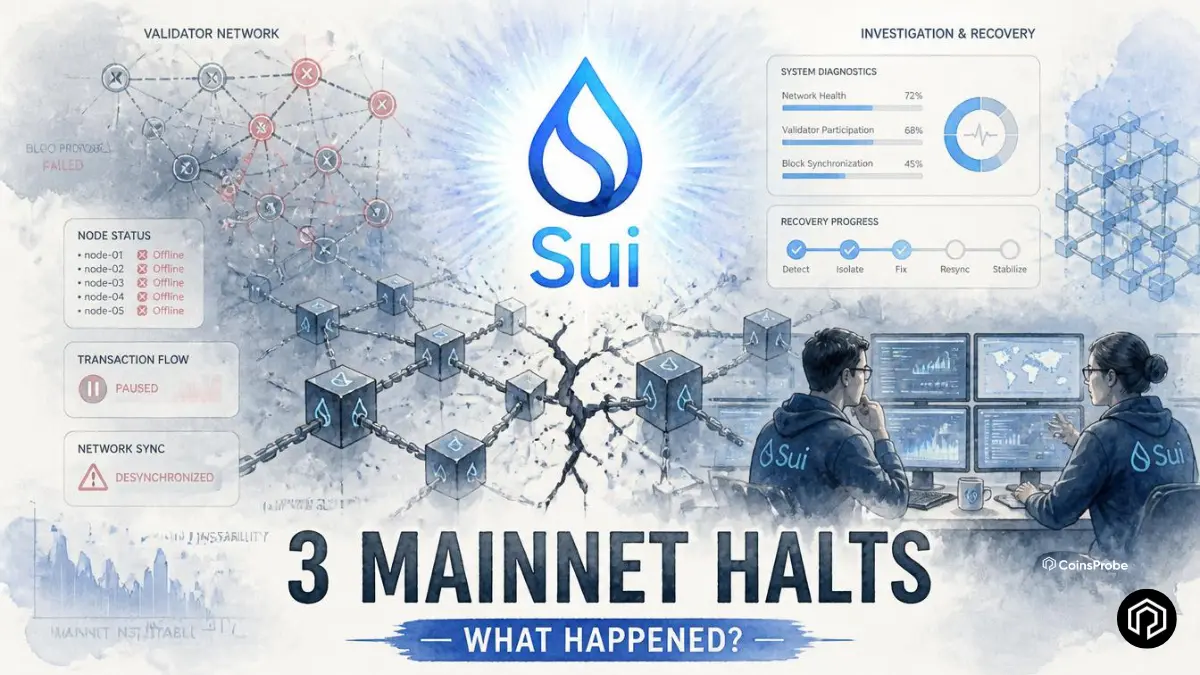

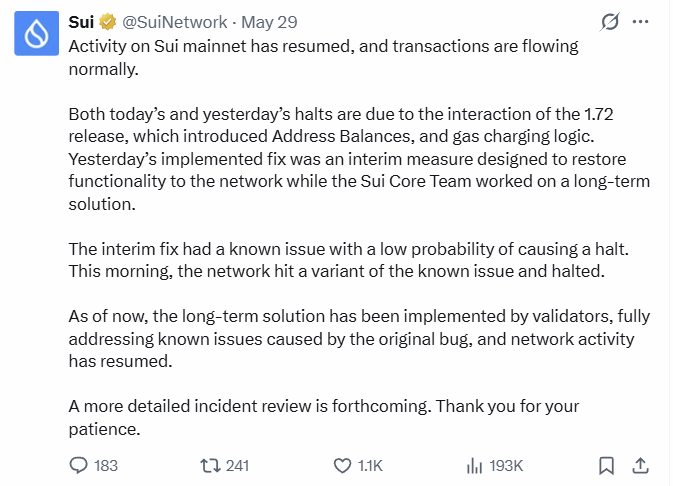
- Sui's mainnet experienced three consecutive outages between May 28–29, 2026 — totalling approximately 16 hours of halted block production — with all incidents now resolved and no user funds lost.
- The root cause was version 1.72's Address Balances feature — which introduced complex interactions with Sui's gas charging logic that triggered two separate bugs across the three incidents.
- SUI is trading at $0.8855 — down -14.15% over 7 days and -36.86% year-to-date — with a market cap of approximately $3.55 billion — reflecting both the broader market weakness and the incident-driven selling.
- The Sui Foundation has published a detailed post-mortem — confirming permanent fixes have been deployed and identifying gas charging logic, epoch resilience, and failure containment as key areas for infrastructure improvement.
Sui Network has had one of its most difficult weeks since mainnet launch. Three consecutive outages across a 48-hour window — totalling approximately 16 hours of halted block production — have raised serious questions about the high-performance Layer-1’s production readiness and its ability to maintain uptime under real-world conditions.
The Sui Foundation has responded with a detailed and technically thorough post-mortem — published on blog.sui.io — that walks through the root cause, the fix sequence, and the lessons the team is taking forward. The transparency of the disclosure is notable. But the market has already delivered its verdict: SUI is down -14.15% over 7 days to $0.8855.

The -36.86% year-to-date decline reflects the broader altcoin correction that has compressed most Layer-1 valuations in 2026 — but the three consecutive outages have added a specific credibility discount that will take demonstrable uptime to rebuild.
The Three Outages — Timeline
All three incidents occurred within a 48-hour window and were resolved through coordinated validator upgrades:
| Outage | Date | Time (PT) | Duration |
|---|---|---|---|
| Outage 1 | May 28 (Thursday) | ~7:00 AM – 1:30 PM | ~6.5 hours |
| Outage 2 | May 29 (Friday) | ~5:00 AM – 8:30 AM | ~3.5 hours |
| Outage 3 | May 29 (Friday) | ~1:30 PM – 7:20 PM | ~6 hours |
| Total downtime | — | — | ~16 hours |
All three were resolved through validator coordination and node upgrades. Critically — no user funds were lost and no committed transactions were reverted. The network halted cleanly rather than producing inconsistent state — which is the best-case outcome for a consensus failure event.
Root Cause — Version 1.72 and Address Balances
The origin of all three incidents traces to a single source: Sui version 1.72, which introduced the Address Balances feature.
Address Balances is designed to simplify how users store funds and pay gas — removing the need to manually manage coin objects. Under version 1.72, transactions can pay gas through three mechanisms:
- Address balances only — direct balance payment
- Traditional coin objects — the prior system
- Hybrid — a combination of both methods
While the feature simplifies the user experience, it introduced complex new interactions with Sui’s existing gas charging logic — specifically with the settlement transaction that reconciles balance changes at the end of each transaction. Two distinct bugs emerged from these interactions — each causing a separate set of outages.
Outage 1 and 2 — The Gas Smashing Underflow Bug
The bug:
When a transaction using hybrid gas was cancelled due to an InsufficientFundsForWithdraw error — meaning an attempted overdraft on an address balance — the gas smashing logic still attempted to debit funds from the settlement system. Since the cancellation had already prevented the transaction from completing, this debit created a negative delta in the settlement system — triggering an underflow crash that halted block production.
The first fix:
An interim patch was deployed quickly after Outage 1 — restoring the network within 6.5 hours. However the team acknowledged at deployment that the fix had a known low-probability flaw: in certain cancellation edge cases, the InsufficientFundsForWithdraw error could be masked rather than properly handled — bypassing the fix and allowing the same underflow crash to occur under specific conditions.
Outage 2 — occurring Friday morning — was exactly that edge case triggering the known flaw. The interim patch had worked for the majority of scenarios but was insufficient for all of them.
Outage 3 — The Randomness State and Epoch Change Failure
The third outage emerged from a completely separate but connected issue — exposed by the validator restarts required to deploy the improved gas fix.
The bug:
Sui uses a Distributed Key Generation (DKG) protocol at the start of each epoch for on-chain randomness generation — a critical system that requires a threshold number of validators to participate. When validators restarted to apply the improved fix, a latent bug in how randomness state is preserved across restarts was triggered during the subsequent epoch change.
The DKG protocol failed to meet its participation threshold — causing it to disable itself. However — critically — the failure state was not properly persisted. When validators came back online, they had no memory that the DKG had failed and disabled itself. This inconsistency stalled the end-of-epoch queue — which could not advance because it was waiting for a DKG state that had been forgotten — halting the entire network.
This was a classic latent bug exposed by an unusual operational condition: the validator restarts created a scenario that normal operation would never produce — and the failure mode had not been adequately tested or handled.
The Fixes Deployed
The Sui Foundation has confirmed that permanent fixes for all three root causes have been deployed and adopted by validators:
Gas logic fix: Prevents gas smashing from executing on InsufficientFundsForWithdraw cancellations — eliminating the underflow crash entirely rather than patching around its edge cases.
Robust masking fix: Addresses the specific cancellation scenarios where the interim patch allowed the error to be masked — improving conservation checks across the gas charging system.
Epoch resilience fix: Persists DKG status across validator restarts — ensuring the failure state is properly remembered and accounted for. Additionally adds a coordinated “force-close” mechanism for stuck epochs — providing validators a path to advance past a stalled epoch queue without requiring full network coordination from scratch.
The network is operating normally as of publication.
Lessons the Sui Foundation Is Taking Forward
The post-mortem is unusually candid about the systemic lessons beyond the specific bug fixes:
Gas charging logic is critical infrastructure — The team acknowledges that gas charging deserves the same rigour and testing investment as the Move VM and consensus layer. It is not auxiliary plumbing — it is a core transaction processing component where failures halt the entire network.
End-of-epoch resilience requires stronger degradation — The epoch change mechanism needs graceful degradation and force-close capabilities that do not depend on perfect state preservation across unexpected restarts. The fix is a start — the broader architectural work continues.
Failure containment must be improved — The most important systemic lesson: a single bad transaction or edge case scenario should not be capable of halting the entire network. Future designs need better isolation — ensuring that one crash surface does not propagate to full block production stoppage.
AI-powered diagnostics helped — The Sui Foundation specifically highlighted that AI-assisted debugging tools helped accelerate the root cause identification — reducing the time between outage detection and fix deployment.
What This Means for Sui’s Positioning
Three outages in 48 hours is a significant infrastructure credibility event — and it arrives at a moment when Sui has been positioning itself as the high-performance Layer-1 alternative for applications requiring sustained throughput and uptime.
The transparent post-mortem reduces but does not eliminate the credibility damage. What matters now is demonstrable uptime over the coming weeks and months — and whether the architectural improvements announced in the post-mortem are implemented at the depth the failures revealed is necessary.
On-chain activity has recovered since the outages — and the permanent fixes address the specific root causes that caused all three incidents. But the market’s -14.15% weekly response reflects a trust deficit that uptime alone will need to rebuild.
Bottom Line
Sui’s three mainnet outages in 48 hours were caused by two distinct bugs in the version 1.72 Address Balances feature — both rooted in insufficient handling of edge cases in the gas charging and settlement logic — with a third outage triggered by a latent DKG state preservation bug exposed by the validator restarts required to fix the first two.
The Sui Foundation’s post-mortem is technically detailed, honest about the failures, and specific about the fixes. All permanent fixes are deployed. No funds were lost. The network is running.
The harder work — rebuilding confidence in a platform that halted three times in 48 hours — is only beginning. And for SUI at $0.8855 with -36.86% year
Frequently Asked Questions (FAQ)
What caused Sui’s three mainnet outages?
Two bugs in version 1.72’s Address Balances feature — a gas smashing underflow triggered by hybrid gas cancellations, and a latent DKG randomness state preservation bug exposed during validator restarts. Both have been permanently fixed.
How long was Sui’s mainnet offline?
Approximately 16 hours total across three incidents — Outage 1 (~6.5 hours on May 28), Outage 2 (~3.5 hours on May 29), and Outage 3 (~6 hours on May 29).
Were user funds affected ON Sui?
No — no user funds were lost and no committed transactions were reverted. The network halted cleanly rather than producing inconsistent state.
What is the Address Balances feature that caused the issues?
A new Sui v1.72 feature simplifying gas payments — allowing transactions to pay via address balances, traditional coin objects, or a hybrid of both. The hybrid mode’s interaction with gas smashing logic and settlement transactions introduced the edge cases that triggered the outages.
What permanent fixes have been deployed?
Three fixes: preventing gas smashing on InsufficientFundsForWithdraw cancellations, addressing error masking in edge cases, and persisting DKG status across validator restarts with a force-close mechanism for stuck epochs.
The opinions and market insights shared on CoinsProbe represent the views of individual authors based on prevailing market conditions at the time of publication. Cryptocurrency investments carry significant risk and volatility. Readers are encouraged to conduct their own research and seek professional financial advice before making investment decisions. CoinsProbe and its contributors do not accept responsibility for financial losses or decisions made based on published content.
CoinsProbe may publish sponsored articles, affiliate links, or promotional collaborations. All sponsored material is clearly labeled to maintain transparency with our audience. Our editorial decisions remain fully independent, and advertising partnerships do not influence reviews, rankings, or published opinions.
Since 2023, CoinsProbe has delivered reliable insights on cryptocurrency, blockchain, and digital assets. Our content is created by experienced researchers and analysts who follow strict editorial standards focused on accuracy, transparency, and credibility. Every article is carefully reviewed and verified using trusted sources and current market data. We provide unbiased analysis and timely updates covering everything from emerging crypto projects to major industry developments.