
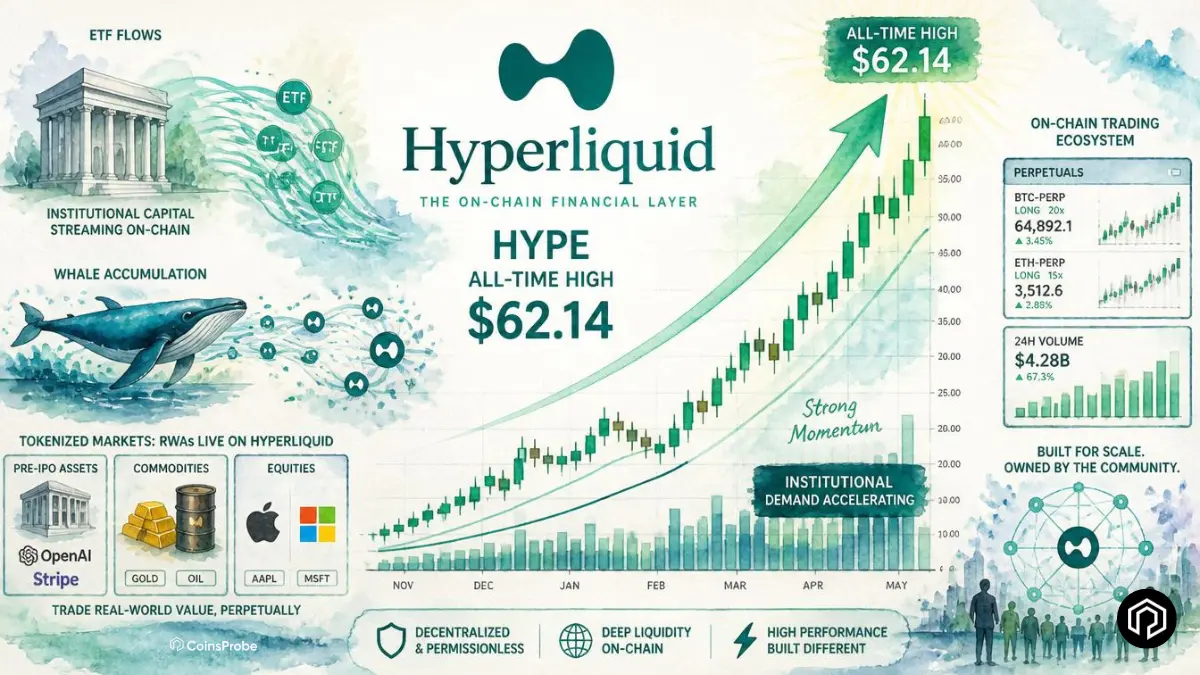

- HYPE hit a new all-time high of $62.14 on May 21, 2026 — currently trading at $57.89 — up +26.64% in 7 days and +43.10% over 30 days — with a market cap of $14.72 billion.
- A convergence of institutional, regulatory, product, and ecosystem catalysts has driven one of the most sustained rallies in HYPE's history — each building directly on the last.
- Bitwise is now staking over 6 million HYPE — with CEO confirming more ETF-driven accumulation ahead — while Goldman Sachs has added a new Hyperliquid position in Q1 2026.
- The SEC's innovation exemption for tokenized securities — combined with Hyperliquid's $2.6B+ RWA open interest ATH — positions the protocol as the leading infrastructure for on-chain traditional finance.
Hyperliquid’s HYPE token hit a new all-time high of $62.14 on May 21, 2026 — and the rally that produced it is not driven by a single catalyst or a wave of speculative retail momentum. It is the result of a sustained, multi-month convergence of institutional investment, regulatory validation, product expansion, and ecosystem growth that has been building since early 2026. Understanding why HYPE got here requires understanding every layer of what happened — because each piece reinforces the others.
1. Goldman Sachs Adds Hyperliquid Position — Wall Street Has Arrived
The most significant institutional signal came when Goldman Sachs disclosed a new Hyperliquid position in its Q1 2026 13-F filing — simultaneously exiting Solana and XRP ETF positions. As we covered in our Goldman Sachs Hyperliquid article, this is not a retail narrative — it is Wall Street’s most recognisable name making a deliberate allocation to HYPE.
When Goldman Sachs rotates out of established crypto ETF positions and into Hyperliquid specifically, it signals that institutional due diligence at the highest level has concluded that HYPE represents superior risk-adjusted positioning relative to prior crypto allocations. That signal carries weight that no amount of retail sentiment can replicate — and it contributed directly to the sustained bid underneath HYPE through May 2026.
2. Bitwise, Grayscale and 21Shares — ETF-Driven Accumulation Confirmed
The institutional layer driving HYPE’s rally is not just one firm — it is an expanding group of major asset managers simultaneously building positions and launching regulated products around the token.
21Shares launched the first US Spot HYPE ETF on May 12, 2026 — the opening gun for institutional ETF access to HYPE at a moment when the token’s market cap sat just over $10 billion. Since then, total net assets across HYPE ETFs have climbed to above of $60 million — a meaningful start, though as analysts note, $60M in ETF assets alone does not explain HYPE adding $5 billion to its market cap in under two weeks. The ETFs are part of the story — but they are also a signal that is attracting broader institutional attention beyond the ETF products themselves.
Grayscale — which filed an S-1 with the SEC for a HYPE ETF in January 2026 — has accumulated $25 million worth of HYPE and staked it over the past two weeks. Grayscale’s approach mirrors the broader institutional pattern: firms are not just providing price exposure through ETF wrappers — they are taking direct balance sheet positions in HYPE and staking them, aligning their economics with the protocol’s long-term performance.
Bitwise — whose $BHYP ETF is already live — is now staking over 6 million HYPE with its CEO publicly confirming more accumulation is ahead. As we detailed in our Bitwise staking article, the commitment to devoting 10% of $BHYP management fees to buying and holding HYPE — with a minimum 12-month hold — creates a compounding flywheel where ETF success directly drives protocol-aligned demand.
The combined picture from Bitwise, Grayscale, and 21Shares is a coordinated institutional on-ramp that has opened simultaneously from multiple directions — ETF launches, S-1 filings, direct staking, and balance sheet accumulation — creating sustained and diversified demand from regulated capital that retail momentum alone could not generate.
3. SEC Innovation Exemption — Regulatory Green Light for Tokenized Securities
The regulatory catalyst that changed everything arrived when the SEC announced an “innovation exemption” that would officially allow tokenized traditional securities to trade 24/7 on decentralised crypto platforms. As we covered in our SEC exemption and HYPE surge article, this is one of the most significant U.S. regulatory shifts toward on-chain infrastructure in crypto’s history.
The reason this matters specifically for Hyperliquid is that the protocol is not preparing for tokenized securities — it is already doing it. With $2.6 billion+ in HIP-3 RWA open interest covering stocks, indices, commodities, and pre-IPO perpetuals — the SEC exemption transforms Hyperliquid’s existing product suite from operating in regulatory grey area into a framework-compliant infrastructure layer. That is the difference between a regulatory risk and a regulatory tailwind — and markets priced the shift decisively in the days leading up to the $62.14 ATH.
4. SpaceX Pre-IPO Perpetual ($SPCX) — The Highest-Profile RWA Listing Yet
The product expansion that most visibly demonstrated Hyperliquid’s RWA ambition was the launch of $SPCX — the SpaceX Pre-IPO perpetual by trade.xyz. As we detailed in our SPCX listing article, the contract launched at a $150 reference price implying a $1.78 trillion market cap — the highest-profile private company ever brought on-chain as a perpetual.
The $SPCX launch — combined with simultaneous whale accumulation of over $15 million into HYPE — demonstrated that each new major RWA listing drives both trading volume and HYPE demand. Whale 1 rotated $10.2 million from gold specifically into HYPE with a 5x leveraged long — a conviction trade that made the SPCX catalyst’s impact on HYPE unmistakable in the days before the ATH.
5. Coinbase and Circle USDC — Institutional Infrastructure Alignment
The partnership that changed Hyperliquid’s stablecoin infrastructure fundamentally was the simultaneous commitment from Coinbase as official USDC treasury deployer and Circle as technical deployer and HYPE staker. As we covered in our Coinbase and Circle article, both institutions are not just integrating USDC — they are staking HYPE to activate AQAv2 and sharing yield with the Hyperliquid protocol.
This alignment creates a structural demand floor from two of the most respected and regulated names in crypto — each with financial incentives tied directly to Hyperliquid’s protocol growth. USDC replacing USDH as the aligned quote asset across all HIP-1 through HIP-4 markets also eliminates stablecoin fragmentation and channels USDC reserve yield revenue directly to the protocol — a meaningful and ongoing revenue stream that grows with platform usage.
6. HIP-4 Prediction Markets — Expanding the Addressable Market
As we covered in our HIP-4 binary prediction markets article, Hyperliquid launched binary prediction market contracts that directly challenge Polymarket and Kalshi — with zero open fees and unified margin across spot, perps, and prediction markets in a single account. HIP-4 markets generated $6.2 million in volume on day one — and have continued growing since.
Each new HIP expansion — HIP-3 for RWA perpetuals, HIP-4 for prediction markets — adds a new revenue stream and user category to the HYPE flywheel. With 97% of trading fees directed to HYPE buybacks, every product expansion directly strengthens the deflationary mechanics driving HYPE’s supply reduction.
7. CME and NYSE Lobbying — Competitive Validation
Paradoxically, one of the most bullish signals for HYPE came from the entities trying to slow it down. As we covered in our CME and NYSE lobbying article, traditional exchanges are actively lobbying U.S. regulators to impose oversight on Hyperliquid — citing market manipulation risks from a platform that is influencing real-world commodity price discovery.
The community response — led by ZachXBT’s exposure of ICE’s $1.64 billion Polymarket investment — turned the lobbying story into a validation signal: you only attract this level of institutional opposition when you are genuinely threatening established market structures. Hyperliquid has grown large enough that CME and NYSE view it as a competitive threat. That is not a bearish signal for HYPE. It is a credibility marker.
8. HIP-3 Open Interest ATH — $2.6 Billion in Real Trading Activity
Beneath every narrative catalyst is the fundamental metric that matters most: real trading activity. HIP-3 open interest hit a new all-time high of $2.6 billion — with trade.xyz accounting for over 90% of HIP-3 activity across tokenized equities, indices, commodities, and pre-IPO perpetuals. As we covered in our HIP-3 OI ATH article, this is not speculative froth — it is real capital committed to active derivative positions.
Every dollar of open interest generates fee revenue. Every dollar of fee revenue drives HYPE buybacks. Every HYPE buyback reduces circulating supply. The flywheel is mechanical — and $2.6 billion in OI is a large and growing input into that mechanism.
HYPE at a Glance — May 22, 2026

Bottom Line
HYPE’s $62.14 all-time high on May 21, 2026 is not a mystery. It is the compounding result of eight distinct catalysts — each reinforcing the others — that built the most comprehensive institutional, regulatory, and product foundation any on-chain derivatives protocol has assembled.
Goldman Sachs added HYPE. Bitwise staked 6 million of it. The SEC gave tokenized securities a regulatory green light. SpaceX came on-chain. Coinbase and Circle staked HYPE. HIP-4 launched prediction markets. CME and NYSE proved Hyperliquid is a genuine competitive threat. And $2.6 billion in real open interest confirmed the platform is delivering substance — not speculation.
HYPE reached its $62.14 all-time high on May 21. The question now is not whether it got there — it is where it goes from here.
Frequently Asked Questions
Why did HYPE rally to a new ATH?
The rally was driven by multiple catalysts including Goldman Sachs’ new position, SPOT ETF Inflow, SEC tokenization developments, and record HIP-3 growth.
When did HYPE reach its all-time high?
HYPE hit a new ATH of $62.14 on May 21, 2026, before pulling back to around $57.89.
How is Goldman Sachs connected to Hyperliquid?
Goldman Sachs disclosed a new Hyperliquid-related position in its Q1 2026 filing while exiting Solana and XRP ETF holdings.
Why is the SEC innovation exemption bullish for Hyperliquid?
The framework supports tokenized securities — directly benefiting Hyperliquid’s growing RWA and pre-IPO perpetual ecosystem.
The opinions and market insights shared on CoinsProbe represent the views of individual authors based on prevailing market conditions at the time of publication. Cryptocurrency investments carry significant risk and volatility. Readers are encouraged to conduct their own research and seek professional financial advice before making investment decisions. CoinsProbe and its contributors do not accept responsibility for financial losses or decisions made based on published content.
CoinsProbe may publish sponsored articles, affiliate links, or promotional collaborations. All sponsored material is clearly labeled to maintain transparency with our audience. Our editorial decisions remain fully independent, and advertising partnerships do not influence reviews, rankings, or published opinions.
Since 2023, CoinsProbe has delivered reliable insights on cryptocurrency, blockchain, and digital assets. Our content is created by experienced researchers and analysts who follow strict editorial standards focused on accuracy, transparency, and credibility. Every article is carefully reviewed and verified using trusted sources and current market data. We provide unbiased analysis and timely updates covering everything from emerging crypto projects to major industry developments.