
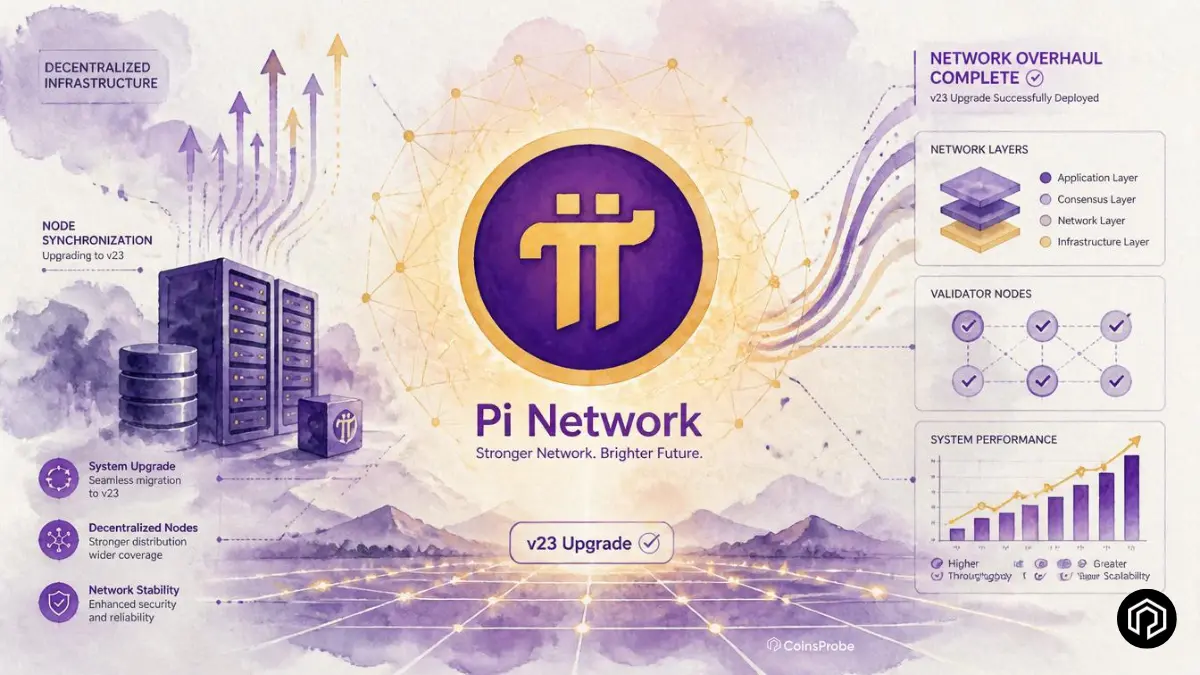

- The Pi Core Team confirmed on May 20, 2026 that most major Mainnet Node operators have successfully upgraded to v23 — with the full protocol transition to v23 expected in the coming days.
- This is described as one of the most challenging upgrades in Pi Network's history — involving simultaneous upgrades across three critical subsystems: Protocol 22→23, Ubuntu 20→24, and PostgreSQL 12→16.
- Protocol 23 is the gateway to native smart contract functionality via Soroban — enabling dApps, DeFi, NFTs, and real-world asset tokenization on Pi Mainnet.
- Testnet 1 and Testnet 2 completed the migration earlier — providing a validated testing ground before Mainnet nodes took on the upgrade.
Pi Network has reached one of the most significant technical milestones in its mainnet history. On May 20, 2026, the Pi Core Team confirmed via @PiCoreTeam:
“Big kudos to Mainnet Node operators for upgrading to v23. Most major Nodes have now been upgraded, and the protocol is expected to move to v23 soon. This was one of the most challenging upgrades to date, as it involved multiple subsystem upgrades and optimizations that required internal data reprocessing. Protocol 22 → 23, Ubuntu 20 → 24, PostgreSQL 12 → 16.”
This is not a routine software patch. What node operators have just completed is a coordinated overhaul of three separate critical systems — simultaneously — on a live Mainnet. The fact that most major nodes have successfully completed the migration is a significant demonstration of the infrastructure reliability and operator commitment that underpins Pi’s network.
As we covered in our Protocol 23 upgrade deadline guide and our deadline extension to May 19, this upgrade has been the most technically demanding step in Pi’s entire protocol upgrade sequence — and the rapid progress since the deadline shows how seriously the node operator community has treated it.
What the v23 Upgrade Actually Changed — Three Systems at Once
What makes this upgrade categorically different from every prior step in Pi’s upgrade sequence is that it required three separate major migrations to happen in coordination:
Protocol 22 → 23 — The Smart Contract Gateway
This is the headline change. Upgrading from Protocol 22 to Protocol 23 aligns Pi Mainnet with the latest Stellar Core advancements — and specifically enables native smart contract functionality via Soroban, Stellar’s smart contract platform. This is the technical foundation that unlocks:
- Decentralised applications (dApps) — developers can now build and deploy on Pi Mainnet
- DeFi protocols — lending, borrowing, liquidity pools, and automated market makers
- NFTs — verifiable digital ownership on Pi’s blockchain
- Real-world asset (RWA) tokenization — physical assets represented as digital tokens on-chain
As we detailed in our Consensus 2026 coverage, this is the capability that both Pi co-founders presented to 20,000+ institutional attendees in Miami — and it is now being activated at the infrastructure level.
Ubuntu 20 → 24 — Operating System Overhaul
A full major version OS upgrade across distributed node infrastructure — bringing modern security patches, improved performance, extended long-term support, and better compatibility with current hardware. This is not glamorous work — but running production blockchain infrastructure on an outdated operating system creates security and stability risks that grow over time. The Ubuntu 24 upgrade eliminates those risks and positions node hardware for years of reliable operation.
PostgreSQL 12 → 16 — Database Migration
The database layer migration is perhaps the most technically demanding component of the three. PostgreSQL 16 delivers significant improvements in data storage efficiency, query speed, and horizontal scalability — capabilities that become increasingly critical as Pi’s transaction volume grows toward institutional-grade usage. This migration involved live internal data reprocessing across distributed systems — the element the Pi Core Team specifically highlighted as what made this upgrade the most challenging to date.
Why Testnet First — The Right Engineering Approach
Before a single Mainnet node began the v23 migration, Testnet 1 and Testnet 2 had already completed the full upgrade sequence — providing a real-world validation environment where any issues could be identified and resolved without risk to the live network.
This sequencing — Testnet validation first, Mainnet migration second — is the correct engineering approach for an upgrade of this complexity. It explains why the Pi Core Team was willing to extend the original May 15 deadline to May 19: not because the upgrade was failing, but because ensuring every operator had access to an improved release and sufficient time to migrate safely was more important than hitting an arbitrary date.
The rapid completion by most major nodes since the deadline demonstrates that the Testnet validation work paid off — the migration pathway was well-defined and operators could execute it with confidence.
What Comes Next — Full Protocol Migration to v23
The node software upgrade is complete for most major operators — but the full protocol migration to v23 on Mainnet is the next step and is expected in the coming days.
Once the protocol transition completes, Pi Mainnet will be operating on the full v23 foundation — with smart contract capability active, the upgraded database layer supporting higher transaction volumes, and the modern OS providing long-term infrastructure stability.
From there, the development roadmap accelerates:
- dApp development — builders can deploy applications on a production-ready smart contract platform
- DEX experiments — already being tested on Testnet — move closer to Mainnet activation
- Ecosystem expansion — the Pi Launchpad and app ecosystem gain the programmable foundation they need to operate at scale
- Protocol 24.1 preparation — the next upgrade step in the roadmap, with a deadline of May 25, 2026
For Pi’s 60 million+ engaged users and the 18.1 million+ KYC-verified Pioneers confirmed in the April 2026 network update, the v23 completion marks the moment the network they have been building shifts from a mobile mining project into a production-ready programmable blockchain.
A Note on Node Operators
The Pi Core Team’s statement specifically called out node operators — and the recognition is deserved. What these operators completed was not a simple restart-and-update process. It was a coordinated, multi-system migration on live infrastructure involving real-time data reprocessing across a distributed network.
Maintaining network uptime and stability while simultaneously upgrading the OS, migrating a major database version, and transitioning the core protocol is the kind of engineering work that rarely gets public recognition — but represents exactly the infrastructure reliability that separates serious blockchain projects from those that collapse under technical complexity.
As one community member noted in reply to the official announcement: “The backbone of this ecosystem is rock solid.”
Bottom Line
Pi Network’s v23 upgrade is not a marketing milestone — it is the infrastructure foundation that everything else depends on. Protocol 23 brings smart contracts. Ubuntu 24 brings security and stability. PostgreSQL 16 brings the database performance needed for real scale. All three together, completed simultaneously on a live Mainnet, represent one of the most complex technical achievements in Pi’s history.
The protocol transition to v23 is expected in the coming days. When it completes — Pi Mainnet enters its smart contract era.
Frequently Asked Questions
What is included in the Pi Network v23 upgrade?
The v23 upgrade includes Protocol 23 activation, Ubuntu 24 migration, and PostgreSQL 16 database upgrades for improved performance, security, and scalability.
Why is Protocol 23 important for Pi Network?
Protocol 23 enables native smart contracts through Soroban, unlocking dApps, DeFi, NFTs, and real-world asset tokenization on Pi Mainnet.
Why was the v23 upgrade difficult to execute?
The Pi Core Team had to complete multiple major system migrations simultaneously while keeping the live Mainnet stable and operational.
What happens after the v23 node upgrade is completed?
Pi Mainnet will transition fully to Protocol 23, enabling smart contract functionality and paving the way for future upgrades like Protocol 24.1.
The opinions and market insights shared on CoinsProbe represent the views of individual authors based on prevailing market conditions at the time of publication. Cryptocurrency investments carry significant risk and volatility. Readers are encouraged to conduct their own research and seek professional financial advice before making investment decisions. CoinsProbe and its contributors do not accept responsibility for financial losses or decisions made based on published content.
CoinsProbe may publish sponsored articles, affiliate links, or promotional collaborations. All sponsored material is clearly labeled to maintain transparency with our audience. Our editorial decisions remain fully independent, and advertising partnerships do not influence reviews, rankings, or published opinions.
Since 2023, CoinsProbe has delivered reliable insights on cryptocurrency, blockchain, and digital assets. Our content is created by experienced researchers and analysts who follow strict editorial standards focused on accuracy, transparency, and credibility. Every article is carefully reviewed and verified using trusted sources and current market data. We provide unbiased analysis and timely updates covering everything from emerging crypto projects to major industry developments.