

- Ethereum co-founder Vitalik Buterin has publicly outlined concrete short-term technical improvements to bring native privacy to Ethereum's L1 — addressing what many consider the network's most critical missing feature.
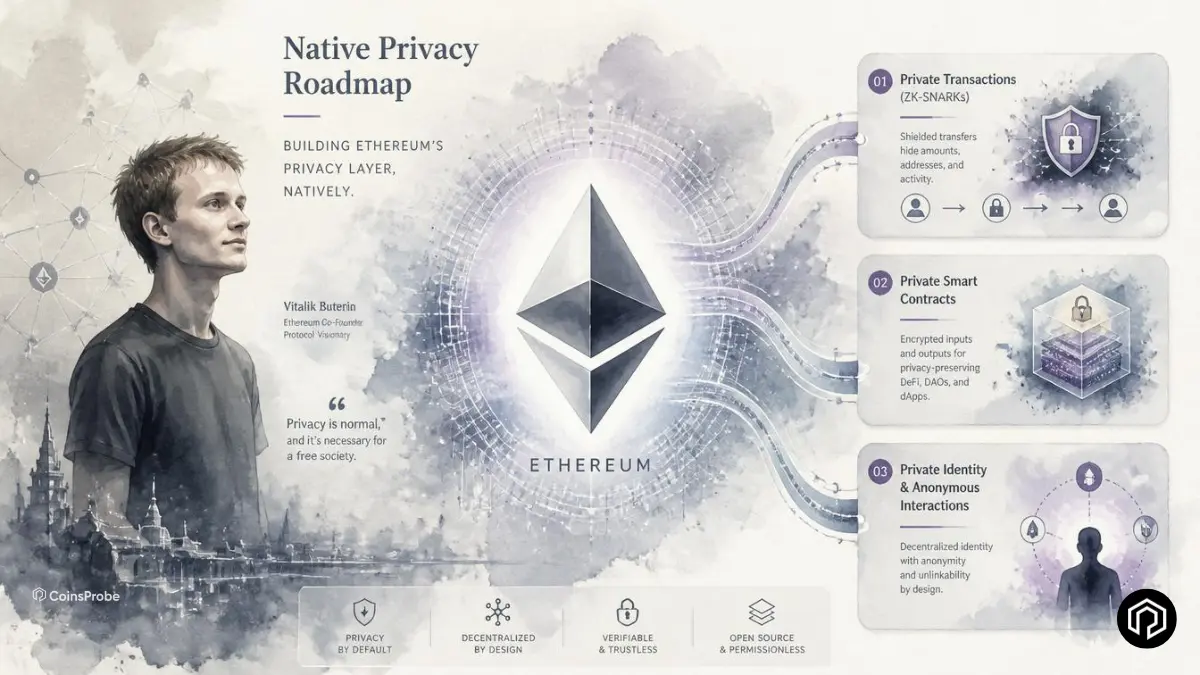
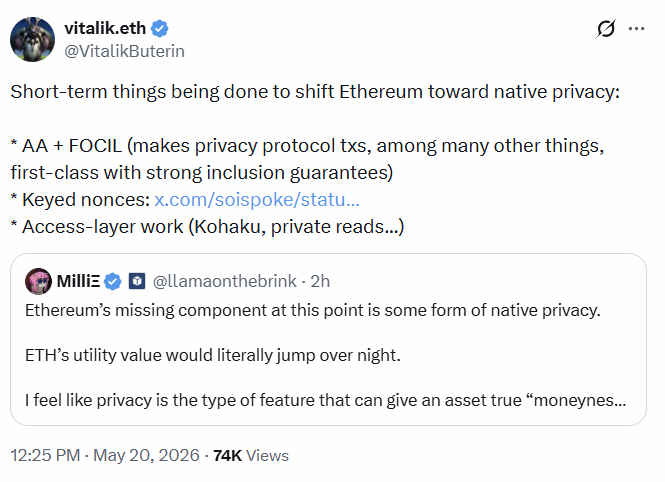
- Three specific upgrades are in progress: AA + FOCIL for censorship-resistant private transactions, Keyed Nonces (EIP-8250) targeted for the Hegota fork, and access-layer work on Kohaku to close side-channel leaks.
- The development signals a shift in Ethereum's core priorities — from scalability and staking toward practical, modular privacy built directly into L1 infrastructure.
- Privacy at L1 could give ETH true "moneyness" qualities — enabling private DeFi trades, confidential governance, untraceable payments, and a surge in mainnet fees.
Vitalik Buterin has stepped directly into one of the most consequential conversations in Ethereum’s development — and what he posted is more specific and near-term than most expected.
In a post today, Buterin responded to a widely discussed take that “Ethereum’s missing component at this point is some form of native privacy” — and rather than offering a philosophical defence or a distant roadmap, he listed three concrete technical improvements already underway that will bring meaningful privacy closer to Ethereum’s base layer. For a feature that has been discussed for years while being consistently punted to Layer-2 solutions, today’s update from Buterin signals something has changed in how the core development community is prioritising privacy.
What Vitalik Actually Said — Three Specific Upgrades
1. AA + FOCIL — Privacy Transactions as First-Class Citizens
The combination of Account Abstraction (AA) and FOCIL — a mechanism for fair and guaranteed transaction inclusion — is designed to give privacy-protocol transactions the same inclusion guarantees as standard Ethereum transactions.
Currently, privacy protocol transactions face a structural disadvantage: because they look different from standard transactions, validators can choose to censor or delay them without penalty. FOCIL addresses this directly by creating a fair inclusion mechanism that prevents selective censorship of transaction types.
The result: private transactions would become first-class citizens on Ethereum L1 — processed with the same guarantees and without the censorship risk that currently forces privacy-conscious users toward less composable Layer-2 solutions.
2. Keyed Nonces (EIP-8250) — Solving the Nullifier Problem
The second upgrade is more technically specific but equally impactful for privacy protocol developers. EIP-8250 proposes replacing Ethereum’s traditional single-sender nonce with a (nonce_key, nonce_seq) structure — a seemingly small change with significant implications.
The current nonce system creates real friction for privacy protocols that use nullifiers — the cryptographic mechanism that prevents double-spending in systems like Tornado Cash, Aztec, and similar tools. The single nonce creates replay protection conflicts when multiple users try to withdraw from a shared sender concurrently — effectively forcing privacy protocols to queue withdrawals sequentially rather than processing them in parallel.
EIP-8250 solves this directly — enabling concurrent withdrawals and frame transactions from shared senders without replay conflicts. For privacy protocols already deployed on Ethereum, this is an immediate practical improvement that does not require any application-layer changes. EIP-8250 is targeted for the Hegota fork — making it a near-term deliverable rather than a conceptual proposal.
3. Access-Layer Work — Closing the Side-Channel Leaks
The third area Vitalik highlighted is ongoing development on Kohaku and improvements to private reads — work focused on closing side-channel information leaks at the wallet and execution layer.
Side-channel leaks are the category of privacy vulnerability where even when transaction content is hidden, the metadata around how data is read and accessed can reveal sensitive information about a user’s activity. For privacy at the application layer to be genuinely meaningful, the access layer beneath it also needs to be private — and this is what the Kohaku and private reads work addresses.
These improvements are designed to be modular and composable — meaning existing privacy protocols can benefit immediately without waiting for a comprehensive protocol overhaul.
Why This Matters — The “Moneyness” Argument
The post that prompted Vitalik’s response captured the broader implication precisely:
“ETH’s utility value would literally jump overnight. I feel like privacy is the type of feature that can give an asset true ‘moneyness’ qualities. L1 privacy could also drive a surge in mainnet fees.”
This framing is worth unpacking. True monetary utility — the kind that makes people choose an asset for everyday transactions and store of value — requires fungibility, which requires privacy. A currency where every transaction is publicly traceable is not truly fungible — because units can be discriminated against based on their history. Bitcoin faces this problem. Ethereum faces this problem.
Native L1 privacy changes the equation fundamentally. Once private transactions are first-class citizens at the base layer, an entirely new category of use cases becomes practical:
Private DeFi — Traders can execute swaps, provide liquidity, and manage positions without revealing their strategy to front-running bots and competitors.
Confidential DAO governance — Governance votes can be cast without revealing how specific wallets voted before the outcome is finalised — eliminating the strategic voting behaviour that plagues on-chain governance.
Untraceable payments — Everyday transactions between individuals and businesses without public exposure of amounts, counterparties, and balances.
Regulatory-friendly private stablecoins — Stablecoin transactions that satisfy compliance requirements without broadcasting every transfer to the public blockchain.
Each of these use cases generates real mainnet activity — and each one has been limited by the absence of native privacy rather than by lack of demand.
As we covered in our Ethereum ETH/BTC fractal analysis and our ETH Bullish Bat harmonic setup, ETH is navigating a challenging price environment in 2026. But fundamental development of this kind — Vitalik directly addressing privacy with concrete near-term deliverables — is exactly the category of progress that shifts the long-term fundamental thesis rather than the short-term price action.
The Broader Context — Why Now?
Ethereum has made remarkable progress on scalability through rollups and staking through the Merge — but privacy has consistently been the feature that gets acknowledged as critical and then deferred. Layer-2 solutions like Railgun, Aztec, and ZK pools have addressed parts of the privacy gap — but they do so with composability trade-offs that make them less practical for everyday users and less seamlessly integrated into the broader Ethereum ecosystem.
Vitalik’s update signals that the core development community has shifted from treating privacy as a Layer-2 responsibility to treating it as a base-layer priority — one that deserves practical, incremental improvements rather than waiting for a single comprehensive privacy overhaul that may never arrive.
The modular approach is deliberate. Rather than designing a monolithic privacy system that requires every application to rebuild from scratch, the three upgrades Vitalik outlined are designed to improve the privacy stack for existing protocols immediately while laying the foundation for more comprehensive native privacy in future forks.
Bottom Line
Vitalik Buterin just made native privacy a near-term priority rather than a long-term aspiration — and the three technical upgrades he outlined are specific, targeted, and deliverable on concrete timelines. AA + FOCIL, EIP-8250 for the Hegota fork, and Kohaku access-layer work together represent the most credible Ethereum privacy roadmap the community has seen.
If privacy at L1 gives ETH true “moneyness” qualities — as the prompted post argued — then what Vitalik outlined today is the beginning of one of Ethereum’s most significant fundamental upgrades. The fee surge and utility expansion that follows native privacy will not happen overnight. But it starts with exactly the kind of concrete, incremental work that was posted today.
Frequently Asked Questions
What privacy upgrades did Vitalik Buterin discuss for Ethereum?
Ethereum co-founder Vitalik Buterin highlighted upgrades including FOCIL, EIP-8250, and Kohaku access-layer improvements to strengthen Ethereum privacy.
What is EIP-8250?
EIP-8250 introduces a new nonce structure designed to improve privacy protocol functionality and enable concurrent withdrawals.
How does FOCIL improve Ethereum privacy?
FOCIL helps ensure private transactions receive fair inclusion on-chain, reducing the risk of validator censorship.
Why is Layer-1 privacy important for Ethereum?
Native privacy could improve ETH’s usability for payments, DeFi, and governance while increasing fungibility and network utility.
When could these privacy upgrades go live?
Some features, including EIP-8250, are expected to be considered for future Ethereum upgrades such as the Hegota fork.
The opinions and market insights shared on CoinsProbe represent the views of individual authors based on prevailing market conditions at the time of publication. Cryptocurrency investments carry significant risk and volatility. Readers are encouraged to conduct their own research and seek professional financial advice before making investment decisions. CoinsProbe and its contributors do not accept responsibility for financial losses or decisions made based on published content.
CoinsProbe may publish sponsored articles, affiliate links, or promotional collaborations. All sponsored material is clearly labeled to maintain transparency with our audience. Our editorial decisions remain fully independent, and advertising partnerships do not influence reviews, rankings, or published opinions.
Since 2023, CoinsProbe has delivered reliable insights on cryptocurrency, blockchain, and digital assets. Our content is created by experienced researchers and analysts who follow strict editorial standards focused on accuracy, transparency, and credibility. Every article is carefully reviewed and verified using trusted sources and current market data. We provide unbiased analysis and timely updates covering everything from emerging crypto projects to major industry developments.