
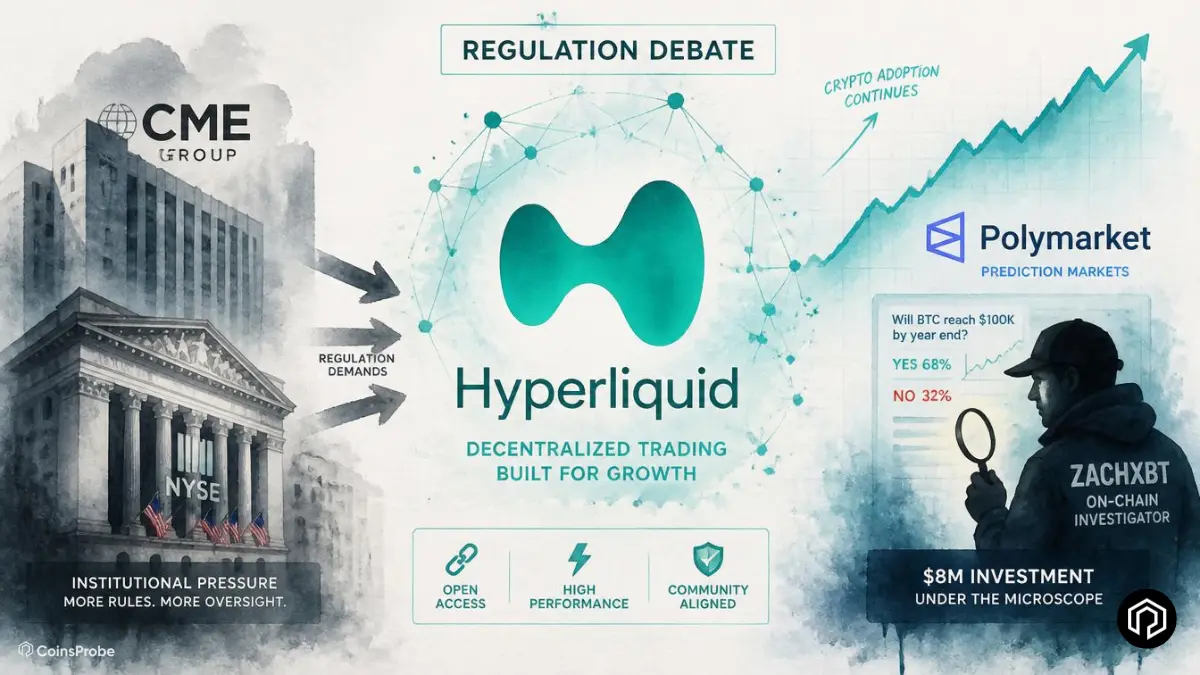

- CME Group and NYSE are actively lobbying U.S. regulators to impose stricter oversight on Hyperliquid — citing risks of market manipulation and sanctions evasion.
- ZachXBT immediately flagged the contradiction: the NYSE's parent company ICE finalised a $600 million investment in Polymarket in March 2026 — bringing its total stake to approximately $1.64 billion — while simultaneously calling for Hyperliquid's regulation.
- HYPE dropped -5.32% in one hour on the news — currently trading at $42.98 with a market cap of $10.94 billion.
- Multiple ETF filings for HYPE — including Bitwise's $BHYP already live and proposals from Grayscale and VanEck — represent a potential counterweight to the regulatory pressure.
Traditional finance is making its move against Hyperliquid — and the crypto community is firing back hard.
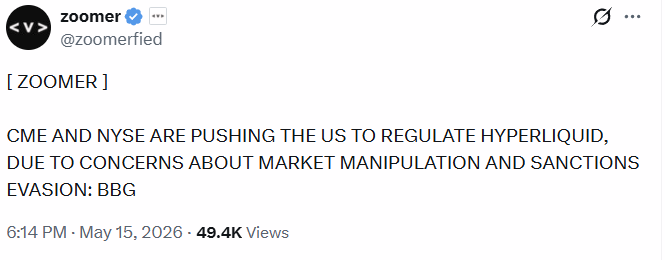
A Bloomberg report highlighted by crypto commentator @zoomerfied confirms that CME Group and NYSE are actively lobbying U.S. regulators to crack down on Hyperliquid’s permissionless derivatives platform — citing concerns about market manipulation, spoofing, and sanctions evasion enabled by the protocol’s lack of traditional KYC/AML controls.
The pressure is not entirely surprising. As we covered in our HIP-3 open interest ATH analysis and our Coinbase and Circle USDC partnership article, Hyperliquid’s 24/7 high-leverage trading in commodities including oil has begun influencing real-world price discovery — making it a genuine competitive threat to established exchange infrastructure rather than a niche crypto product.
What has ignited the community is not the lobbying itself — it is who is doing the lobbying and what they are simultaneously investing in.
The Core Complaint — And Why It Has Merit to Consider
CME and NYSE’s regulatory argument centres on three specific concerns:
Market manipulation risk — Hyperliquid’s permissionless model allows high-leverage commodity trading without the surveillance and reporting requirements that traditional venues operate under. The concern is that coordinated manipulation — spoofing, wash trading — is harder to detect and penalise on a decentralised platform.
Sanctions evasion — Without KYC controls, regulators argue that sanctioned entities could use Hyperliquid’s infrastructure to trade global commodities in ways that circumvent existing financial sanctions frameworks.
Real-world price influence — Hyperliquid’s commodity perps markets — particularly oil — have grown large enough to affect price discovery in ways that traditional market structure was not designed to account for.
These are not frivolous concerns. A platform processing billions in perpetuals volume daily that operates outside traditional surveillance infrastructure raises legitimate questions that regulators will eventually need to address — regardless of the motives behind who is pushing those questions.
ZachXBT’s Response — The $1.64 Billion Contradiction
What turned a regulatory news story into a full community controversy was a single reply from @zachxbt:
“Interesting how NYSE only has issue with HL but not Polymarket. Never mind it all makes sense now.”
Attached was a Reuters screenshot confirming that Intercontinental Exchange (ICE) — the parent company of the NYSE — finalised a $600 million investment in Polymarket in March 2026, bringing its total stake in the prediction market platform to approximately $1.64 billion.
The contradiction is stark and difficult to explain away:
- Hyperliquid — a permissionless DeFi protocol with no KYC — faces active regulatory lobbying from NYSE’s parent company
- Polymarket — a prediction market platform operating in a legally grey area with its own regulatory uncertainty — receives $1.64 billion from the same NYSE ownership group
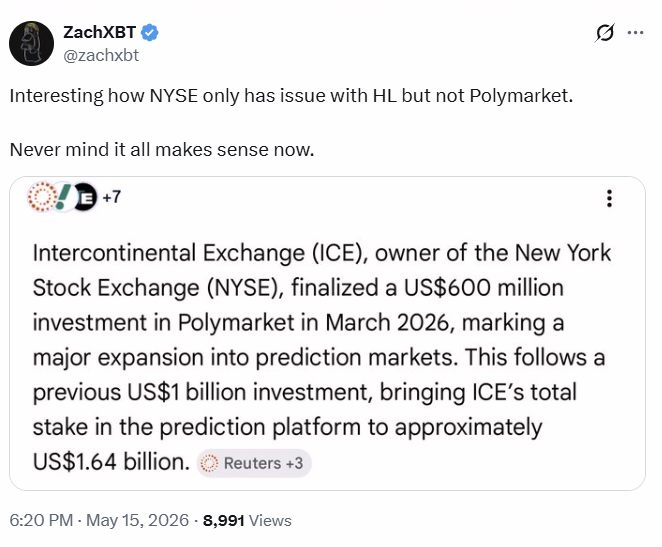
Community responses in the thread captured the sentiment quickly:
“Well Poly can’t move the oil market but Hyperliquid can.” “And they want to launch perps too on Polymarket lol.” “Naked lobbying for their own interests.”
The implication is clear: this is not purely a principled regulatory stance — it is competitive lobbying from established financial infrastructure against a protocol that is winning market share from them in real time.
Immediate Market Reaction — HYPE Drops 5%
The news triggered an immediate reaction in Hyperliquid’s native token:

The drop is sharp but contained — reflecting genuine uncertainty about the regulatory outcome rather than a fundamental reassessment of the protocol’s value. HYPE’s +69% year-to-date performance and the recent institutional alignment through Coinbase’s USDC treasury deployment and Circle’s HYPE staking provide a meaningful buffer against short-term regulatory noise.
The ETF pipeline is also a significant counterweight. Bitwise’s $BHYP is going live today, with Grayscale and VanEck filing proposals — meaning institutional demand for regulated HYPE exposure is growing simultaneously with the regulatory pressure from traditional exchanges. The irony of traditional finance simultaneously lobbying against Hyperliquid and filing ETFs for HYPE exposure is not lost on the community.
What This Means — Three Perspectives
For regulators: The CME and NYSE lobbying forces a genuine policy question onto the agenda — how does the U.S. treat on-chain derivatives platforms that have grown large enough to influence real-world commodity price discovery? The answer will set precedent not just for Hyperliquid but for the entire on-chain derivatives sector.
For Hyperliquid: The protocol already maintains a Washington D.C. presence — suggesting the team anticipated regulatory engagement would eventually be necessary. The path forward likely involves some combination of policy engagement, optional compliance tooling for institutional users, and technical adaptations that preserve decentralisation while addressing the most acute regulatory concerns.
For the broader DeFi community: ZachXBT’s post has amplified a question that extends far beyond Hyperliquid — why should one protocol face regulatory pressure for operating without KYC while the same institutions lobbying for that pressure invest billions in another platform operating in similarly grey territory? The consistency question is one regulators will need to answer credibly.
Bottom Line
The CME and NYSE lobbying campaign against Hyperliquid is the clearest signal yet that on-chain derivatives have grown large enough to be taken seriously as a competitive threat by traditional financial infrastructure. That is both a regulatory risk and a validation of what Hyperliquid has built.
ZachXBT’s ICE-Polymarket revelation has exposed the competitive motivations behind the regulatory push — and the community response has made it impossible for that contradiction to go unnoticed. Whether this results in targeted DeFi perps regulation, broader industry clarity, or simply highlights the inconsistency of selective enforcement remains to be seen.
The battle lines are drawn. Hyperliquid dominates on-chain derivatives. Wall Street wants a piece of the action — and failing that, it wants regulation. The fight for the future of trading just became very public.
Frequently Asked Questions (FAQ)
Why are CME and NYSE criticizing Hyperliquid?
CME and NYSE raised concerns about market manipulation, sanctions risks, and the lack of KYC/AML controls on Hyperliquid’s permissionless trading platform.
What did ZachXBT reveal about ICE and Polymarket?
ZachXBT pointed out that ICE — NYSE’s parent company — reportedly invested heavily in Polymarket, despite lobbying against Hyperliquid over similar regulatory concerns.
How did HYPE react to the news?
HYPE fell over 5% within an hour following the regulatory headlines, reflecting short-term uncertainty around DeFi regulation.
Does Hyperliquid have institutional or regulatory support?
Yes. Hyperliquid has expanded its presence in Washington D.C., while Coinbase, Circle, Bitwise, Grayscale, and VanEck have all shown growing alignment or interest around the ecosystem.
What is the selective enforcement debate?
Critics argue regulators are targeting Hyperliquid while traditional institutions continue investing in other decentralized or prediction-market platforms operating in similar legal grey areas.
The opinions and market insights shared on CoinsProbe represent the views of individual authors based on prevailing market conditions at the time of publication. Cryptocurrency investments carry significant risk and volatility. Readers are encouraged to conduct their own research and seek professional financial advice before making investment decisions. CoinsProbe and its contributors do not accept responsibility for financial losses or decisions made based on published content.
CoinsProbe may publish sponsored articles, affiliate links, or promotional collaborations. All sponsored material is clearly labeled to maintain transparency with our audience. Our editorial decisions remain fully independent, and advertising partnerships do not influence reviews, rankings, or published opinions.
Since 2023, CoinsProbe has delivered reliable insights on cryptocurrency, blockchain, and digital assets. Our content is created by experienced researchers and analysts who follow strict editorial standards focused on accuracy, transparency, and credibility. Every article is carefully reviewed and verified using trusted sources and current market data. We provide unbiased analysis and timely updates covering everything from emerging crypto projects to major industry developments.