

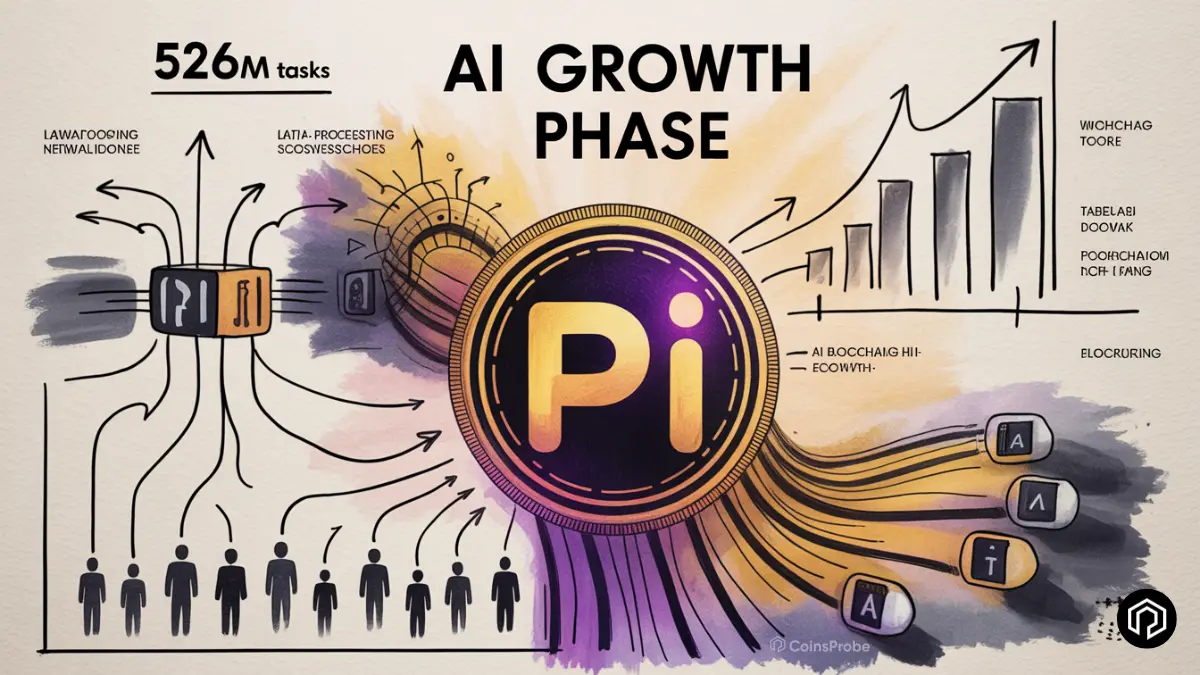

- Pi Network has formally revealed its AI infrastructure strategy — positioning its 1M+ verified human workforce and 421,000+ nodes as a direct solution to AI's biggest operational challenges.
- Over 526 million validation tasks were completed by 1 million+ verified Pioneers through Pi's KYC system — paid directly in $PI tokens at 21x the base mining rate.
- Pi's KYC system has already verified 18 million people across 200+ countries — combining AI automation with human-in-the-loop validation at a scale no other blockchain has achieved.
- Both Pi co-founders — Nicolas Kokkalis and Dr. Chengdiao Fan — are confirmed to speak at Consensus 2026 in Miami in early May, making it the first major public stage for the full Pi for AI vision.
Pi Network has spent years building something that the AI industry desperately needs and has struggled to replicate — a massive, globally distributed, identity-verified workforce of real human beings. Now, for the first time, the Pi Core Team has formally articulated what that asset means for the future of artificial intelligence — and the implications are significant.
In a new blog post published today, the Pi Core Team laid out its case for why Pi Network’s human infrastructure is uniquely positioned to solve three of the most pressing and expensive challenges facing AI companies today: scale, authenticity, and cost. The announcement follows the first distribution of KYC validator rewards — a milestone that put real numbers behind what Pi has been building — and arrives just weeks before Pi’s founders take the main stage at Consensus 2026 in Miami to present on Pi and AI.
The Problem AI Companies Can’t Solve Alone
Building reliable AI is still deeply human work. AI models need human-in-the-loop input to refine outputs, define quality, verify correctness, and ensure systems are actually useful to real people. Automated methods have well-documented limitations — they optimise proxies rather than true human preferences and cannot fully capture nuance, changing norms, and real-world judgment.
This creates three core challenges for every AI company building at scale:
Scale — Human input is needed in enormous volumes — especially in robotics and physical AI, where foundation models may depend on massive amounts of human-generated data about real-world environments.
Authenticity — Scaled input is only valuable if it comes from real, verified people. Without identity verification and bot elimination, human-in-the-loop systems become vulnerable to fraud and corrupted training signals.
Cost — Quality human-in-the-loop systems are expensive to build and operate. Pi proposes a different model — one where $PI tokens serve as the global payment rail for distributed human work.
Pi’s Answer — 526 Million Tasks. 1 Million Humans. Already Done.
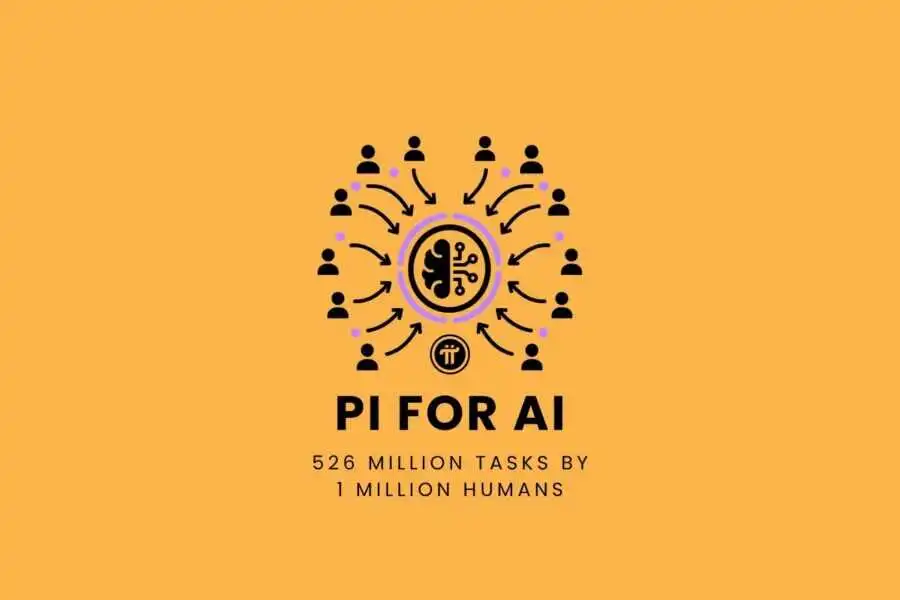
Rather than a hypothetical, the Pi Core Team pointed to something already demonstrated at production scale. Over 1 million verified individuals completed over 526 million validation tasks through Pi’s native KYC system — verifying 18 million people across 200+ countries — with every human KYC validator paid directly in Pi tokens.
The reward pool stood at 16.57 million Pi, supplemented by 10 million Pi from the Pi Foundation. The final payout came to roughly 0.05 Pi per task — approximately 21 times the base mining rate — with rewards sent directly to validators’ Mainnet Pi Wallets.
This is not a whitepaper promise. It is a demonstrated, paid, production-scale human workforce — and Pi is now positioning it as infrastructure available to AI companies that need exactly what Pi has already built.
Two Pillars — Human Input and Decentralised Compute
The Pi for AI strategy rests on two distinct but complementary pillars that together address the full AI infrastructure stack.
Pillar 1 — Verified Human Input for AI Training
Pi’s 18 million+ KYC-verified Pioneers represent a ready workforce for AI data labelling, reinforcement learning from human feedback (RLHF), model evaluation, and any task requiring authentic human judgment at scale. Crucially, these are not anonymous crowdsourced workers — they are identity-verified individuals whose authenticity has already been established through the KYC process. This addresses the authenticity problem that has plagued other human-in-the-loop platforms at a fundamental level.
Because compensation can be distributed in Pi tokens directly to Mainnet wallets — anywhere in the world, at any scale — the cost and friction of paying a globally distributed workforce is dramatically reduced compared to fiat-based alternatives. Every task completed represents real $PI utility demand anchored to economic activity, not speculation.
Pillar 2 — Decentralised Compute via Pi Nodes
Pi has already demonstrated that its global node network is not just a blockchain validation layer — it is a distributed computing resource capable of AI workloads. In collaboration with OpenMind — a robotics startup invested in by Pi Network Ventures — a proof-of-concept showed that the spare computing capacity of over 421,000 Pi Nodes can process AI training and inference tasks and return useful results quickly. This demonstrated that Pi’s node infrastructure is a real, functional AI compute layer — not a theoretical one.
Together, these two pillars position Pi as the human and compute infrastructure layer that AI companies can build on — paying for access in Pi tokens and tapping a globally distributed, identity-verified resource pool that would take years and hundreds of millions of dollars to replicate independently.
The Consensus 2026 Moment — Pi and AI on the World Stage
The timing of the Pi for AI announcement is not accidental — and it connects directly to what is shaping up to be Pi Network’s most high-profile public moment to date.
Pi co-founder Nicolas Kokkalis is scheduled to speak at Consensus 2026 in Miami in early May — one of the crypto industry’s most globally watched stages. Kokkalis, who leads Pi’s technical development, is expected to present on Pi’s AI infrastructure vision to an audience of institutional investors, developers, and ecosystem builders who have the resources and need to act on exactly what Pi is offering.

Alongside him, Pi co-founder Dr. Chengdiao Fan is also confirmed to speak at Consensus 2026 — bringing the full founding team to the main stage at a moment when the numbers behind Pi’s AI thesis are already compelling and verifiable. Dr. Fan’s appearance adds a second dimension to Pi’s Consensus presence, signalling that the Pi Core Team views this event as a strategic platform — not just a speaking opportunity.
The combination of both founders on stage at Consensus 2026 — armed with 526 million completed tasks, 18 million verified identities, 421,000 active nodes, and a formal Pi for AI framework — makes this one of the most anticipated Pi presentations in the project’s history. Whatever is announced in Miami will be watched closely by the entire crypto industry.
Why This Matters for $PI
The implications of Pi’s AI strategy for the $PI token are direct and concrete — and they build on top of the token’s already dominant market position.
As covered in our PI market analysis, $PI currently commands roughly 95% of the entire Mobile Mining sector on CoinMarketCap — with a $1.84B market cap that dwarfs every other token in the category. That dominance is built on community scale and network effect. The Pi for AI strategy adds a fundamentally new demand layer on top of it.
If AI companies begin using Pi’s human workforce and node compute for training and inference tasks, $PI becomes the payment currency for that activity — creating genuine, recurring, utility-driven demand for the token that is entirely independent of speculative trading. Every task completed, every validation submitted, every compute job processed through Pi’s infrastructure represents a new demand vector for $PI that did not previously exist.
Bottom Line
Pi Network has spent six years building what it is now revealing as a strategic AI asset — a million-person, globally distributed, identity-verified human workforce that has already completed half a billion tasks and been paid in Pi tokens. Combined with 421,000+ nodes already demonstrated as capable AI compute infrastructure, Pi is making a serious case that it has built something the AI industry needs and cannot easily replicate.
The Consensus 2026 appearances of Nicolas Kokkalis and Dr. Chengdiao Fan in early May will be the first major public stage for this full vision — and the numbers behind it are already impossible to dismiss.
The Pi for AI strategy is not a pivot — it is a revelation of what Pi’s infrastructure was always capable of becoming.
Frequently Asked Questions (FAQ)
What is Pi Network’s AI strategy?
Pi aims to use its verified user base and global nodes to provide human input and computing power for AI, with $PI used as the payment layer.
What are the 526 million tasks Pi completed?
They are KYC verification tasks completed by users to help validate over 18 million identities, with rewards paid in Pi tokens.
Why is Pi’s human workforce important for AI?
AI needs real human input for training and validation, and Pi provides a large, verified global workforce to support these tasks efficiently.
What was the OpenMind proof-of-concept?
It showed that Pi Nodes can process AI workloads using spare computing power, proving the network’s potential for distributed AI tasks.
How does this impact the $PI token?
If adopted, $PI could be used to pay for AI-related tasks and compute power, creating real utility-driven demand.
When will Pi reveal more about its AI plans?
Pi is expected to present its AI strategy at Consensus 2026 in Miami, marking its first major public showcase.
The opinions and market insights shared on CoinsProbe represent the views of individual authors based on prevailing market conditions at the time of publication. Cryptocurrency investments carry significant risk and volatility. Readers are encouraged to conduct their own research and seek professional financial advice before making investment decisions. CoinsProbe and its contributors do not accept responsibility for financial losses or decisions made based on published content.
CoinsProbe may publish sponsored articles, affiliate links, or promotional collaborations. All sponsored material is clearly labeled to maintain transparency with our audience. Our editorial decisions remain fully independent, and advertising partnerships do not influence reviews, rankings, or published opinions.
Since 2023, CoinsProbe has delivered reliable insights on cryptocurrency, blockchain, and digital assets. Our content is created by experienced researchers and analysts who follow strict editorial standards focused on accuracy, transparency, and credibility. Every article is carefully reviewed and verified using trusted sources and current market data. We provide unbiased analysis and timely updates covering everything from emerging crypto projects to major industry developments.