
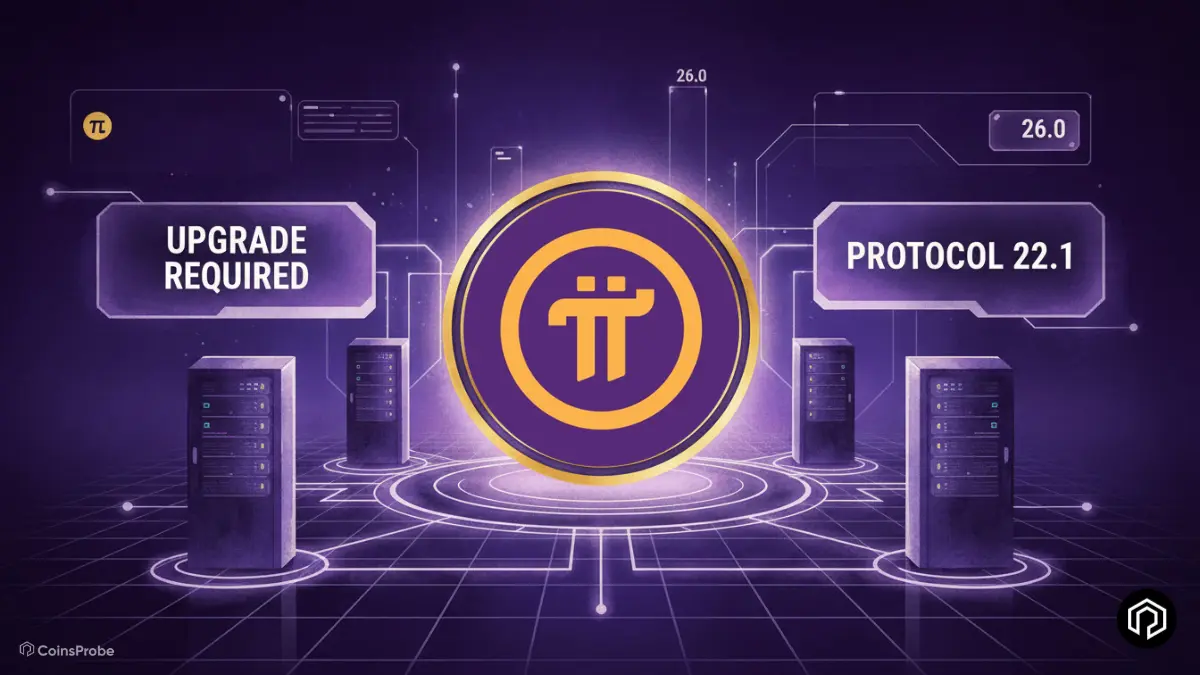

- The 21.2 → 22.1 upgrade is now ACTIVE with a deadline of April 27, 2026 — node operators must complete this upgrade immediately or risk Mainnet disconnection.
- The upgrade is one of the quickest in the entire sequence — expected downtime of under 5 minutes — using Docker image pinetwork/pi-node-docker:organization_mainnet-v1.0-p22.1.
- Pi Network's upgrade roadmap has been significantly expanded — extending beyond the previously known v23.0 to now include v24.1 (June 8), v25.1 (June 22), and v26.0 — signaling an accelerating development pace heading into summer 2026.
- As with all previous upgrades — do NOT upgrade all nodes simultaneously — divert traffic to other nodes or point to https://api.mainnet.minepi.com during the process.
Pi Network has activated the next step in its protocol upgrade sequence — the 21.2 → 22.1 upgrade is now ACTIVE with a deadline of April 27, 2026. The activation marks the fifth consecutive successful protocol migration in Pi Network’s carefully sequenced rollout — and comes with a significantly expanded roadmap that now extends all the way to Protocol 26.0 in June 2026.
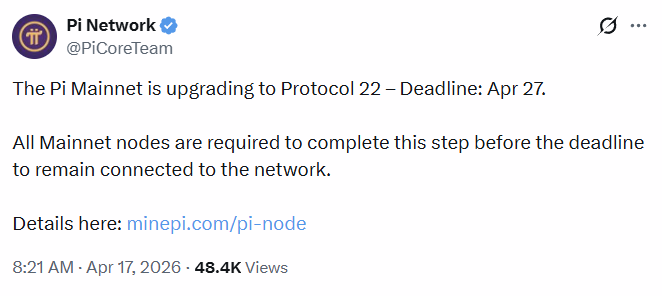
This follows the successful completion of Protocol 21.2 — confirmed across all Mainnet nodes — and continues the momentum Pi Network has been building throughout early 2026 toward full smart contract functionality.
Full Upgrade Status — April 2026
Here is the complete and updated protocol upgrade roadmap as of the latest Pi Core Team announcement:
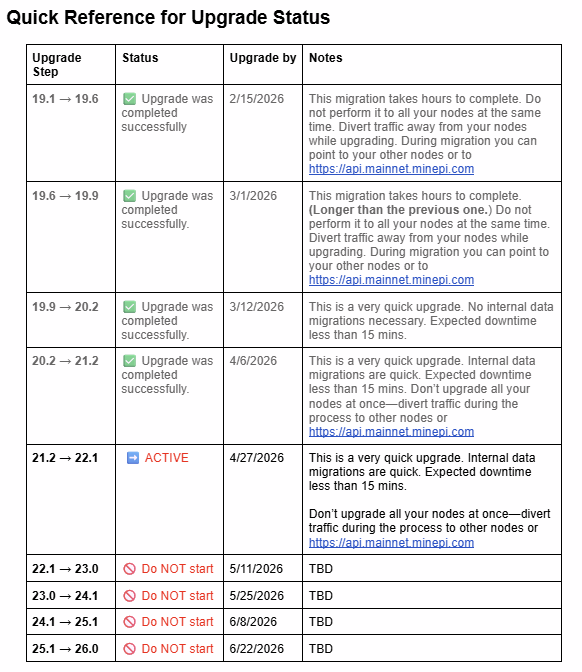
Two important observations from this updated roadmap:
The deadline for Protocol 23 has moved — from the previously announced May 18 to May 11, 2026 — one week earlier than the original timeline we covered in our Protocol 21 deadline article. Node operators should update their planning accordingly.
Four new upgrade steps have been revealed — Protocols 23.0, 24.1, 25.1, and 26.0 — extending the upgrade roadmap through June 22, 2026. This expanded sequence signals that Pi Network’s development pace is accelerating significantly — with five major protocol milestones now scheduled across a 10-week window from May through late June 2026.
Protocol 22.1 — Upgrade Details
The 21.2 → 22.1 upgrade is one of the most straightforward in the entire current sequence — but its deadline demands immediate attention from all node operators.
Key technical specifications:
Docker Image:
pinetwork/pi-node-docker:organization_mainnet-v1.0-p22.1
Release Notes: Available at https://github.com/PiCoreTeam/pi-node-docker/releases/tag/organization_mainnet-v1.0-p22.1
Expected Downtime: Under 5 minutes in most cases — the fastest upgrade in the current sequence. In rare cases, restarts may take longer — allow them to finish without interruption.
Migration Type: Internal data migrations are quick and straightforward — no complex data restructuring required.
How to Complete the Protocol 22.1 Upgrade
Critical reminder: Do NOT upgrade all your nodes at the same time. Divert traffic to other nodes or point to https://api.mainnet.minepi.com during the upgrade to maintain network stability.
Method 1 — Pi Desktop (Windows and macOS) Simply restart your Pi Node via Pi Desktop — the upgrade will trigger automatically. No manual steps required.
Method 2 — Linux Node CLI
If auto-update is enabled — no action required.
If auto-update is disabled:
pi-node update-protocol
Monitor with:
watch pi-node status
Method 3 — Self-Managed Docker
Update your docker-compose.yml with the new image:
pinetwork/pi-node-docker:organization_mainnet-v1.0-p22.1
Then run:
docker-compose up -d
Verifying Completion:
To confirm the migration has finished — compare ingest_latest_ledger from your node:
curl http://localhost:31401
Against the same value on https://api.mainnet.minepi.com
When the two values are approximately equal, your node has finished migrating. Note that during the migration process this number will not gradually update — it only updates at the very end of the process.
What the Expanded Roadmap Signals
The revelation of four new upgrade steps beyond Protocol 23 — extending to v26.0 by June 22, 2026 — is one of the most significant pieces of information in this announcement for the broader Pi Network ecosystem.
Previously, the upgrade roadmap visible to node operators ended at v23.0 — which we understood to be the milestone introducing broader smart contract functionality. The expanded roadmap suggests that what the Pi Core Team is building toward requires not one but multiple sequential protocol upgrades across a concentrated 10-week window — each building on the previous to deliver the full capabilities planned for mid-2026.
This aligns with the broader ecosystem momentum Pi has been building throughout early 2026:
The Pi Launchpad Testnet approached 500,000 Pioneer participants with the IRRA test token in its distribution phase. The second migrations have brought referral bonuses on-chain for over 119,000 Pioneers. The KYC validator rewards first distribution compensated over 1 million validators for 526 million verifications. And the public RPC server opened the Testnet to smart contract development for the first time.
Each of these milestones has been building toward the same destination — a fully functional, smart contract-enabled Pi Mainnet. The expanded upgrade roadmap extending to v26.0 suggests that destination is now clearly in sight and the pace is accelerating.
What Node Operators Should Do Right Now
Complete the 21.2 → 22.1 upgrade immediately — The April 27 deadline is less than two weeks away. With expected downtime of under 5 minutes this is one of the easiest upgrades in the sequence — there is no reason to delay.
Do NOT start Protocol 23 or beyond — The 22.1 → 23.0 upgrade is still marked “Do NOT start” and must not be attempted until officially activated. The deadline is May 11, 2026 — but wait for the official Pi Core Team activation announcement.
Update your planning for the full roadmap — With five additional upgrade steps now revealed through June 22, node operators should plan for a concentrated period of upgrade activity over the next 10 weeks. Each upgrade will have its own deadline and instructions — monitor @PiCoreTeam on X and minepi.com/blog for each activation announcement.
Monitor node performance — With each protocol upgrade, monitor your node’s sync status after completion and report any anomalies through official Pi Network channels.
Frequently Asked Questions
What is the Protocol 22.1 upgrade deadline?
The 21.2 → 22.1 upgrade deadline is April 27, 2026. Node operators must complete this upgrade before this date or risk Mainnet disconnection. The upgrade is expected to take under 5 minutes — making it one of the quickest in the entire sequence.
What Docker image should I use for the Protocol 22.1 upgrade?
The correct Docker image is pinetwork/pi-node-docker:organization_mainnet-v1.0-p22.1. Update your docker-compose.yml with this image and run docker-compose up -d to complete the upgrade.
Has the Protocol 23 deadline changed?
Yes — the Protocol 23 (22.1 → 23.0) deadline has moved from the previously announced May 18 to May 11, 2026 — one week earlier. Node operators should update their planning accordingly.
How many more upgrades are in the current roadmap?
The updated roadmap now shows five remaining upgrades beyond Protocol 22.1 — including Protocol 23.0 (May 11), Protocol 24.1 (May 25), Protocol 25.1 (June 8), and Protocol 26.0 (June 22) — extending the upgrade sequence through late June 2026.
Can I start the Protocol 23 upgrade after completing Protocol 22.1?
No — the 22.1 → 23.0 upgrade is marked “Do NOT start” and must not be attempted until officially activated by the Pi Core Team. Always wait for the official activation announcement before beginning any upgrade step.
How do I verify my Protocol 22.1 upgrade is complete?
Compare the ingest_latest_ledger value from your node (curl http://localhost:31401) against the same value on https://api.mainnet.minepi.com. When the two values are approximately equal, your node has successfully completed the migration.
The opinions and market insights shared on CoinsProbe represent the views of individual authors based on prevailing market conditions at the time of publication. Cryptocurrency investments carry significant risk and volatility. Readers are encouraged to conduct their own research and seek professional financial advice before making investment decisions. CoinsProbe and its contributors do not accept responsibility for financial losses or decisions made based on published content.
CoinsProbe may publish sponsored articles, affiliate links, or promotional collaborations. All sponsored material is clearly labeled to maintain transparency with our audience. Our editorial decisions remain fully independent, and advertising partnerships do not influence reviews, rankings, or published opinions.
Since 2023, CoinsProbe has delivered reliable insights on cryptocurrency, blockchain, and digital assets. Our content is created by experienced researchers and analysts who follow strict editorial standards focused on accuracy, transparency, and credibility. Every article is carefully reviewed and verified using trusted sources and current market data. We provide unbiased analysis and timely updates covering everything from emerging crypto projects to major industry developments.