



Key Highlights
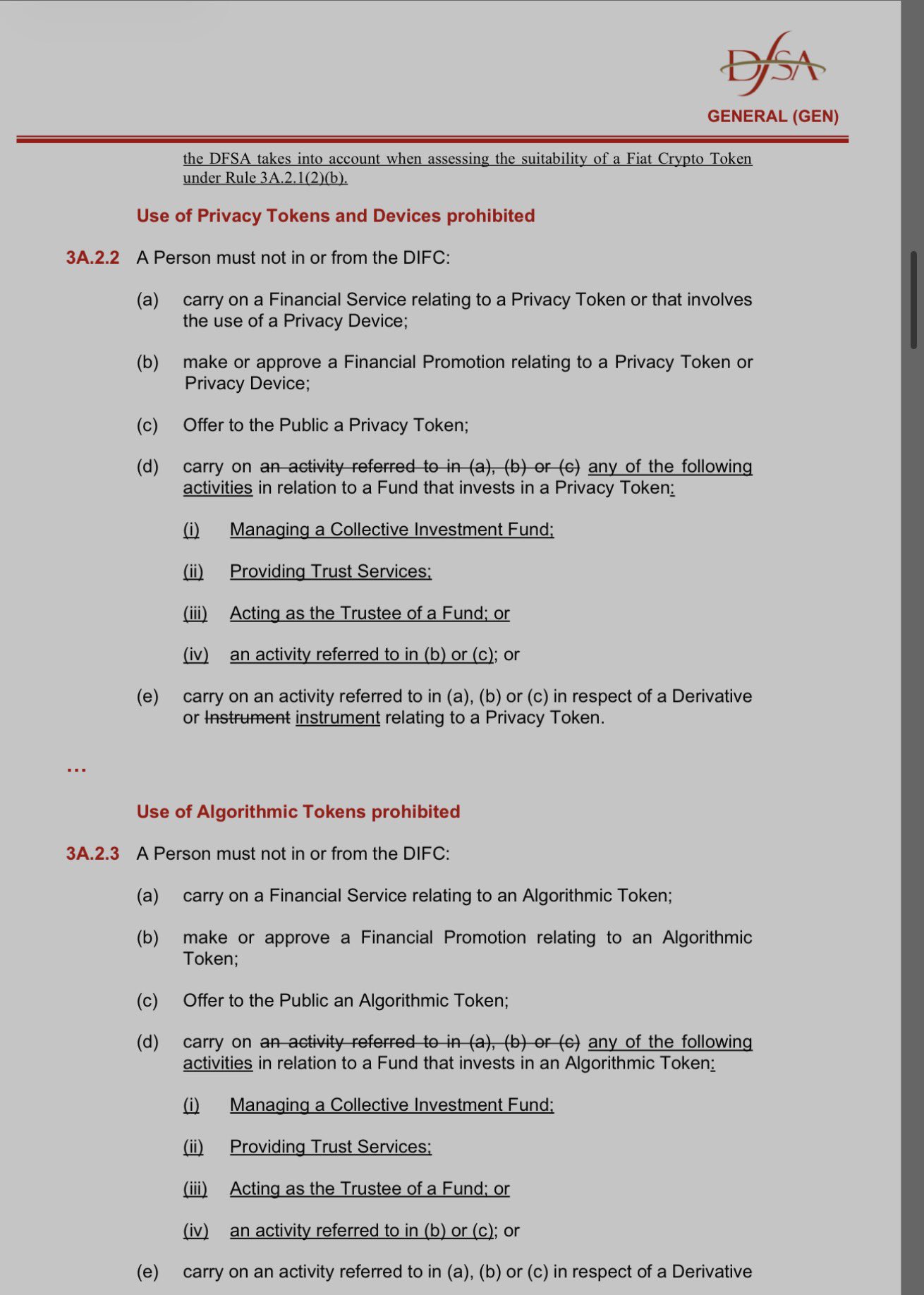
- Total Ban on Privacy Assets: Regulated firms in the DIFC are now strictly prohibited from trading, promoting, or offering services for privacy tokens. This includes a ban on obfuscation tools like mixers and tumblers.
- End of the “Whitelist” Era: The DFSA has removed its centralized “Recognized Tokens” list. Responsibility has shifted to licensed firms, which must now conduct and document their own suitability assessments for every token they offer.
- Stablecoin Crackdown: Only fiat-backed tokens with liquid, high-quality reserves qualify as “Fiat-Referenced Crypto Tokens.” Algorithmic stablecoins are stripped of their stablecoin status and moved to a higher-risk category.
- Alignment with Global Standards: The move specifically targets compliance with FATF (Financial Action Task Force) and AML/CFT (Anti-Money Laundering) requirements to prevent sanctions evasion and financial crime.
- Institutional Flexibility: While regulations are stricter, the “firm-led” model allows institutions more freedom to innovate with Real-World Assets (RWAs) and new technologies, provided they can prove they have managed the risks.
The Dubai Financial Services Authority (DFSA) has rolled out a significant update to its Crypto Token regulatory framework in the Dubai International Financial Centre (DIFC), effective immediately today. The changes introduce a full ban on privacy tokens (anonymity-enhanced cryptocurrencies) for regulated entities, stricter definitions for stablecoins, and a shift to a firm-led suitability assessment model — marking a key “reset” to bolster compliance, transparency, and alignment with global anti-money laundering (AML) and Financial Action Task Force (FATF) standards.
Why Dubai Banned Privacy Tokens in the DIFC
Under the updated rules, licensed and regulated firms operating in or from the DIFC — including exchanges, brokers, custodians, and other authorized financial service providers — are now prohibited from:
- Trading,
- Promoting,
- Offering derivatives on,
- Or otherwise dealing with privacy-focused assets.
The DFSA explicitly cites the incompatibility of these tokens with international compliance norms, as their design obscures transaction histories and holder identities, making it “nearly impossible” for firms to meet FATF requirements for AML, counter-terrorism financing (CFT), and sanctions evasion prevention.
Deputy Director Elizabeth Wallace stated: “Privacy tokens’ ability to conceal transaction histories and holders makes it nearly impossible for firms to comply with FATF requirements.”
The framework also bans the use or offering of privacy-enhancing tools, such as mixers, tumblers, or other obfuscation services that hide transaction details.
New 2026 Stablecoin Rules: Algorithmic Tokens vs. Fiat-Backed Reserves
On stablecoins, the DFSA has refined classifications to limit the “fiat-referenced crypto tokens” category to those backed by fiat currencies and high-quality, liquid reserves capable of handling redemptions under stress. Algorithmic stablecoins (e.g., projects like Ethena) are no longer classified as stablecoins and fall under general crypto token rules, requiring separate suitability evaluations.
A major structural change eliminates the previous centralized “recognized tokens” list (which once included assets like Bitcoin and Ethereum). Licensed firms must now conduct their own documented suitability assessments for any crypto tokens they engage with, increasing internal compliance responsibilities while offering more flexibility.
The updates reflect Dubai’s strategy to position itself as a leading, compliant hub for institutional crypto, tokenized real-world assets (RWAs), and innovation — while prioritizing transparency over unrestricted anonymity.
The crypto community has shown mixed reactions on social media: supporters see it as essential for mainstream adoption and institutional trust, while others worry about reduced privacy options in the region.
Firms in the DIFC must adapt swiftly, with the DFSA providing detailed supervisory guidelines, policy statements, and an explainer on crypto token regulations to aid compliance.
As one of the globe’s premier financial centers, Dubai’s latest crypto framework overhaul underscores its balance of fostering innovation with strong safeguards — a model likely to influence regulatory trends across the Middle East and internationally
The Bottom Line
The 2026 overhaul marks a decisive “reset” for Dubai’s crypto landscape. By sacrificing total anonymity in favor of institutional-grade transparency, Dubai is positioning the DIFC as a safe harbor for global banks and serious investors. For firms, the “bar has been raised”—success in this market now depends on robust internal compliance rather than just following a government-provided list.
Frequently Asked Questions (FAQ)
Are privacy tokens like Monero illegal to own in Dubai?
The ban specifically applies to regulated firms and licensed entities within the DIFC. It does not directly criminalize personal ownership for individuals using non-custodial wallets outside of DIFC-regulated services.
What is the new “Firm-Led” assessment model?
Instead of following a government whitelist, licensed crypto firms in Dubai must now conduct and document their own internal due diligence to prove a token is suitable for their clients.
Disclaimer: The views and analysis presented in this article are for informational purposes only and reflect the author’s perspective, not financial advice. Technical patterns and indicators discussed are subject to market volatility and may or may not yield the anticipated results. Investors are advised to exercise caution, conduct independent research, and make decisions aligned with their individual risk tolerance.
About Author: Nilesh Hembade is the Founder and Lead Author of Coinsprobe, with over 5 years of experience in the cryptocurrency and blockchain industry. Since launching Coinsprobe in 2023, he has been providing daily, research-driven insights through in-depth market analysis, on-chain data, and technical research.
The opinions and market insights shared on CoinsProbe represent the views of individual authors based on prevailing market conditions at the time of publication. Cryptocurrency investments carry significant risk and volatility. Readers are encouraged to conduct their own research and seek professional financial advice before making investment decisions. CoinsProbe and its contributors do not accept responsibility for financial losses or decisions made based on published content.
CoinsProbe may publish sponsored articles, affiliate links, or promotional collaborations. All sponsored material is clearly labeled to maintain transparency with our audience. Our editorial decisions remain fully independent, and advertising partnerships do not influence reviews, rankings, or published opinions.
Since 2023, CoinsProbe has delivered reliable insights on cryptocurrency, blockchain, and digital assets. Our content is created by experienced researchers and analysts who follow strict editorial standards focused on accuracy, transparency, and credibility. Every article is carefully reviewed and verified using trusted sources and current market data. We provide unbiased analysis and timely updates covering everything from emerging crypto projects to major industry developments.