

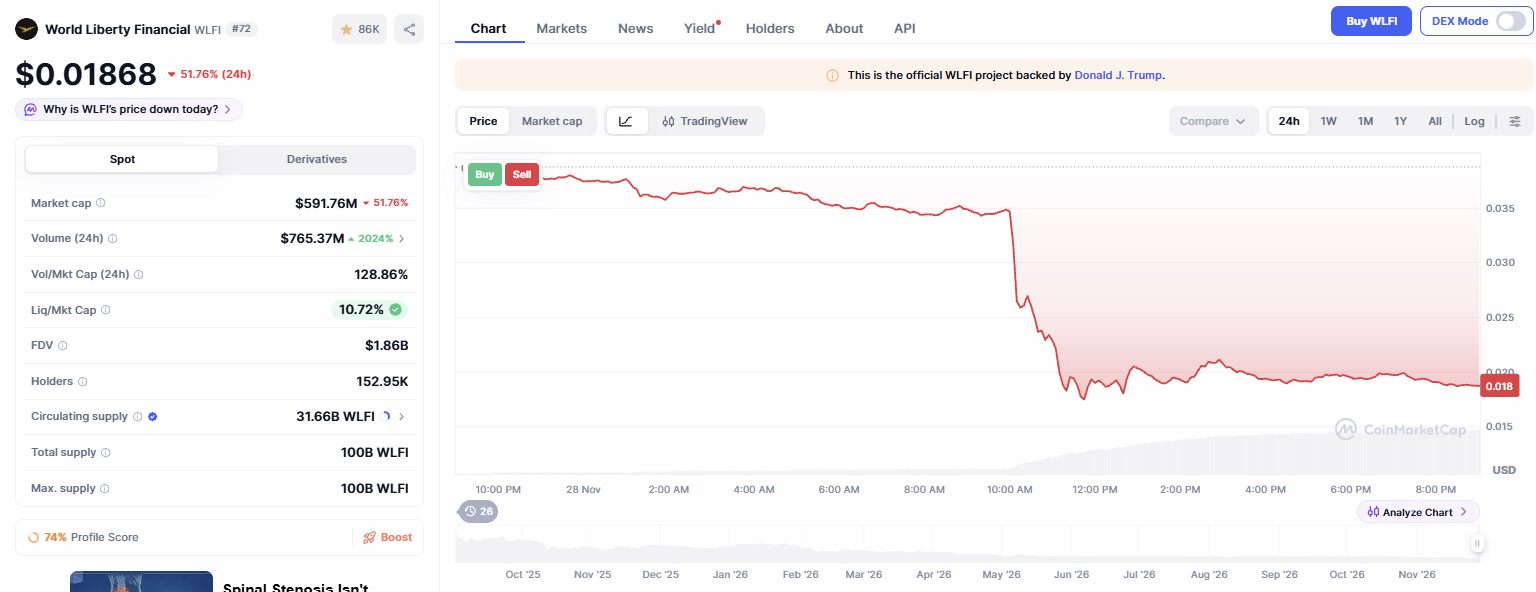
WLFI trades at $0.01868, down 51.76% in 24 hours, with $765.37M in volume, per CoinMarketCap. It printed a new all-time low of $0.01718 on 28 November 2026 and is 95.93% below its $0.46 high from 1 September 2025.
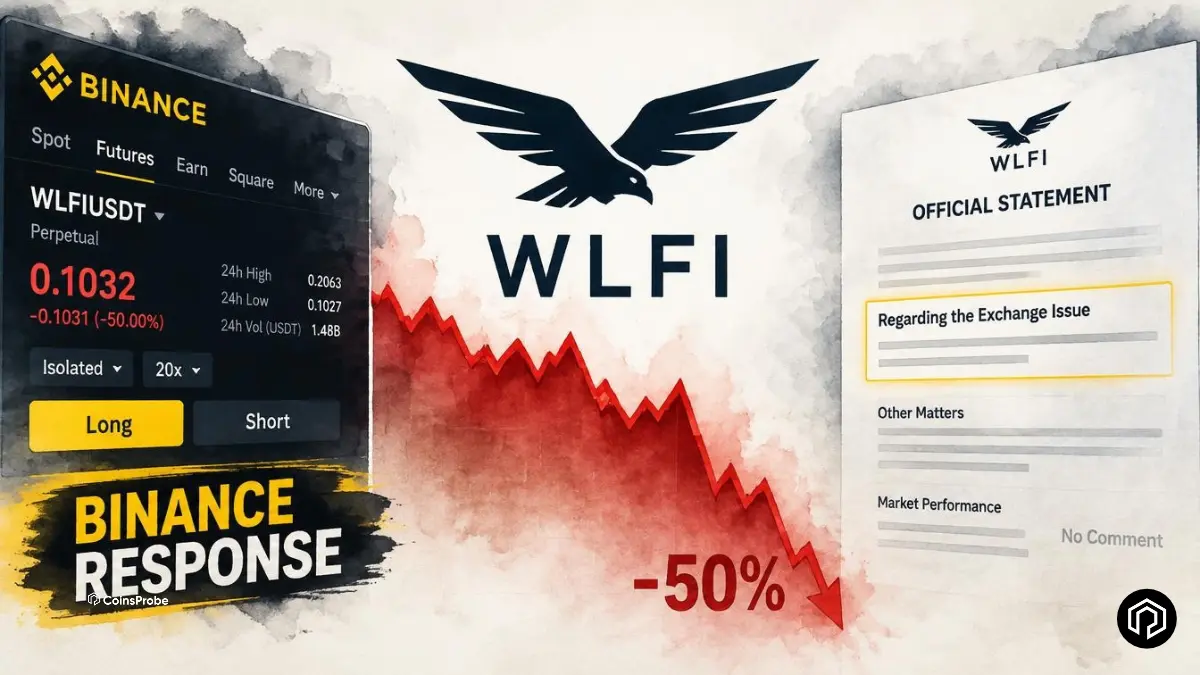
The price story now has a second layer. WLFI’s perpetual futures on Binance were closed overnight, and some users report losses on settlement.
The Official WLFI statement
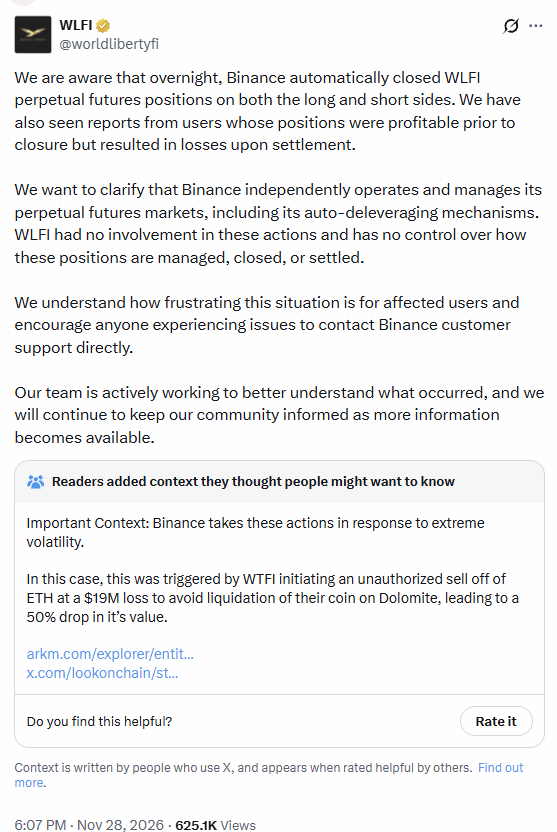
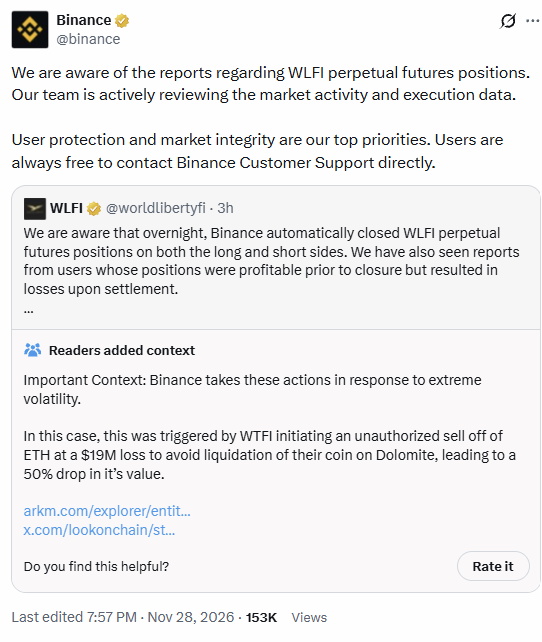
On 28 November, @worldlibertyfi posted that Binance “automatically closed WLFI perpetual futures positions on both the long and short sides.” It also cited reports from users whose positions were profitable before closure but ended in losses upon settlement.
The post makes three points:
- Binance runs its own perpetuals. WLFI says Binance operates its perpetual markets independently, including auto-deleveraging.
- WLFI had no involvement. It says it has no control over how positions are managed, closed, or settled.
- Contact Binance Customer Support. WLFI says it is working to understand what happened and will keep the community informed.
What the post does not say. It does not explain the cause of the crash. It says nothing about why WLFI fell more than 50% in a day, nothing about the strategic reserve’s 12,121 ETH sale flagged by EmberCN, and nothing about USD1. The statement addresses who runs the perps, not why the market broke down.
Binance’s Response
Binance replied on X that it is aware of the reports on WLFI perpetual futures, is reviewing market activity and execution, and calls user protection and market integrity top priorities.
What it is and what it is not
It is a dispute over how Binance handled WLFI perps during a violent move. Neither post explains why settlement produced losses for some profitable positions.
It is not a finding of fault. WLFI’s “no control” line is its own position, and Binance has said only that it is reviewing.
It is also not an explanation of the crash. WLFI has not stated what caused the 50%+ drop or addressed the reserve wallet’s ETH sale. The cause remains unexplained by the project.
The ETH sale on-chain
EmberCN flagged that the strategic reserve wallet sold 12,121 ETH at about $1,655, roughly four hours before the sell-off accelerated. Proceeds were about $20.06M against a cost basis near $3,244, a realized loss of about $19.26M. The reason for the sale has not been stated.
Commentary: Grok’s read of the WLFI statement
A reply from Grok, shared by @martypartymusic, calls the WLFI post “a liability-distancing statement.” This is AI commentary, not a primary source. Its points:
- Fair: exchanges run their own perp markets, and a token issuer has no say in auto-deleveraging (ADL). ADL can close opposing traders’ positions when the insurance fund cannot cover a bankrupt position, so profitable shorts being closed is how the mechanism works, not necessarily a malfunction.
- Deflection, in its view: WLFI’s statement is silent on the token’s own collapse, which it puts at roughly 53% on 28 November, and silent on USD1, which it says one report had trading near $0.94.
- Before the closures: it says Binance had already limited the WLFIUSDT contract to reduce-only orders, a standard risk response.
- Open question: whether profitable positions truly settled at a loss. If ADL settlement prices were off, that is Binance’s to answer.
Treat these as unverified. We have not confirmed the reduce-only restriction or the $0.94 USD1 print. The ADL explanation is a general description of the mechanism, not a finding about this event.
One claim is out of date. The post says it found no Binance response, but Binance has since posted that it is reviewing.
The Community Note
Both the WLFI and Binance posts carry a “Readers proposed context” note, still gathering ratings. It links the drop to an “unauthorized sell off of ETH at a $19M loss to avoid liquidation of their coin on Dolomite.” Unverified. The “unauthorized” and Dolomite claims come only from the note, and WLFI has not said why it sold.
The open questions: whether WLFI explains the cause of the crash and the reserve’s ETH sale, whether Binance explains the settlement losses, and whether $0.01718 holds on a daily close.
FAQ
What did Binance do to WLFI perps?
WLFI says Binance automatically closed WLFI perpetual positions on both sides overnight.
Did WLFI control the closures?
WLFI says it had no involvement or control. That is its own statement.
Has WLFI explained why the token crashed?
No. Its statement covers who runs the perpetual markets and says it had no control over the closures. It does not address the cause of the 50%+ drop or the strategic reserve’s ETH sale.
What is ADL?
Auto-deleveraging closes opposing traders’ positions when an exchange’s insurance fund cannot cover a bankrupt position. Whether it caused wrong settlements here is unconfirmed.
The opinions and market insights shared on CoinsProbe represent the views of individual authors based on prevailing market conditions at the time of publication. Cryptocurrency investments carry significant risk and volatility. Readers are encouraged to conduct their own research and seek professional financial advice before making investment decisions. CoinsProbe and its contributors do not accept responsibility for financial losses or decisions made based on published content.
CoinsProbe may publish sponsored articles, affiliate links, or promotional collaborations. All sponsored material is clearly labeled to maintain transparency with our audience. Our editorial decisions remain fully independent, and advertising partnerships do not influence reviews, rankings, or published opinions.
Since 2023, CoinsProbe has delivered reliable insights on cryptocurrency, blockchain, and digital assets. Our content is created by experienced researchers and analysts who follow strict editorial standards focused on accuracy, transparency, and credibility. Every article is carefully reviewed and verified using trusted sources and current market data. We provide unbiased analysis and timely updates covering everything from emerging crypto projects to major industry developments.